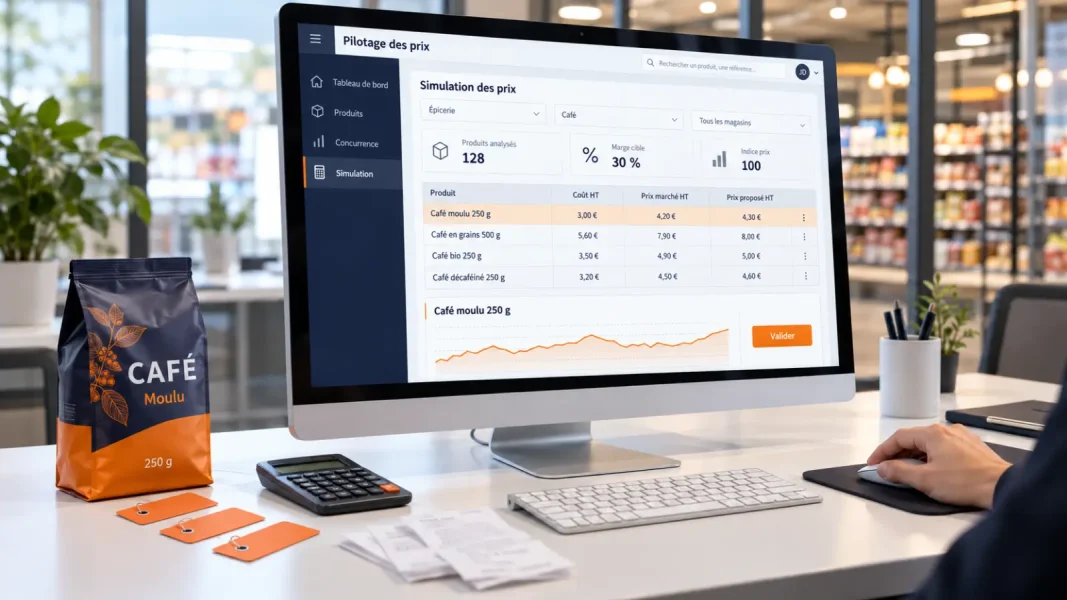

Within a given product category, several items may be sold by the same retailer but cater to different needs. An entry-level product helps keep costs down. A standard private-label product is ideal for regular purchases. A premium line offers a unique recipe, origin, or experience for which customers are willing to pay more.
The three types of private-label products, classified by their positioning, are entry-level private labels, standard private labels, and premium private labels. This segmentation helps retailers organize their private-label brands around different value propositions.
However, product positioning is not limited to three price tiers. The product’s content, packaging, presentation, and intended use must justify its place in the product line. Without perceptible differences, products may end up competing primarily on price.
For retailers, the challenge is to make these choices clear within their product lineup—both when compared to national brands and among their own products.
In this article, we’ll explore what sets these three types of private-label products apart and how to determine each one’s place in the product lineup.
What are the three main types of private-label brands?
A private label It can cover several product categories and price tiers. The terms “entry-level,” “standard,” and “premium” describe its market positioning—or that of a portion of its product lineup.
Budget-priced products are designed to be affordable. Standard private-label brands offer everyday items with a good value-for-money ratio intended to encourage repeat purchases. Premium private-label brands stand out for features that consumers value.
This classification provides an economic perspective on the product offering. Other segmentation methods exist. The Federation of Commerce and Distribution, for example, distinguishes between traditional, themed, entry-level, and premium private-label brands. An organic or regional product line can therefore be analyzed based on its specialization, and then according to its price point and value proposition.
Criterion | Low-price private label | Standard private label | Premium private label |
Promise | Meeting Essential Needs on a Limited Budget | Offer a reliable option for everyday shopping | Making a difference that is appreciated |
Position in the Offer | Entry-level | Core Lineup | Top tier in specific attributes |
Comparison Criteria | Price, quantity, essential function | Usage, consistency, value for money | Recipe, Origin, Expertise, Performance |
Product Design | Generally Simplified Offer | Services tailored to common needs | Distinctive Features |
Main Risk | Falling short on essential functionality | Not much different from the lowest price | Do not provide a justification for the requested surcharge |
The private-label model explains who owns the brand and how the product line is developed. Distinguishing between the three types of private labels allows us to examine more closely what each product promises the customer.

1. Low-price private-label brands: a product line focused on affordability
Meeting basic needs with low prices
The low-price store brands occupy the entry-level tier of a category. Their offering is based on a product that fulfills an expected function at a price that is as affordable as its features and cost-effectiveness allow.
This offer applies in particular to everyday food items, household cleaning products, and personal hygiene products. Within these categories of fast-moving consumer goods, some purchases are driven by immediate need: having flour for cooking, soap for washing, or a cleaning product.
Retailers can streamline the number of recipes, flavors, or sizes to focus their offerings on the most common needs. The decision remains a business one: each option retained must offer sufficient value to the consumer.
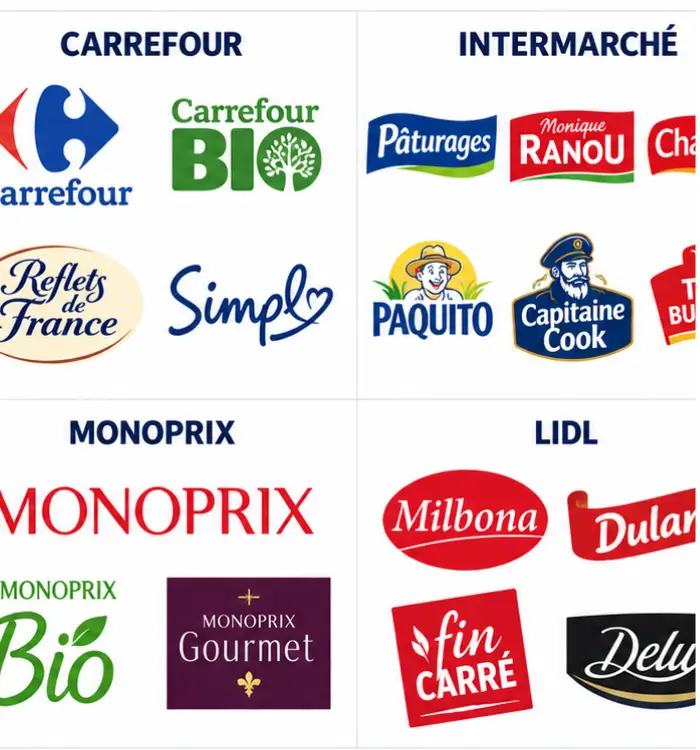
Carrefour thus presents Simpl as a line of everyday essentials designed to offer the lowest prices on the shelf. This promise clearly positions the brand as focused on affordability.
Distinguishing Between Low Prices and Poor Quality
Just because a product is an entry-level option doesn’t mean it can’t meet its advertised purpose. Fragile packaging, a product that’s hard to measure out, or a formula that isn’t well-liked can negate the appeal of the low price.
Quality must therefore be assessed based on concrete criteria. For a dairy product, composition, taste, and texture may be important factors. For laundry detergent, the number of doses and effectiveness under actual usage conditions are more indicative than the price of the container alone.
Trade-offs may involve product variety, ingredients, finishes, or packaging. They must remain consistent with the product’s value proposition. An economical option can be fully suited to a need without incorporating all the features of a more elaborate product.
Treating discount products as mere generic items also prevents us from understanding their brand identity. A retailer can give them a brand name, visual elements, and a recognizable spot on its shelves.
Compare the upfront cost and the cost of ownership
A small package may be more affordable at the time of purchase, while a large size offers a better price per kilogram. Both options meet different needs.
The unit price, the price per unit of measurement, and the number of uses should be considered together. An offer that seems economical at first glance may lose its appeal if it requires a larger quantity to achieve the desired result.
For supermarkets and hypermarkets, low-price items contribute to theprice image when customers can find them and compare their content. An offer that is not very visible or is frequently unavailable does not fulfill this function as well.
Comparable offerings from discount retailers can serve as benchmarks for competition. However, “hard discount” refers to a retail model, whereas “low-price” refers here to a product positioning strategy. The two concepts are not interchangeable.
2. Standard private-label brands: the everyday choice
Building a Recognizable Core Product Line
The Standard private-label brands, also known as traditional private-label brands, offer features that meet the typical expectations for their category. Their appeal lies in the balance between product quality, ease of use, and price.
They can cover a wide variety of regular purchases, from groceries to fresh produce, frozen foods, and household cleaning supplies. Their purpose is to become a reliable enough choice that customers will continue to choose them without having to reevaluate all their options every time they visit the store.
Carrefour describes its Classic line as a collection of everyday essentials that combine quality, ease of use, and affordable prices. This presentation illustrates the promise of a core product line designed to meet regular needs.
A mid-range product is therefore not defined solely by its price. A mid-range product must have characteristics that explain why it costs more than the lowest-priced option and why it might be preferred over a domestic brand.
Positioning itself between budget brands and national brands
The comparison is made on two fronts.
In the face of budget-friendly options, standard private-label products must clearly demonstrate what they offer: a different recipe, a convenient format, more choices, or a feature that meets consumer expectations.
In the face of domestic brands, it offers a different combination of features and prices. The difference may be worth a try, but whether you’d buy it again depends on your experience.
It would be inaccurate to systematically portray products as identical and less expensive. A national brand and a standard private label may differ in their composition, concentration, or quantity. Even when a manufacturer produces products for multiple brands, the specifications may vary.
The value for money must therefore be evaluated based on comparable uses. A package of cookies, a bottle of cola, or a cosmetic product cannot be compared based solely on their names.
For the retailer, this clarification prevents the need to look for a price discrepancy when faced with an offer that actually meets a different need.
Make consistency a reason to buy again
A standard private-label product gradually becomes part of consumers’ routines when they find the qualities they value. Consistency in taste, texture, effectiveness, and convenience are key factors in this relationship.
Changes to the recipe or packaging must be evaluated in light of these expectations. Cost savings can be disappointing if they alter a feature that is essential to customers.
Returns, complaints, and repeat purchases provide useful information. They help distinguish a product that customers choose to keep from one they bought only during a promotion.
Customer customer loyalty It cannot, therefore, be inferred from sales volume alone. It is demonstrated by the product’s ability to retain customer preference when the customer has several options available at the point of sale.
3. Premium private-label brands: A move upmarket that needs to be justified
Highlight features that matter to the buyer
The premium private-label brands develop a product offering that is more distinctive than the standard in their category. The difference may lie in a recipe, an ingredient, a source, the aging process, the finishing touches, or technical performance.
In the food retail sector, this approach may apply to specialty grocery items, dairy products, frozen foods, or prepared meals. In the non-food sector, it may be based on the material, durability, or an additional feature.
The term “premium” remains a marketing positioning strategy. It must be supported by specific evidence rather than simply a claim of superior quality.
For example, Carrefour distinguishes between its “Classic” and “Extra” lines, associating the latter with more elaborate recipes, specific origins, certifications, or longer aging periods. These attributes illustrate the differences that can support a move upmarket.
The company must then verify that these characteristics are recognized and appreciated. A more expensive ingredient does not automatically increase the value attributed to the product.
Provide evidence beyond the packaging
The packaging helps highlight a product line and showcase its value proposition. Colors, materials, and information guide the eye in large retail spaces as well as on e-commerce pages.
For a premium private-label product, the description must explain what sets the product apart. A recipe can highlight an ingredient or a preparation method. A claim of origin must specify what it refers to. A claim of expertise must correspond to an actual characteristic of the product.
Packaging alone cannot set a product apart. Eye-catching packaging can encourage people to try it; the contents must then live up to the expectations it creates.
Thebrand image is also built on this consistency. A customer who is satisfied with a premium product may become more attentive to other products bearing the same brand identity. A disappointment, too, can extend beyond the product in question.
Compare prices based on the appropriate level of service
A premium private label may be more expensive than a standard national brand. A private label’s status does not determine its position in the price hierarchy.
The comparison must be between similar products. Comparing a specialty item with a common product provides insight into the options available on the shelf, but does not allow us to conclude that one is poorly positioned.
The occasion for the purchase also matters. A product intended for entertaining guests may be chosen based on different criteria than an everyday purchase. The same consumer may be willing to pay a premium in one category and prioritize a low price in another.
For the brand, the question is whether the “premium” promise remains specific enough to justify the higher price. When the difference is understood solely through the price tag, the brand’s positioning becomes fragile.

How can you tell the difference between the three types of MDD?
Rankings are more effective when based on product attributes rather than solely on the product’s name or price.
In a category of cookies, for example, the three levels can be distinguished by the recipe, ingredients, texture, size, and presentation. This illustration is not a mandatory model: the relevant criteria vary depending on the context.
Point to Consider | First Prize | Standard | Premium |
Need Met | Essential Use | Regular consumption with expected benefits | Specific expectations or desired experience |
Recipe or Design | Choices Focused on the Essentials | Features tailored to the current market | Specific differences to explain |
Packaging | Functional | Convenient for everyday use | Tailored to the brand promise and the purchasing occasion |
Overview | Identifying the Best Value Offer | Recognition and Trust | Highlighting Distinctive Features |
A Useful Comparison | Other comparable budget options | Competing private-label brands and relevant national brands | Products with similar features and specifications |
The differences do not necessarily follow the same pattern across all criteria. An entry-level product may feature a convenient format. A premium product may use simple packaging. Positioning is determined by the overall value proposition.
It is also important to distinguish between measurable quality and personal preference. A characteristic may be objectively different without being sought after by all buyers. A more intense flavor or a particular texture may appeal to some customers but be less appealing to others.
Are organic, local, or regional private-label products considered premium?
The organic products—whether organic, local, or regionally specific—meet criteria that can span several price points.
One organic product line may focus on affordability. Another may combine certification, a specific recipe, and carefully selected ingredients. The fact that they are organic is therefore not enough to justify the same price positioning for both.
Whether a product is of French or local origin provides information about one aspect of the offering, which should be specified depending on the product. This information alone does not determine all of its features or its position within the product line.
A region can foster an identity rooted in a regional specialty and local expertise. Reflets de France thus highlights recipes and products associated with French regions. This example illustrates differentiation based on origin and culinary heritage.
For large retail chains, it is helpful to maintain two distinct descriptions. The first describes the product’s specialization: organic, regional, plant-based, or intended for a specific use. The second specifies its value proposition and performance level.
This distinction prevents a label or origin from being used as a shortcut to automatically classify a product as premium.
Retail brands, private labels, and umbrella brands: How do they relate to product tiers?
These terms relate to brand architecture. They do not refer to the three economic levels of private-label brands.
A brand name takes the distributor’s name. A private label may have a different identity. In common usage, the term private labels can also refer more broadly to brands owned by retailers.
An umbrella brand brings together several products under a common identity. It can encompass different product families or focus on a specific category.
The names found in large food retail chains illustrate this diversity. Some products bear the store’s name directly; others use distinct brand identities, such as Marque Repère at E.Leclerc. However, the name alone is not sufficient to classify all products within a particular product line.
Each offering must be evaluated based on its characteristics and value proposition. A single brand architecture can encompass multiple product lines, while an entry-level offering can be marketed under several brand identities.
For the customer, clarity depends on how well the names, packaging, and information make these differences understandable.
How can we ensure that the three types of private-label products coexist in the product lineup?
Addressing Different Expectations
Three levels are not necessary in every category. Their coexistence must serve sufficiently different needs.
Before introducing new products, the retailer must be able to explain what they add to the available selection. A specific use, recipe, or feature can justify adding a product to the lineup. A difference in packaging without any identifiable benefit can actually make the decision more difficult.
The ranges must also take into account the role of major brands and well-known products. A standard private-label product can round out a shelf, but it does not automatically replace the demand associated with a national brand.
The selection must continue to be reviewed at theproduct line, taking into account the benefits actually covered and any potential overlaps.
Maintaining Understandable Differences
The price difference between the lowest-priced option and the standard option must reflect a recognized difference. The same verification applies between the standard and premium options.
Sales can temporarily narrow the price gap. A major brand on sale may become cheaper than a standard store brand. A premium store brand on sale may match the price of a mid-range product.
These situations do not necessarily make the offer inconsistent. However, they require a clear presentation of the terms and duration of the benefit. They must also be observed after the promotion ends, when regular prices are reinstated.
The goal is not to mechanically maintain the same spread everywhere, but to preserve a logical relationship between characteristics and prices.
Take merchandising into account
Even when internal data is clearly segmented, it can still be difficult to interpret on the shelf. Products must be easy to locate and compare without requiring extra effort.
The merchandising contributes to this understanding. The availability of comparable benchmarks, information on units of measurement, and the visibility of attributes make it possible to identify the differences between offers.
Online, product descriptions, images, and filters serve part of this purpose. An inaccurately described recipe or packaging can skew the comparison, even if the positioning has been correctly defined.
Consistency must therefore be verified at retail locations and on the interfaces where customers prepare their purchases.
Can a single consumer purchase all three types of private-label products?
The product lines do not correspond to three distinct customer groups.
A person may opt for the lowest-priced items when it comes to products they consider to be fairly similar, buy a standard store brand out of habit, and choose a premium product for a special occasion.
Consumer behavior depends on budget, the importance placed on the product category, and the intended use. The role of a product offering can therefore vary within the same shopping basket.
For retailers, this approach avoids limiting budget private-label brands to only those households with the tightest budgets, or premium lines to a single customer segment.
The three tiers allow for different trade-offs. Their value lies in the flexibility they offer customers to choose where to limit their spending and where to invest in additional services.
Any increase in sales for a product line should therefore be interpreted with caution. It may reflect a lasting preference, a promotion, or a temporary shift in purchasing behavior. Repeat purchases and customer feedback round out the analysis.
How can we verify that the three levels of private label products are clearly distinguished?
The first check focuses on the claim. Can each claim be described using specific characteristics, beyond terms like “economical,” “high-quality,” or “superior”?
The second point concerns comparison. Do quantities, uses, and features help us understand prices? A small premium size and a large standard size do not necessarily meet the same need, even when they belong to the same product family.
The third factor relates to the experience. Do customers recognize the advertised differences after using or consuming the product? Feedback, complaints, and repeat purchases help answer this question.
Border to be monitored | Question to Ask |
First Prize / Standard | Is the supplement considered a valued benefit? |
Standard / Premium | Is the difference still noticeable after use? |
Overview / Product | Does the packaging accurately describe the contents? |
Product Code / Product Line | Does the product address an unmet need? |
Promise / Experience | Does customer feedback confirm the positioning? |
The economic implications must be considered in light of these observations. Satisfactory profit margins on a featured item are not enough if its introduction shifts sales without expanding the selection. An increase in sales volume must also be evaluated in relation to the discounts offered and other products in the aisle.
The role of private-label brands in retailers’ strategies becomes clearer when each product line has a clearly defined role. The retailer’s own brand offerings can then combine affordability, trust, and differentiation without making the selection process more confusing.
First-tier, standard, premium: roles that should not be confused
The distinction between entry-level, standard, and premium is not based solely on a pricing hierarchy. It depends primarily on each tier’s ability to meet a different and clearly identifiable need.
The entry-level product must make the purchase affordable without compromising the product’s core function. The standard private-label product must offer a compelling enough balance to become a regular purchase. The premium product, on the other hand, must offer a tangible difference—whether in recipe, origin, craftsmanship, performance, or experience—that justifies a higher price.
For the retailer, the challenge is therefore less about offering three product tiers than about ensuring that each one occupies a distinct place in the product lineup. When differences in product, usage, or perception become too small, segmentation loses clarity, and products are particularly at risk of competing with one another.
An effective private-label architecture is thus based on a simple principle: each level must give the customer a clear reason to choose it over another.