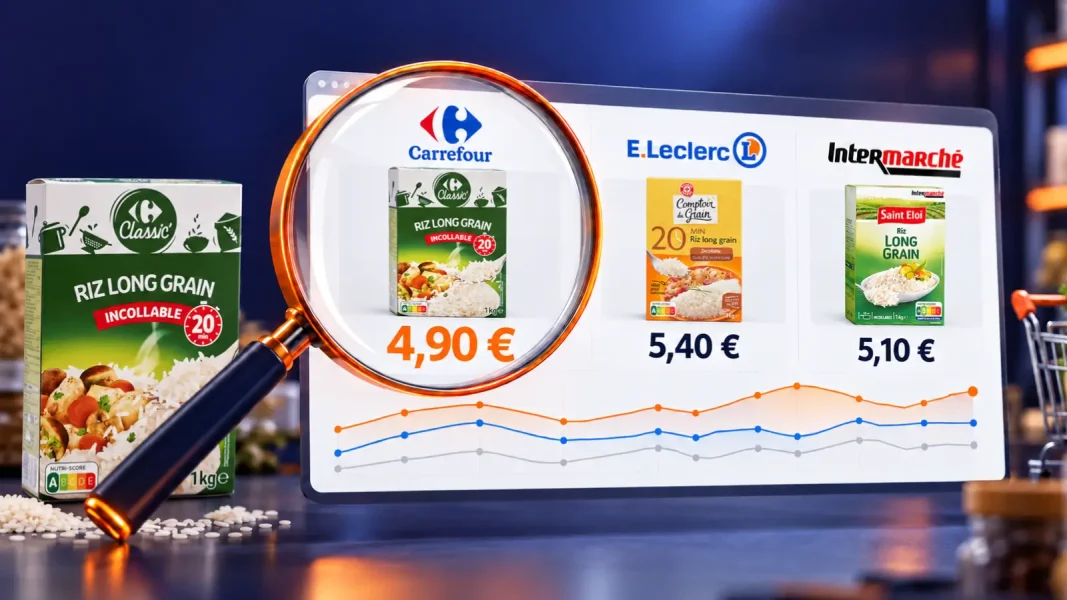




As the start of the school year approaches, competitive pressure intensifies. Retailers ramp up their sales promotions, consumers compare offers, and certain high-visibility products become the focus of intense price competition.
Faced with this pressure, the temptation is strong: to follow the competition’s lead, ramp up promotions, and maintain competitiveness across as many product lines as possible.
But the start of the school year should not turn into a widespread price war.
Not all products have the same visibility, price sensitivity, or role in the purchasing decision. A price reduction may be a deciding factor for one product and have almost no effect on another.
For retailers, the question is therefore no longer simply whether they are competitive. It is a matter of determining where to focus on price competitiveness to drive traffic and conversions, and where to protect margins.
Being competitive everywhere? That’s exactly the trap
Price transparency might suggest that a retailer must defend its positioning across its entire product lineup.
However, consumers do not pay the same amount of attention to every price.
Certain products—because they are frequently purchased, easily remembered, or readily comparable—play a much more important role in shaping theprice image of the brand. This is particularly true of the KVI (Key Value Items), whose positioning has a disproportionate impact on the perception of price level. Identifying these products allows companies to focus their efforts on improving competitiveness where it will actually have an impact, rather than defending every product with the same intensity. Poor positioning of just a few of these products can be enough to fuel a perception of high prices that extends far beyond the specific products in question.
Conversely, other products are less subject to comparison or have demand that is less price-sensitive. Systematically seeking to list the lowest price for these products can therefore lead to sacrificing profit margins without sufficiently changing purchasing behavior.
Price competitiveness is therefore not measured by the number of products for which a retailer is the least expensive. It depends on the retailer’s ability to be well-positioned on the products that truly matter to consumers.
This distinction is fundamental: it shifts pricing from a model of generalized alignment to a model ofarbitrage.

Not all price differences warrant a response
A competitor lowers the price of a product. Should we match the price immediately?
Not necessarily.
Competitive intelligence helps a retailer understand where it stands in relation to the market. But the price gap observed is only one indicator. On its own, it does not reveal which decision will be the most economically sound.
Before reacting, there are several questions that need to be asked.
Does the benchmark product play a major role in shaping price perception? Is it frequently compared? How price-sensitive is it? What would be the likely impact of a price reduction on sales volume? What margin level can the retailer afford? And is the price difference compared to competitors significant enough to influence the consumer’s decision?
For a highly visible, price-sensitive product, making a pricing concession can be a strategic move to maintain the perception of competitiveness and drive conversions.
For a less sensitive product, the same effort may yield only a small increase in volume while directly reducing the margin.
The same competitive gap can therefore lead to two completely different decisions, depending on the role played by the product.
The challenge is no longer to track competitors’ prices in order to match them, but to understand when they should actually influence pricing decisions.
Price sensitivity: How much volume must you actually gain in exchange for a price drop?
This reasoning also requires an understanding of how demand responds to price changes.
Not all products have the same sensitivity. This sensitivity should not be confused with the product’s visibility. A benchmark can play a major role in price perception even if demand for it is not highly elastic, and vice versa. The two dimensions must therefore be analyzed together.
For some products, even a relatively small change can lead to a significant shift in volume. For others, demand will change little.
This difference completely changes the economic equation.
If a price reduction stimulates demand sufficiently, the sacrifice in unit margin can be offset by increased volumes—or even help generate more traffic or conversions. Before implementing any price reduction, therefore, an economic question should be asked: How much additional volume will need to be generated to offset the decline in unit margin? The greater the pricing effort, the larger the increase in volume needed to maintain the economic contribution. From an economic perspective, the expected response in demand must therefore be weighed against the margin sacrifice made and the objective being pursued.
But if demand is unresponsive, the price cut essentially amounts to selling a product at a lower price that some consumers would have bought anyway.
The question, therefore, is not just how low a retailer can lower its price, but what it can actually expect in return for that price reduction.
It is this shift from a price-based approach to an impact-based approach that helps better protect profitability.
Does a promotion that generates more sales necessarily mean it’s effective?
The same question arises even more acutely when it comes to promotions.
A sales promotion can cause a sharp increase in volume over a few days and immediately give the impression of success.
But simply noting that sales have increased isn’t enough.
Some of the purchases might have taken place even without the discount. Some consumers may simply have brought their purchase forward to take advantage of the offer. And if the discount offered is too large relative to the actual additional sales, a promotion that generates spectacular sales volume may ultimately prove to be much less profitable in terms of margin.
We must therefore distinguish between sales observed during the promotion and the truly incremental sales generated by it. To measure this performance, we must estimate what would likely have been sold in the absence of the promotion. This baseline scenario makes it possible to distinguish between naturally expected sales and the truly additional sales generated by the promotion. The challenge, therefore, is to measure the promotion’s actual incremental impact, rather than simply the sales peak observed during the promotion.
The effectiveness of a promotion should therefore be evaluated based on several factors: the actual increase in demand, the margin allowed, the promotion’s role in driving traffic or conversions, and, more broadly, the value generated by the campaign.
In other words, more promotion does not necessarily mean better promotion.
As the school year begins, the goal is not to offer more discounts, but to identify the products for which a promotion can actually change consumer behavior.

Shifting from a focus on price cuts to a focus on investment
This is probably where the most significant shift in perspective lies.
A price reduction or promotion should not be viewed solely as a reduction in profit margin. It can be viewed as a business investment, provided you know what the retailer is looking to achieve in return. Strengthen its price image, drive traffic, boost conversion, or increase sales volume: The effectiveness of a pricing initiative cannot be assessed independently of the objective being pursued. The challenge, therefore, is to link each cost-saving measure to a specific objective and then assess whether it has actually delivered the expected value.
This approach leads to segmenting the product lineup and differentiating strategies. Depending on their role in the price image, their sensitivity to demand, and their competitive exposure, individual products may require different levels of monitoring and pricing strategies. For certain strategic products, the retailer may agree to invest more in its competitiveness. For others, where it has greater pricing flexibility, the priority may be to preserve margins and contribute more to profitability.
Pricing is no longer about choosing between “low prices” and “high margins.” It’s about allocate pricing efforts intelligently across the product lineup.
It involves intelligently allocating pricing efforts across the product range.
Pricing Analytics to Inform Decision-Making, Not to Automate Price Wars
When dealing with thousands—or even tens of thousands—of SKUs, making these trade-offs manually quickly becomes complex.
That is precisely where Pricing Analytics truly comes into its own.
By cross-referencing competitors’ prices with sales history, price sensitivity, the role of benchmark products, promotional performance, and margin targets, we can go beyond simply noting a price difference. The challenge is to determine where this gap truly warrants action, what response in demand can be expected, and whether the effort involved is consistent with the business objective being pursued.
The goal is not to react automatically to every move a competitor makes.
The goal is to enable the Pricing and Commerce teams to identify the SKUs for which a pricing effort can create value from those where, on the contrary, profitability should be protected.
This capability is particularly strategic at the start of the school year, when sales pressure can lead to an increase in rapid responses and promotions.
Because in an environment where everyone can adjust their prices, the competitive advantage does not necessarily lie in the ability to lower prices faster than others, but in the ability to know when it is appropriate to do so.
Winning the Back-to-School Battle Without Getting Dragged Into a Price War
Success this back-to-school season will likely not come from trying to be the cheapest on every item. It will come from knowing where price truly influences consumer perception and behavior—and where, on the other hand, the retailer has enough leeway to maintain its margin.
Factors that shape price perception, demand sensitivity, competitive positioning, and actual promotional performance: by analyzing these factors together, retailers can determine where to invest in their price competitiveness and where to protect their profitability.
Optimix’s Pricing Analytics solutions are designed with this approach in mind: leveraging market, competitive, and sales performance data to objectively evaluate these trade-offs and identify the products where pricing efforts can truly create value.
Because winning the price war doesn’t mean being the cheapest everywhere. It means knowing exactly where price can make a difference and where profit margins must remain a priority.