



Companies are faced with an ever-increasing number of operational decisions: setting prices, managing promotions, prioritizing orders, allocating stocks, arbitrating margins or managing logistical exceptions. These decisions are part of increasingly complex business processes, interconnected to the information system and structured around numerous, interdependent and evolving management rules. Their coherence relies on software solutions capable of automating processes while guaranteeing traceability and control.
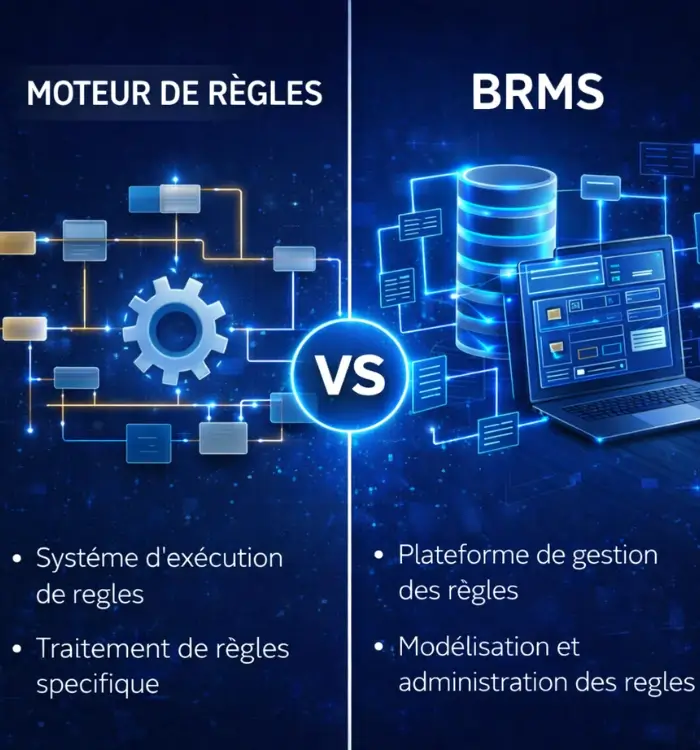
Two notions are often confused in this context: the rules engine and BRMS, or Business Rules Management System. Yet their functional scope, strategic role and organizational impact differ significantly, particularly in environments where business process management is becoming a key performance driver.
Understanding the difference between a business rules engine and a complete rules management system is essential for structuring BI governance, securing automation and supporting complex pricing and supply chain environments.
Business Rules Engine (BRE): definition and limits
A rules engine, or business rules engine, is a software component responsible for executing predefined rules within a decision automation framework. It analyzes input data, applies conditional logic and produces a decision that can be used by downstream systems, notably in workflow or automated processing environments.
This rules engine is generally part of a structured, modular architecture. It is based on a rules repository, an inference engine responsible for execution, and an integration interface with existing systems such as ERP or CRM. This integration can be facilitated via connectors, guaranteeing interoperability with existing applications and databases. As a decision-making management tool, it formalizes business rules, guarantees their consistent application and reinforces process orchestration.
It is also designed to enable business teams to customize the rules engine by autonomously configuring or adjusting the rules, without having to resort to heavy development or systematically mobilize technical resources.
The logic is self-explanatory: when a condition is met, an action is triggered. If a stock level falls below a defined threshold, an order can be generated. If a minimum margin is reached, a price adjustment can be blocked. The rules engine thus becomes a structuring tool for managing business rules, translating internal policies into operational decisions, and can be integrated into an SOA architecture to reinforce modularity, scalability and control of decision-making governance.
Limits of the simple rules engine
This simplicity is also its main limitation. As the number of rules increases, business rule management becomes more complex. Interactions between rules can create conflicts or unanticipated effects. Decision traceability becomes more difficult, and rule modification often requires technical intervention on the rules engine.
The frequency with which rules evolve, particularly in dynamic pricing or multi-site supply chains, quickly reveals the limitations of an isolated rules engine. While it ensures the execution of business rules, it does not always provide the structured framework of a genuine rules management system, enabling governance to be organized, interactions between rules to be anticipated or their impact to be assessed before deployment.

What is a BRMS (Business Rule Management System)?
A Business Rules Management System goes beyond the execution of a simple rules engine. It constitutes a rules management software solution integrating governance, control and simulation, at the heart of the company’s information system. It is fully in line with the logic of digital transformation, structuring the automation and control of decisions.
The components of a complete BRMS
A structured BRMS centralizes rules in a single, versioned repository. It integrates not only a high-performance inference engine, but also interfaces dedicated to business teams, enabling them to manage, modify and test rules without permanent dependence on technical teams. These interfaces promote organizational agility and facilitate rule modeling in complex environments.
As an advanced tool, the Business Rules Management System offers simulation functions to measure the impact of a change before it goes into production. It is part of a business process management approach, helping to automate processes and optimize operational processes. It also ensures traceability and governance of decisions within the decision-making system, thanks to monitoring and control mechanisms.
This architecture clearly separates decision-making logic from transactional systems. ERP and CRM continue to manage flows and data, while BRMS drives business logic and structured rules management, in line with the standards of ERP and integrated software solutions.
BRMS vs. rules engine: the fundamental difference
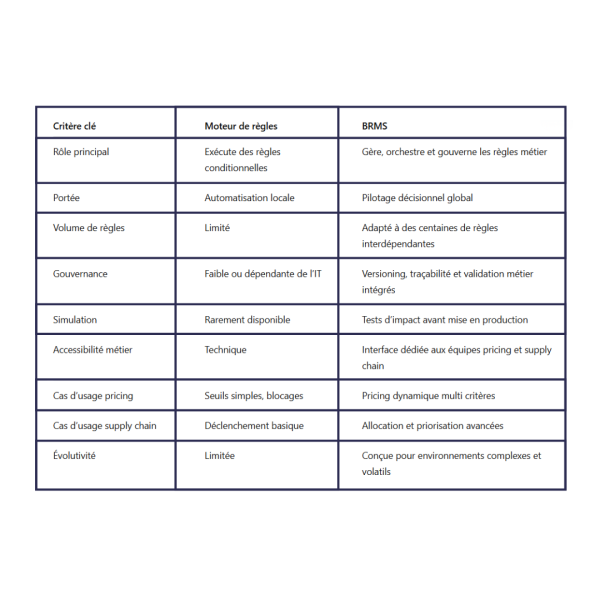
The essential difference lies in the steering capacity of the rules management system. Where a rules engine is limited to applying conditional logic within an execution framework, BRMS structures a genuine decision-making system and business rules management platform.
It makes it possible to manage a large volume of interdependent rules, organize their hierarchy, test different scenarios and anticipate potential conflicts. Mastery of the decision-making system and rules management becomes decisive as complexity increases, and performance depends on rigorous, consistent coordination of business rules.
Rules engine vs. BRMS
BRMS benefits for Pricing and Supply Chain teams
BRMS provides Pricing and Supply Chain teams with a structured framework for steering complex decisions with greater consistency, responsiveness and control.
Autonomy and decision-making agility
Teams can configure and adjust business rules without systematically relying on specific developments. They can quickly adapt their parameters in response to competitive developments, supply constraints or strategic orientations.
Structuring and consistency in pricing
In pricing, a BRMS can simultaneously combine several criteria within a business rule management system: margin constraints, competitive pressure, customer segmentation, price elasticity or stock levels. Rules can be prioritized according to explicit economic priorities within a structured management framework.
This organization strengthens the coherence between pricing strategy and operational execution, limits improvised adjustments and improves margin control thanks to controlled decision-making automation.
Optimization and prioritization in the supply chain
In the supply chain, the BRMS facilitates order prioritization in the event of tension, dynamic stock allocation and differentiated management of products according to their criticality. The management of replenishment rules becomes more precise, integrated and aligned with overall performance objectives.
Governance and security
Rules are centralized, versioned and traceable. Teams can simulate different scenarios before deployment, thus ensuring the security of their decisions.
The BRMS thus becomes a lever for collective performance, structuring decision-making while reinforcing alignment between pricing and supply chain.

BRMS or simple rules engine: which decision-making framework for your software?
Sufficiently simple motor
A simple engine may suffice when the volume of rules remains limited and stable. In an organization with a limited number of structuring rules, and few complex interactions, an ERP-integrated engine may meet the need.
This choice is appropriate when governance remains simple and changes are infrequent.
BRMS essential
A BRMS becomes indispensable when complexity increases. Pricing involving hundreds of interdependent rules, or a multi-channel supply chain requiring constant arbitration, calls for a structured decision-making layer.
Traceability, simulation and governance become critical performance factors. Without such structuring, the multiplication of rules undermines strategic coherence.
BRMS and decision support for 2026
The explosion in data volumes, the growing complexity of omnichannel models and increased market volatility make pricing and supply chain decisions more sensitive and structuring than ever. In this context, the isolated execution of rules is no longer enough: companies need to implement decision-making governance capable of reconciling agility, margin control and operational stability.
The Business Rules Management System (BRMS) provides this structuring framework. It centralizes and organizes business rules within the information system, while clearly separating decision-making logic from transactional systems. Integrated into ERP environments and omnichannel architectures, it not only automates decisions, but above all manages their lifecycle: versioning, validation, simulation and traceability.
By 2026, the challenge will no longer be to add rules, but to structure and prioritize them to guarantee consistency and scenario-based management. Performance will be based on the ability to industrialize rapid, robust and comprehensible arbitration.
The BRMS extends the strategy to a larger scale, making decisions more secure and reinforcing the sustainability of performance.