

The Challenges of the Supply Chain – Shortages, Inflation, and Geopolitical Risks at the Forefront

Whitepaper-How-to-choose-a-Supplychain-solution-optimix-solutions
How to choose your Supply Chain solution?
This guide offers you a clear methodology and concrete benchmarks to identify the Supply Chain solution best suited to your challenges, in the face of growing complexity and ever-increasing expectations.
2023 supply chain challenges inflation shortages and geopolitical risks in the frontline en optimix solutions mini

The past three years have been marked by a series of contingencies such as shortages, inflation, climate issues, geopolitical and health crises. Unfortunately, it seems that these problems are becoming the norm rather than exceptional events.

To ensure the resilience of the company, it is crucial to consider the risk mapping of the supply chain in 2023.

Challenge 1: Being unable to meet the demand

A major concern is the fear of not being able to meet the demand. Despite the return of growth in certain sectors in 2022, new disruptions are expected this year. The shortage of raw materials, components, and workers poses a significant problem for supply chains worldwide.

This shortage is due to several factors, such as the Covid crisis, which led to the halt or slowdown of certain productions, as well as recruitment difficulties related to changing employee expectations regarding purpose, working conditions, and compensation.

Challenge 2: Rising costs

Another concern is the rise in costs, which is cited as the second top concern by the respondents. With the recovery of consumption after the health crisis, inflation is back. The prices of raw materials have increased due to certain shortages, and the costs of energy and transportation have also risen due to the situation in Ukraine.

It is important to find solutions to optimize the transportation budget and control the costs. Business failures are also a threat because many supply chain actors cannot pass on these cost increases to their selling prices, which affects their profitability.

Furthermore, the risks associated with cybercrime are concerning, especially for small and medium-sized enterprises that are often targeted by hackers and may struggle to protect themselves against the increasing digitization of the supply chain.

hausse-de-prix-optimix-xfr

Challenge 3: Geopolitical Risks

Geopolitical risks are also a major source of concern. The conflict between Russia and Ukraine has a significant impact on the supply chains of many sectors. In addition to shortages, this conflict fuels inflation and could lead to increasingly protectionist policies, which would be detrimental to international trade.

The tensions between China and the United States regarding Taiwan could also have significant consequences, as Taiwan represents a vital portion of the global volume of semiconductors.

guerre-ukraine

Challenge 4: Logistics Risks

Logistics risks rank fifth in the list of concerns. Maritime freight is still strained, with strikes in several ports and intensive work to catch up on the delays accumulated during the health crisis.

The road transport sector faces increasing demand due to the rise of e-commerce but is grappling with a shortage of qualified drivers due to unattractive salary levels and challenging working conditions.

The use of transport optimization solutions can help it organize its chartering operations more efficiently.

Fret-maritime-optimix-xfr

Finally, other risks such as demand volatility, resource scarcity, and the climate crisis are also concerns for supply chain actors. It is crucial for them to diversify their sourcing to address resource scarcity and to consider extreme weather events that can impact logistics infrastructure and production tools.

To strengthen your company’s resilience, it is necessary to develop strategies to cope with shortages, inflation, cyber, geopolitical, and logistical risks, as well as issues related to climate, pandemics, and corporate social responsibility.
Subscribe to our Newsletters :

Our Last Articles :

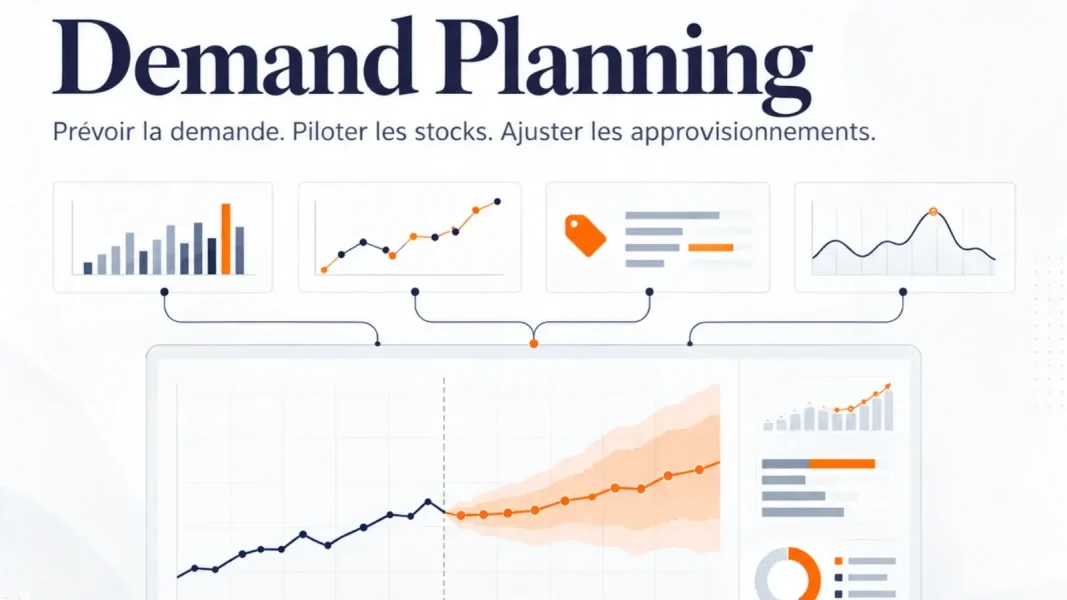
Why is Demand Planning Essential in Supply Chain Management?

Some critical decisions in the supply chain must be made before the actual demand is known. Companies must commit to procurement, reserve capacity, start production, position inventory, and organize supply flows even before customers have made a purchase. However, these decisions cannot always be corrected quickly. The longer the lead times, the broader the product assortments, and the more complex the distribution networks, the more costly a forecasting error becomes. That is precisely what makes demand planning essential. Its role is not to perfectly predict future sales. Rather, it is to reduce uncertainty enough to enable the company to make better decisions before actual demand is known. Underestimating demand can lead to stockouts, lost sales, rush orders, and a decline in customer satisfaction. Overestimating demand ties up capital, increases inventory costs, and exposes the company to excess inventory, markdowns, or obsolescence. But the issue goes beyond the total quantity of goods available. It is essential to have the right product in the right place at the right time. The quality of demand planning thus directly influences inventory management, procurement management, production management, and, more broadly, the management of material flows. So the question isn’t just: “What will demand be?” Above all, it is: “What decisions do we need to make today, given what we know—and what we don’t yet know—about future demand?” Demand Planning: Plan to Make Decisions, Not to Eliminate Uncertainty The Demand Planninginvolves estimating future customer demand based on historical data, forecasting models, and business intelligence. Statistical forecasting is an important component of this process, but it does not encompass the entire approach. Demand planning must also take into account events that could affect demand: promotions, price changes, product launches, changes to the product mix, new store openings, or shifts in purchasing behavior. This distinction is fundamental. An algorithm can identify a trend or seasonality. It does not necessarily know the timeline of a planned sales campaign, the impending loss of a customer, or the expected substitution between two products. Conversely, business intuition is not necessarily more reliable than a model simply because it comes from the field. The challenge, therefore, is to compare the various sources of information, document the assumptions, and gradually assess their contribution to the quality of decisions. The expected result is not a figure presented as a certainty. It is a regularly updated estimate of what might be requested, accompanied by an understanding of the factors that could cause it to change. This approach changes the way we evaluate demand planning: A forecast isn’t valuable simply because it’s accurate. It’s valuable when it enables you to make a better decision early enough to still take action. Why is Demand Planning Essential to Supply Chain Performance? The supply chain operates with a structural lag: customers may want to be served immediately, while companies sometimes need several weeks or months to source, produce, and ship a product. This time lag between when a decision must be made and when demand actually becomes apparent accounts for much of the value of demand planning. The longer or more costly it is to reverse a decision, the more important it becomes to plan ahead. Reduce stockouts without increasing inventory levels In the face of uncertainty, a simple solution is to increase safety stock. This strategy can reduce certain stockouts, but it ties up more capital and does not guarantee that the additional inventory will be for the right SKUs or in the right location. Demand Planning enables a more selective approach to inventory management. Regular, seasonal, intermittent, or heavily discounted products do not carry the same level of uncertainty or have the same consequences in the event of an error. Similarly, a forecasting error for an item that is easy to restock does not have the same impact as one for a seasonal product ordered several months in advance. Not all forecasting errors are therefore the same. The goal should not be to uniformly maximize reserves or even statistical accuracy, but to focus efforts where uncertainty can actually impair service or economic performance. Demand planning thus helps minimize inventory while protecting the products, time periods, and markets where a stockout would have the most significant consequences. Provide visibility into procurement and production Suppliers and industrial sites need visibility to reserve capacity, organize raw materials, and plan their resources. When information arrives too late, the supply chain must compensate by making schedule changes, arranging urgent procurement, or using more expensive transportation solutions. When volumes are overestimated, however, the supply chain commits resources that may not necessarily be put to use. Demand Planning provides a time-based view of demand, which helps improve supply chain management and production planning. It also makes it possible to distinguish between relatively predictable volumes and those that depend on more uncertain assumptions. Teams can then adjust their commitments based on the level of risk rather than treating every forecast figure as a certainty. This visibility improves the organization’s responsiveness, but above all its agility : it’s not just about reacting faster, but about knowing in advance which decisions can be adjusted if demand deviates from the anticipated scenario. Prevent uncertainty from spreading throughout the supply chain A relatively small change in customer demand can lead to much larger adjustments as it moves up the supply chain. A distributor increases its orders as a precaution. The warehouse increases its requirements. The purchasing department reports an even larger increase to the supplier to secure the volumes. At each stage, the initial uncertainty can be amplified. The result is paradoxical: the company seeks to protect itself against risk, but in doing so, it actually contributes to creating greater volatility in its logistics flows. Shared demand planning limits this amplification by providing the various functions with a common reference point and, above all, by making visible the assumptions that explain its evolution. The quality of information flows then becomes just as important as that of physical flows. Better control of these flows is not simply a matter of

Read More »

What is price scraping?

Price scraping automates the collection of prices and pricing information online. Learn how it works and how to use this data to analyze the competition and refine your pricing strategy.

Read More »

Trade news

Immerse yourself in the latest Pricing and Supply Chain news!

Découvrez nos actualités liées au Pricing et à la Supply Chain