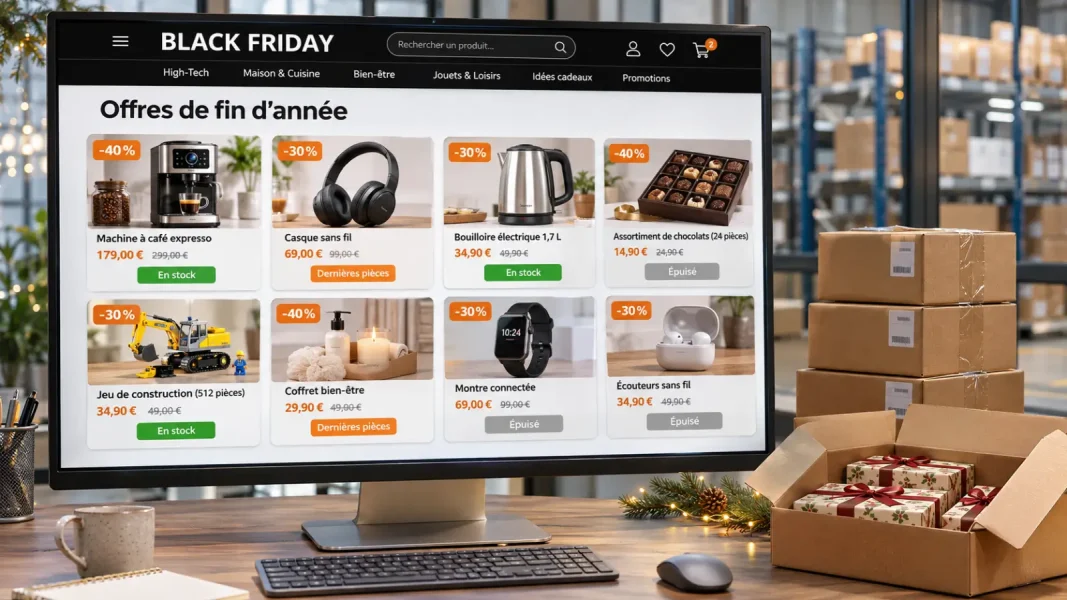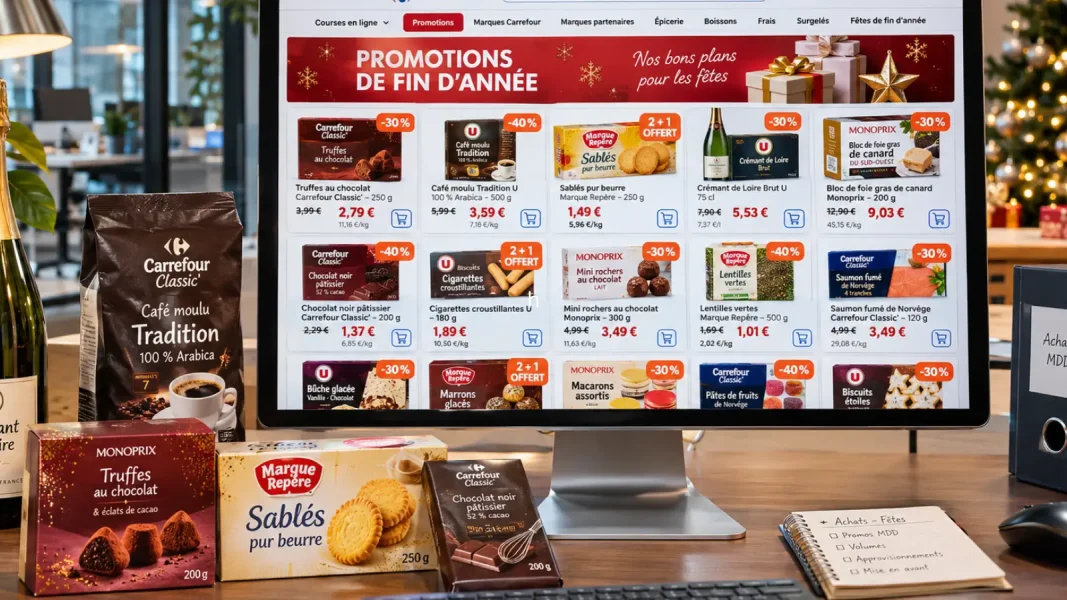

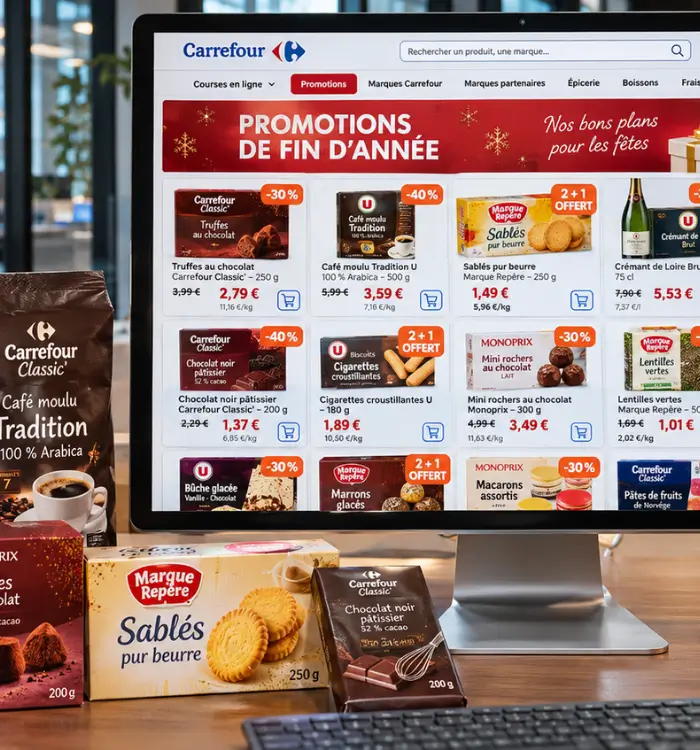
The end of the year brings together several of the most pivotal sales periods in retail: Black Friday, Cyber Monday, Christmas shopping, holiday celebrations, and seasonal promotions. For both retailers and brands, this period highlights the challenges of traffic, conversion, average basket size, and customer loyalty.
In this context, private-label brands occupy a unique position. Historically associated with price competitiveness, they are now called upon to play a broader role: protecting purchasing power, supporting margins, strengthening the retailer’s differentiation, and capturing a larger share of the household shopping basket.
The issue, therefore, is no longer simply whether private-label brands can compete in the promotional arena. It is a matter of determining how to use them as a strategic lever at a time when price pressure, intense competition, and the pursuit of value are all converging.
Three trends are strengthening the strategic role of private-label brands
1. Budgetary pressure increases the importance of spending trade-offs
The holiday season remains a prime time for consumer spending, but it occurs in a context where households are making more careful spending decisions.
This tension creates a favorable environment for private-label brands.
Consumers aren’t necessarily looking to cut back on all their spending. Rather, they’re seeking to reallocate their budget among essentials, impulse purchases, gifts, and holiday spending.
In this context, private-label brands become a tool for balancing spending priorities.
It can help maintain a satisfactory level of consumption in certain categories while freeing up purchasing power for other items deemed more important.
For retailers, the opportunity is twofold: to strengthen the perception of the brand’s value while increasing its share of the consumer’s spending portfolio.

2. Private-label brands are no longer just a pricing tool
The growth of premium, organic, local, sustainable, and specialty product lines has profoundly changed the value proposition of private-label brands.
In many product categories, their role is no longer limited to offering a cheaper alternative.
They can now serve several strategic functions:
- upholding the retailer’s price image;
- generating profit margins;
- differentiating the product assortment;
- meet specific customer expectations;
- strengthen loyalty to the chain.
This trend is particularly evident during the holidays.
Premium product lines offer retailers the opportunity to compete with national brands on dimensions that were once much more difficult to address: perceived quality, enjoyment, sophistication, and desirability.
The battle is therefore no longer fought exclusively on the basis of list price.
It is gradually shifting toward perceived value.
Want to learn more? Discover the 3 types of private-label brands and what really sets them apart.
3. Promotions are no longer limited to major brands
For a long time, promotions were primarily a powerful driver for national brands.
Spectacular discounts, media campaigns, promotional catalogs, and special events allowed them to attract new customers, maintain sales volumes, or boost their visibility during peak sales periods.
Private-label brands relied more on everyday price competitiveness.
Today, this distinction is much less clear-cut.
Retailers now have a wide range of tools at their disposal to place their private labels at the center of their business operations: exclusive prices for loyalty cardholders, personalized offers in apps, deferred discounts, bundles, cross-promotions, and targeted activations based on customer profiles.
This shift is strategic.
When a retailer chooses which products to highlight, it gains a structural advantage: it simultaneously controls the brand, pricing, product assortment, merchandising, and the customer relationship.
During a period as busy as November and December, this control can become a major competitive advantage.
The retailer can decide which products to promote, to which customers, when, and with what level of incentive.
Private label thus becomes a particularly powerful asset in a strategy of promotional personalization.
The challenge is no longer simply to offer a uniform discount, but to create differentiated shopping journeys based on customer value, price sensitivity, consumption habits, or conversion potential.
In other words, the promotional battle is gradually becoming a battle of relevance and orchestration, rather than solely a battle of promotional intensity.
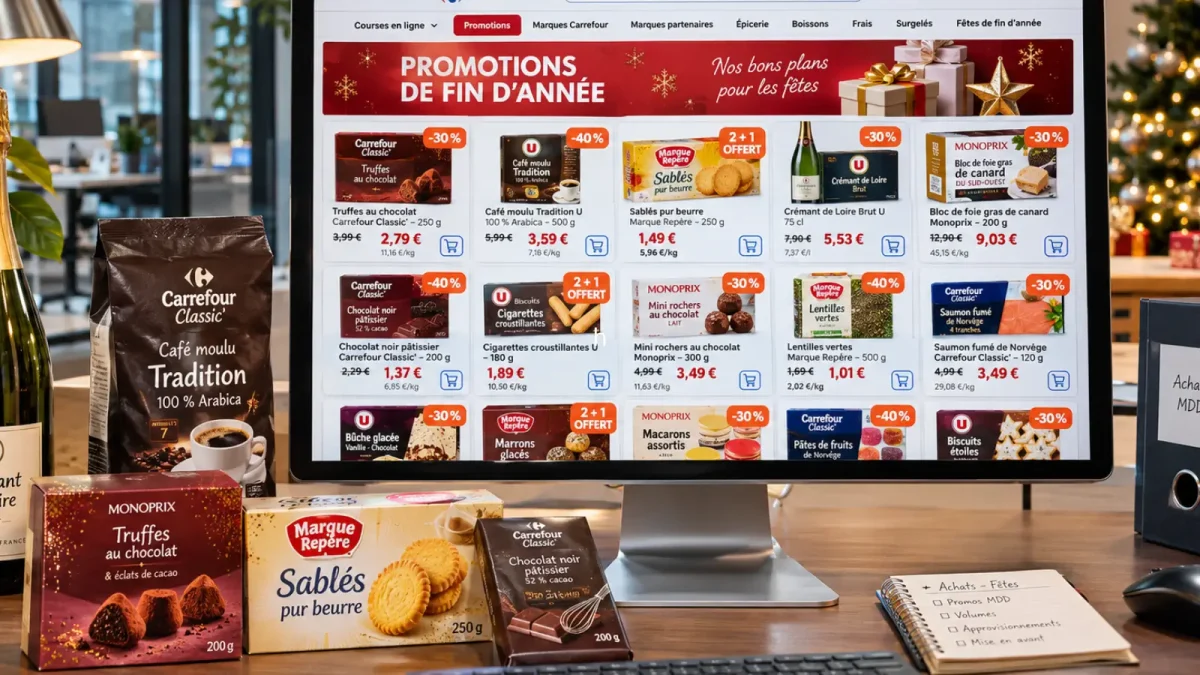
Black Friday: Focus on Acquisition and Trial Rather Than Just Discounts
Black Friday follows a specific logic.
Its effectiveness relies heavily on the perception of an exceptional opportunity. In certain categories, this perception naturally benefits major brands, whose name recognition makes the discount level immediately understandable to consumers.
For private-label brands, directly replicating this approach isn’t necessarily the best strategy.
When their value proposition is already based on a competitive everyday price, offering multiple discounts can make their positioning less clear.
The challenge is different.
Black Friday can be used as a tool for customer acquisition, product discovery, or trial.
An offer focused on a private-label product line can attract a consumer who wouldn’t have tried it under normal circumstances. If the product experience is compelling, the potential benefit far exceeds the initial promotional transaction.
The approach must therefore evolve:
from promotional sales to fostering repeat behavior.
The strategic KPI is then no longer solely the volume generated during the promotion, but the repurchase rate in the weeks or months that follow.
The holidays present a unique opportunity for premium product lines
While Black Friday encourages consumers to try new products, Christmas and New Year’s Eve offer a different opportunity: the chance to upgrade to higher-end products.
In holiday categories, consumers are more willing to increase their spending when perceived quality and the overall experience justify it.
For retailers, this opens up a particularly attractive market.
Premium private-label brands can address a key challenge: offering a rewarding holiday experience without reaching the price points of the most premium national brands.
In this context, categories with a strong emotional or social appeal—appetizers, chocolate, desserts, prepared foods, and gourmet products—become strategic.
The key question for retailers is therefore:
Can private-label products become items that customers are proud to serve, give as gifts, or recommend?
When the answer is yes, the positioning changes profoundly.
Private label is no longer simply a rational choice. It becomes a brand of choice.
This shift is crucial, as it allows the retailer to gradually move the competition from a purely price-based arena to one of consumer preference.
The main risk: over-promoting private-label brands
The growing role of private-label brands does not mean that promotion must be systematically stepped up.
On the contrary, one of their main advantages often lies in the stability of their economic proposition.
Overreliance on promotions could have three negative effects.
First, it can obscure the clarity of the reference price.
Second, it can accustom consumers to delaying their purchases while waiting for a promotion.
Third, it can undermine the value proposition of product lines that are specifically designed to move away from an exclusively price-based positioning.
Promotions must therefore remain selective.
It is particularly effective when it serves a clearly defined objective: recruiting customers, encouraging trial, accelerating a launch, increasing the average order value, or developing a new product category.
It is much less effective when it is merely an automatic response to competitive pressure.
For retailers, the challenge is therefore to strike the right balance between short-term sales activation and long-term value creation.

The real battle takes place after the promotion
For retailers, the main challenge isn’t winning a promotional weekend.
It is to turn the year-end sales events into drivers of brand preference.
Three levels of performance must therefore be distinguished.
The first is transactional: generating volume during the promotion.
The second is behavioral: securing repeat purchases.
The third is strategic: sustainably improving the perception of the private label and, by extension, that of the retailer.
It is this third level that creates the most value.
A private-label brand that resonates during the holiday season can strengthen several aspects simultaneously: satisfaction, loyalty, price perception, differentiation, and profitability.
This perspective also calls for a reevaluation of how promotional performance is measured.
The success of a campaign should not be evaluated solely based on incremental sales or the volume generated during the period. It must also be assessed based on its ability to attract new customers, drive repeat purchases, and increase the share of private-label products in the customer’s shopping basket.
Four Priorities for General and Sales Management
To maximize the contribution of private-label brands during the peak holiday season, we believe four priorities are essential.
- Clarify the role of each private-label product line
Not all product lines should pursue the same objective. Some must reinforce the brand’s value proposition. Others must maximize profit margins. Still others must enhance differentiation or desirability.
Promotional strategies must be based on this role.
- Segmenting Promotional Investments
Flat discounts are becoming less and less relevant.
Data from loyalty programs and digital channels allows you to focus your investment on the customers, categories, and moments where the incremental impact is highest.
The question is therefore no longer just “What promotion should we offer?”, but also “to whom, when, and for what purpose?”
- Measuring Performance Beyond Immediate Volume
Short-term metrics remain essential, but they are not enough.
Retailers must also track trial rates, repurchase rates, frequency, migration between product lines, and changes in portfolio share.
The goal is to distinguish between promotions that temporarily shift volume and those that actually change consumer behavior.
- Protecting Brand Value
As private-label brands move upmarket, consistency across product, price, packaging, experience, and promotion becomes critical.
An aggressive but poorly calibrated promotional strategy can undermine some of the value the retailer is trying to build.
Promotions must therefore support the brand’s positioning, not replace it.
From the Price War to the Battle for Consumer Preference
The year-end sales season is less of a commercial interlude and more of an indicator of the transformation of private-label brands.
Their role is expanding.
They are no longer merely a tool for price competitiveness. They are gradually becoming a lever for differentiation, customer loyalty, and value creation.
For retailers, the strategic question is therefore no longer: how to promote private labels more?
It has become:
how can we use key sales periods to shift private-label brands from being an economical choice to a preferred choice?
Retailers capable of successfully navigating this transition will be able to turn the promotional pressure of the end-of-year season into a lasting competitive advantage.
Because, beyond Black Friday or the holidays, the real victory isn’t about generating an extra sale through a promotion.
It lies in ensuring that consumers continue to choose the private label even after the promotion has ended.