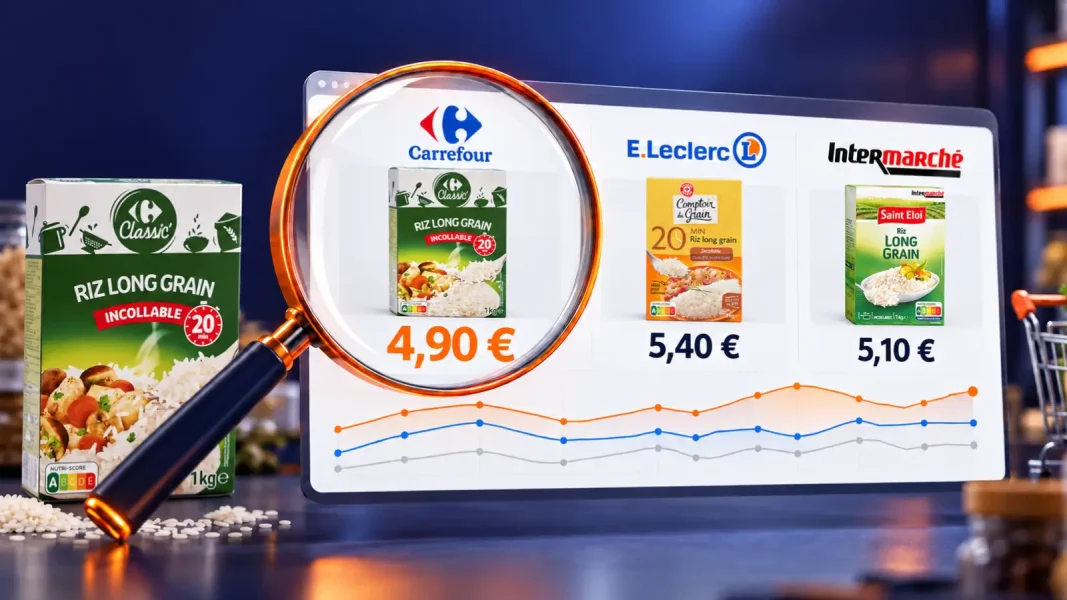
Analyzing competitors’ prices seems simple: identify comparable products, gather their prices, and then adjust your own positioning.
In practice, this is one of the most challenging aspects of pricing.
A poorly conducted competitive pricing analysis can lead to decisions that are far more costly than not conducting an analysis at all: excessive price cuts, erosion of profit margins, a misperception of brand positioning, or the triggering of an unnecessary price war.
The challenge lies in a fundamental principle: monitoring competitors’ prices is not the same as understanding their pricing strategy.
A listed price is merely a signal. To be useful, it must be viewed in context: product, channel, promotion, availability, service level, terms and conditions, customer segmentation, and market dynamics.
Here are the most common mistakes in competitive pricing analysis—and, most importantly, best practices for avoiding them.
Mistakes to Avoid in Competitive Price Analysis.
1. Comparing products that aren’t really comparable
This is one of the most common mistakes in price benchmarking.
Two products may appear similar but offer very different value propositions. The brand, quality, format, features, warranties, or level of service can all justify significant price differences.
Let’s imagine a product that sells for €120, while a competitor sells a seemingly similar product for €99.
It would be risky to jump to the conclusion that the €120 product is too expensive.
The discrepancy can be explained, in particular, by:
- superior quality;
- a longer warranty;
- free shipping;
- additional services;
- a brand with greater name recognition;
- greater availability;
- a more premium positioning.
A price comparison should therefore begin with a simple question: Do the offers actually address the same customer need?
Best practice: Clearly define the criteria for comparability
Before including a product in your competitive benchmark, check several factors:
- technical specifications;
- quantity or format;
- product line;
- brand;
- services included;
- warranty;
- delivery;
- target audience.
In complex categories, it may even be appropriate to assign a similarity score to each product being compared.
The goal is not always to achieve a perfect match, but to determine how reliable each comparison is.
2. Stick to the listed price
The price shown on a product page does not necessarily correspond to the price the customer actually pays.
Between promotions, discount codes, loyalty perks, bundle deals, and shipping costs, two offers with the same listed price can actually have very different total costs.
For example, a competitor might maintain a high list price but offer discounts almost all year round.
Conversely, a particularly aggressive introductory price may be offset by additional fees.
Best practice: Analyze multiple price levels
Whenever possible, distinguish between:
- the list price;
- the promotional price;
- the price after a discount or coupon;
- shipping costs;
- additional services;
- the total amount paid by the customer.
This approach makes it possible to move beyond a simple comparison of listed prices to a comparison that more closely reflects actual market conditions.
To learn more, we’ve written an article on this topic: What Data Is Actually Collected During a Competitive Price Analysis?
3. Using a market average without distinguishing between actual competitors
It’s tempting to compare its price to an overall market average.
But this average can quickly become misleading if it lumps together players whose strategies are completely different.
A premium brand, a discount retailer, and a general-purpose marketplace can sell similar products while catering to completely different customer expectations.
Therefore, their price should not carry the same weight in your analysis.
Best practice: Segment competitors
A thorough competitive analysis generally identifies several groups, such as:
- direct competitors;
- premium players;
- discount retailers;
- marketplaces;
- specialty brands;
- new entrants;
- long-standing leaders.
This segmentation makes it possible to analyze a company’s positioning relative to the truly relevant competitors rather than trying to artificially conform to a market average.

4. Forgetting that price is part of brand positioning
Pricing isn’t just about generating revenue.
It also plays a role in how the brand is perceived.
A higher price may reflect superior quality, specialized expertise, greater exclusivity, or a higher level of service.
Systematically striving to be cheaper than competitors can therefore weaken the company’s market position.
In some cases, a price reduction can even cause customers to become suspicious.
Best Practice: Define the Role of Price in Your Strategy
Before making any decision, it is important to know what position the company wants to take.
Would you like to be perceived as:
- the cheapest;
- a premium benchmark;
- the best value for the money;
- a specialist;
- an innovative player;
- A more affordable alternative to a market leader?
Your pricing policy should reinforce this value proposition, not contradict it.
5. Reacting too quickly to competitors’ moves
In some sectors, prices are constantly changing.
This is especially true in e-commerce, travel, electronics, and marketplaces.
In the face of these changes, some companies make the mistake of adjusting their own prices almost automatically.
The risk is significant: they then cease to have their own pricing strategy and become market followers.
Worse still, when several competitors react to one another, they can trigger a price war that gradually erodes profit margins.
Best practice: Establish guidelines for how to respond
Not all competing variations require action.
Before changing your price, be sure to analyze the following:
- the competitor’s strategic importance;
- the magnitude of the decline or increase;
- the duration of the change;
- the potential impact on sales;
- your available margin;
- your inventory level;
- price sensitivity within the category.
A fluctuation of a few hours or a one-time promotion does not necessarily require a price adjustment.
6. Confusing a temporary promotion with a change in strategy
A low price observed today will not necessarily become the new benchmark price tomorrow.
A decline may be related to a one-time event:
- sales;
- Black Friday;
- clearance sale;
- launch of a new product;
- acquisition transaction;
- clearance sale of an older model;
- a temporary need to move inventory.
Taking immediate action could then result in reducing your margin to address a situation that will disappear a few days later.
Best Practice: Working with Price History
A snapshot of the market provides only limited information.
Looking at a competitor’s track record provides a much clearer understanding of their strategy.
In particular, it is helpful to follow:
- the frequency of promotions;
- their duration;
- their amplitude;
- their seasonality;
- the frequency of price changes;
- a return to the original rate.
True pricing intelligence emerges when we stop focusing solely on the daily price, but how the competitor manages its prices over time.
7. Neglecting product availability
The lowest price on the market isn’t always the best price.
If the competing product is out of stock, its price is no longer a viable alternative for the consumer.
However, many automated analyses continue to treat this price as a benchmark.
The result: a company can lower its prices even though it is currently one of the few players capable of meeting demand.
Best practice: Analyze the price-availability relationship
For each competitive analysis, try to include:
- product availability;
- delivery times;
- local availability;
- the shipping method;
- the inventory level, when this information is available.
Availability can sometimes be just as valuable as the price itself.
8. Collecting a huge amount of data without knowing which parts are actually useful
Price monitoring solutions today make it possible to collect vast amounts of information.
But having thousands or millions of price data points does not guarantee better decisions.
In fact, the opposite is true: accumulating more data without setting priorities can make analysis more complex and slow down decision-making.
So the question isn’t just: how much data can we collect?
The question is rather: What data actually helps us make better pricing decisions?
The Most Useful Indicators
The price index is one of the most commonly used KPIs.
For example, it can be calculated as follows:
Price Index = Your Price / Competitor’s Price × 100
An index of 105 means that your price is about 5% higher than the benchmark price.
However, this indicator must be supplemented by other measures:
- price difference in value;
- price difference as a percentage;
- position in the tariff classification;
- promotional frequency;
- price volatility;
- availability;
- number of competitors present.
The goal is to transform raw data into information that can be used directly.

9. Do not link competitors’ prices to your own sales performance
Simply noting that a competitor is 10% cheaper does not constitute an analysis.
The real question is: Does this discrepancy have an impact on your results?
In certain categories, a difference of just a few euros can significantly affect the conversion rate.
In other cases, brand recognition, customer reviews, delivery times, or the quality of service will have a greater impact than price.
Best Practice: Cross-referencing Competitor Data with Internal Data
Pricing analysis becomes truly strategic when market data is compared with the company’s performance:
- traffic;
- conversion;
- sales volume;
- margin;
- breaking strength;
- tariff classification;
- special offers;
- competitive behavior.
You can then identify the categories in which your price competitiveness actually influences demand.
10. Always strive to be the cheapest
This is probably one of the most dangerous ideas in pricing.
Being cheaper can be a competitive advantage.
But only if this strategy is consistent with your business model.
A price reduction can increase sales while reducing overall profit.
Let’s take an example.
A product sells for €100, with a variable cost of €60.
The profit per unit is therefore €40.
If the price drops to €90, the margin falls to €30.
To maintain the same level of gross margin, it will be necessary to sell about one-third more products.
So the right question isn’t:
“How can we be cheaper than the competition?”
But:
“Will the increase in volume resulting from this price drop be enough to offset the loss in margin?”
Best practice: Focus on profit, not just price
Every pricing decision should take three factors into account:
- the impact on volume;
- the impact on the unit margin;
- the ultimate impact on the gross margin.
It is this approach that helps prevent unnecessary price cuts.
How can you conduct a truly effective competitive pricing analysis?
A thorough rate analysis is based on a structured methodology.
Identify the truly relevant competitors
Not all market participants should be monitored with the same level of attention.
Focus your monitoring efforts on those who directly influence your customers’ purchasing decisions.
Building a Reliable Product Matching System
The quality of the match is essential.
A mismatch between two references can skew the entire line of reasoning that follows.
Strategic products or those that generate significant revenue require special attention.
Historical Context of the Data
The current price provides a snapshot.
Understanding the background helps us understand behavior.
Retaining data over time makes it possible to identify:
- trends;
- recurring promotions;
- seasonality;
- repositioning;
- periods of intense price competition.
Segment products based on their role
Not all products should be managed according to the same rules.
It may be helpful to distinguish between:
- loss leaders;
- highly comparable products;
- traffic-generating products;
- high-margin products;
- exclusive references;
- long train.
A loss leader may require highly competitive pricing, whereas a differentiated flagship product can maintain a higher margin.
Establish safeguards
A good pricing strategy should never depend entirely on competitors’ behavior.
It is essential to set certain limits:
- minimum price;
- minimum margin;
- maximum allowable deviation;
- promotional rules;
- exceptions by category;
- human validation beyond certain thresholds.
These safeguards make it possible to use competitive data without losing control of one’s strategy.
From Price Monitoring to Intelligent Pricing
Competitive price analysis becomes truly effective when a company no longer limits itself to simply collecting price data.
She seeks to understand behavior.
Why does a competitor lower its prices?
In which categories?
When?
How long?
Does he consistently follow certain actors?
Is there any seasonality?
What is its promotional strategy?
These questions help us move from a monitoring approach to true pricing intelligence.
In this approach, the competitor’s price is no longer a guideline to follow.
It becomes an additional factor used in making a decision.
Sometimes, that decision will be to lower the price.
Sometimes, her role will be to maintain it.
In some cases, it may even be necessary to increase it.
Beyond Benchmarking: Building a True Pricing Strategy
Competitive pricing analysis is a powerful tool—provided it is not reduced to a simple comparison of prices.
A price only makes sense when viewed in context: product features, brand positioning, current promotions, availability, service level, and margin targets. Ignoring these factors can lead to counterproductive pricing decisions.
A mature pricing strategy, therefore, does not consist of copying the market, but rather of understanding it well enough to decide when to follow a competitor, when to maintain one’s price, when to adopt a higher-end positioning, and when a price reduction can truly create value.
The goal is not to be the cheapest option every time, but to determine the most appropriate price given your market, your value proposition, and your profitability goals.

FAQ on Competitive Price Analysis
What is a competitive price analysis?
This involves analyzing competitors’ rates, promotions, availability, and pricing strategies in order to better understand one’s own market positioning and improve pricing decisions.
Which competitors should we keep an eye on?
First and foremost, those who target the same customers with an offering that is a true substitute for yours. Direct competitors generally carry more weight than players in very different segments.
Should you always match the prices of a cheaper competitor?
No. Pricing strategy should depend on your margin, your market positioning, the elasticity of demand, and the competitor’s strategic importance.
Which KPIs should you use to analyze competitors' prices?
The key indicators include:
- the price index;
- the price difference;
- price ranking;
- the frequency of promotions;
- price volatility;
- product availability.
Why keep a price history?
Because a price observed on a one-time basis may reflect a promotion or an exceptional circumstance. Price history helps distinguish temporary changes from genuine shifts in strategy.