



Price image is a strategic pillar for any brand wishing to stand out from the crowd and build customer loyalty. It reflects much more than price levels: it’s a global perception, influenced by product quality, communication, positioning and consumer experiences.
A strong price image creates trust, attracts value-conscious buyers and justifies higher prices when perceived value is high. Building this image requires consistency, clarity and relevance at every point of contact.
This article explores the essential levers for shaping a convincing and sustainable price image, capable of strengthening the competitiveness of chains while maximizing their profitability.
The importance of Price-Image in Retail
Price image reflects how consumers perceive the price level of a brand or chain. It’s not limited to price tags, but includes elements such as perceived quality, positioning, promotional offers and communication. A well-mastered price image has a direct influence on purchasing decisions, reinforcing the perception of value and the feeling of getting a good deal.
It enables retailers to differentiate themselves, attract targeted customers and justify higher prices when perceived value is strong. By cultivating a consistent price image, retailers can improve their competitiveness, build customer loyalty and optimize margins without compromising satisfaction. It’s a true strategic asset in a commercial environment where perception is sometimes worth more than price itself.
To find out more, read our article : Price image analysis in retail

How do you build a strong pricing image?
1) Clarify your positioning: the DNA of your price image
Even before setting a price or launching a promotion, a company must answer a fundamental question: what role does it wish to play in the consumer’s mind? Brand positioning is the foundation of price image.
The aim of a premium company is not to be perceived as “cheap”, but to justify its price by the value it creates: quality, rarity, excellence, innovation or customer experience.
Conversely, a brand with a discount positioning aims to maximize the perception of bargain, purchasing power or accessibility. But this should never be at the expense of trust, consistency or transparency.
The price must not contradict the brand promise. It must reflect it, reinforce it and make it credible.
2. Anchor price image in a strong brand strategy
A powerful pricing image is not built in an isolated silo. It’s part of a coherent, global brand strategy. This requires :
- Define a clear brand identity: personality, values, promise, target.
- Translate this identity into a distinctive visual identity and a coherent brand universe.
- Using storytelling to embody prizes: why are they worth what they’re worth?
- Giving narrative direction to fare collection.
Take Coca-Cola, for example. It’s not the price level that shapes its price image, but the power of the storytelling, the consistency of the communication, and the overall customer experience. The result: even with prices often above the market, perception remains positive.
Remember: you can’t build a strong pricing image without building a strong brand image.
3. Understanding the cognitive drivers of price perception
Price perception is a psychological phenomenon, not an economic one. It is influenced by :
- Implicit or explicit comparison with competitors.
- Alignment between price and promise (quality, service, commitment, etc.)
- The visual and verbal context of the offer (design, wording, atmosphere).
- Cognitive biases: anchoring effect, threshold effect (€9.99 vs €10), reference price, framing.
For example, a €29.99 product may be perceived as affordable or excessive depending on whether it is placed in a luxury boutique or on a discount site. The environment encodes price in a logic of value.
We need to shape the customer’s mental references so that they translate price into value.
4 Measuring the price image: objectifying a perception
To manage a price image, you need to be able to evaluate it reliably. Here are the main tools:
- Perception surveys and barometers: measure perceived accuracy, acceptability and understanding of pricing.
- Price sensitivity methods (Van Westendorp, Gabor-Granger).
- Semantic analysis of customer reviews to detect weak signals of perceived cost or value.
- Price Index: track your price position versus the competition.
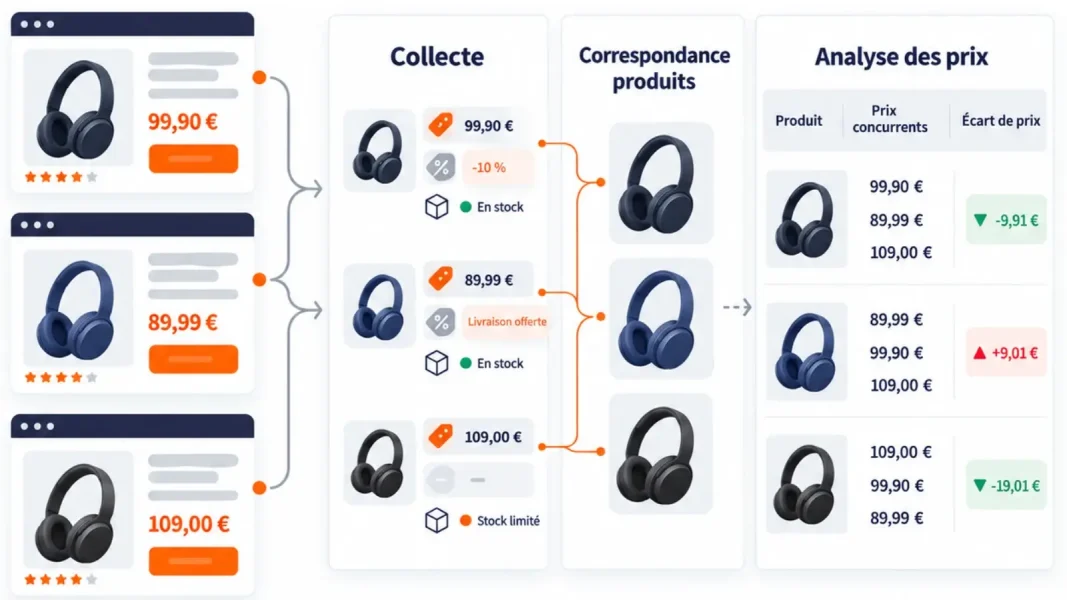
- Pricing intelligence software: these tools enable you to monitor market price trends in real time, identify competitive variations and detect breaks in perceived consistency. Solutions such as XPA-Optimix Pricing Analytics make it easy to monitor competitor prices, and help you to visualize key KPIs and the price gap with your competitors.
The objective is not to have the “best price”, but the best perceived price, in terms of the promise.
5. Aligning pricing reality and perception: consistency first and foremost
A strong image is based on consistency between who you are, what you say and what you do. This means :
- A clear, stable and understandable pricing policy.
- Reasonable, targeted, understandable promotions.
- Omnichannel price harmonization (website, store, app).
- Rigorous management of price differentials between countries, segments, channels or moments.
Every time the consumer perceives a lack of logic, trust breaks down.
Building a price image means first and foremost reducing the dissonance between promise and experience.
6. Care for all contact points
Price perception doesn’t just happen at the checkout. It is built up at every point of contact:
- The design of the site or packaging
- Sales language
- Product sheet content
- The level of service before and after the sale
- Return, after-sales and delivery policies
Anything that enhances the value proposition helps justify the price.
An experience perceived as fluid, human and qualitative makes the price more acceptable.

7. Communicate value, not price
Price, in itself, is just a number. It’s not the number displayed that triggers or blocks a purchasing decision, but the perception of what the customer gets in return. In other words, what counts is the perceived value, not the nominal price. So it’s crucial to focus communication on what the customer gains, understands and feels, rather than on an arithmetical justification of the price. Here are the levers to activate to achieve this:
- Highlight the concrete benefits of the product or service
It’s not about describing technical features, but translating them into tangible benefits for the user. For example, rather than saying “5000 mAh battery”, we’ll communicate “last all day without recharging”. Benefit-oriented communication enables the customer to project usage and understand the real interest of the offer, which reinforces his acceptance of the price. - Explain the origin of the price
Consumers are increasingly sensitive to the intrinsic and contextual value of a product: local manufacturing, sustainable sourcing, technical innovation, artisanal production, fair social conditions… All these elements can explain a higher price positioning. When properly communicated, they reinforce the legitimacy of the price and nurture trust. - Using storytelling to convey value
Narration makes the price emotionally acceptable. By telling the story of a product, a founder, a commitment or a know-how, we move away from the logic of a simple monetary exchange to enter into a relationship of meaning. Storytelling adds depth to the offer and creates a deeper bond with the customer, who then becomes more inclined to invest. - Reassure customers of their return on investment (ROI)
Whether you’re selling to an end-consumer or a business, it’s vital to show that the price you pay is a worthwhile investment. This can take the form of time savings, increased durability, greater efficiency or a more satisfying experience. The aim is to make it clear that the product or service will “pay for itself”, directly or indirectly.
Price is not value. It’s the perceived value that makes the price acceptable. Communication focused on this concrete, emotional and strategic value is the key to building a strong price image, even in a premium context.
8. Integrate price image into overall communication strategy
A strong price image can only exist if it is constantly relayed, embodied and made tangible across all the brand’s communication channels. This means that every point of contact, be it advertising, a digital campaign, a post on social networks, a newsletter, a transactional e-mail, or even product packaging, must convey the same pricing promise and reflect a consistent positioning.
Advertising campaigns must be in line with the price level charged. Premium communication cannot coexist with overly aggressive offers that trivialize perceived value. On social networks, content must reinforce the alignment between perceived quality and price. Working with influencers or brand ambassadors can also play a structuring role, provided that their image is compatible with the target price range. The same applies to point-of-sale elements: Point-of-sale displays, sales pitches, staff speeches, visuals, sounds and smells all contribute to the mental construction of the price.
The same product will not be perceived in the same way, depending on whether the brand’s overall message is coherent and controlled or, on the contrary, contradictory. The uniqueness of the message is a determining factor. A dissonance between a premium spot and a policy of permanent online sales immediately blurs the price image. Conversely, consistent communication across all media amplifies impact and reinforces the brand’s pricing credibility. Consistency multiplies impact. Inconsistency cancels it out.
9. Listening to your audience, managing your e-reputation prices
Your price image also depends on what others say about you. Customer reviews, ratings, forums and social networks all play an amplifying role.
It is therefore crucial to :
- Monitor pricing e-reputation (prices considered abusive, fair, consistent).
- Respond to negative comments in an educational way.
- Capitalize on positive reviews (“good value for money”).
- Identify natural brand ambassadors.
A satisfied customer speaks. A customer impressed by the value/price ratio becomes a prescriber.

10. Stay agile: test, adapt, evolve
Building a strong brand image is never a static exercise. It’s a living, evolving process, requiring flexibility, observation and a constant ability to adjust. The market is changing, consumer expectations are evolving, new uses are emerging, and the competition is innovating. Faced with this reality, companies need to demonstrate pricing agility without compromising their coherence.
This means regularly testing different price levels according to customer segments, distribution channels or key moments in the buying journey. A mature pricing company does not hesitate to experiment with differentiated approaches, observing reactions, analyzing data, then readjusting its offer according to what it learns. It knows how to adapt its pricing to meet emerging needs, refine its segmentation or introduce new pricing models, such as subscription, freemium, bundles or personalized offers.
This agility should not be perceived as instability. When well orchestrated, it sends a positive signal to the market: that of a brand that listens, reacts and adapts without betraying its positioning. Conversely, a rigid, fixed strategy can quickly appear outdated or disconnected from customers’ real expectations.
In the final analysis, a strong pricing image is also built by the company’s ability to evolve intelligently, while maintaining a clear and legible guideline for its customers. Controlled agility is a marker of pricing maturity.

Price image: Beyond price, perceived value
Building a strong price image means giving meaning to the price. It means creating the right perception, in line with the brand promise. It’s about getting the customer to say: “Yes, this price makes sense to me. It lives up to my expectations”.
And that’s the real power of pricing.
But this power is not based on numbers alone. It’s based on trust. A strong price image is one that doesn’t trigger doubt or mistrust. It’s the kind of image that doesn’t make customers wonder if they could have paid less elsewhere, but rather tells them they’ve made the right choice, here and now.
It’s also a question of consistency. The price must be in harmony with the experience, the message, the service and the product. Too low a price can discredit a premium offer. A price that’s too high, with no perceived justification, can lead to rejection. Price image is the subtle balance between real and perceived value.
Above all, it’s an ongoing process. It can’t be decreed, it has to be cultivated. Through every point of contact, every word used, every commercial gesture. It is reinforced by transparency, by education, by the ability to explain why the price is right. If pricing is well thought-out, well communicated and well lived, it becomes much more than an economic lever. It becomes a vector of meaning, a marker of positioning, and sometimes even a symbol of brand identity.
And this is where price ceases to be a number… and becomes a value.