



Pricing a product is an essential strategic step in remaining competitive, ensuring profitability and the long-term future of your business. A poorly-adjusted price can lead to hard-to-satisfy demand, resulting in unsold products and reduced margins. Conversely, well thought-out pricing secures profitability, optimizes inventory management and improves overall sales performance.
Pricing is not based on internal costs alone: it requires a detailed analysis of competition, demand and customer perception. Automating pricing is an increasingly common practice in retail. We won’t go into it again.
In this issue, we take a look at the main pricing strategies, the key steps for structuring your approach, and the essential role of advanced pricing tools. advanced pricing tools like XPA – Optimix Pricing Analytics, which give you access to reliable data to guide your decisions with precision.
Price a product by analyzing costs and competition
Before detailing the precise methods for setting a price, it’s essential to understand that effective pricing is based on two main axes: analysis of production costs and fixed charges to guarantee profitability, and study of the competition to position the sale of a product competitively on the market. This approach makes it possible not only to define a coherent price excluding VAT, but also to integrate the effects of VAT to arrive at a price including VAT that is acceptable to the customer.
You also need to take into account the brand rate and the margin coefficient, which help you measure real profitability and anticipate the psychological threshold beyond which the price may seem too high. These two dimensions form the basis of a robust pricing strategy, and make it possible to determine a final selling price that is competitive, profitable and in line with your business objectives.
Cost analysis: cost price
Cost price is the cornerstone of any pricing strategy. It includes both direct costs (raw materials, components, production, labor) and indirect costs (logistics, storage, marketing, distribution). The cost-plus method, which adds a profit margin to total costs, guarantees minimum profitability. However, this approach alone is not sufficient, as it does not take into account market fluctuations or customer perception.
Competition analysis
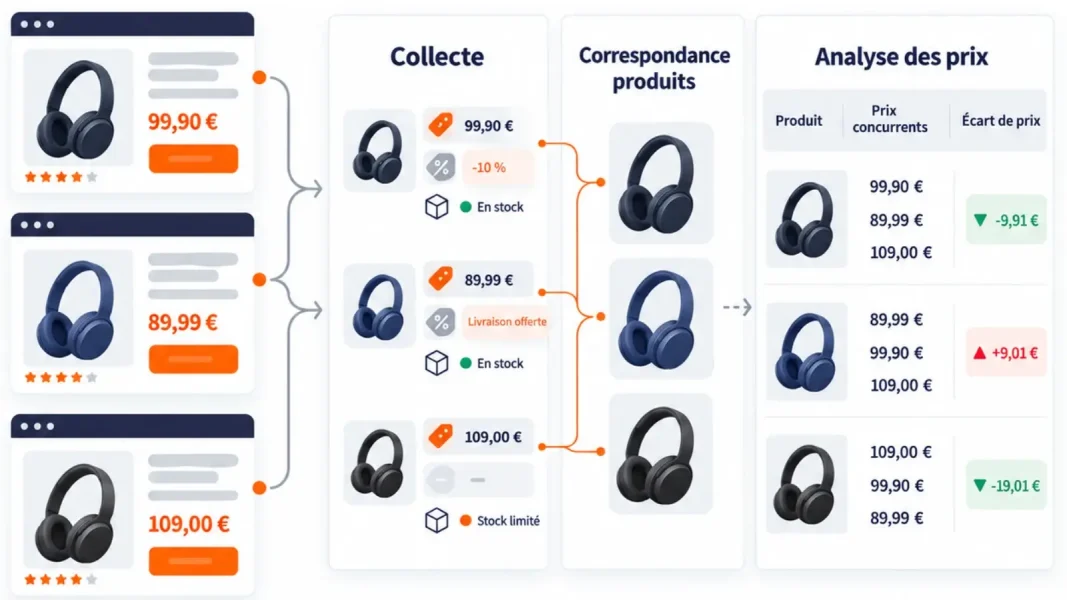
A competitive analysis is essential for strategic price positioning. This involves comparing prices on different channels and determining whether positioning should be aligned with the market, aim for rapid penetration or adopt a skimming strategy. A good reading of the competition enables us to offer a competitive price while preserving margins and avoiding under- or over-valuing the product.
Organic, cosmetics and DIY : uncovering the hidden stakes of pricing
Pricing cannot be one-size-fits-all: each retail sector has its own codes, customer expectations, and profitability levers. To be effective, a pricing strategy must adapt to these specificities.
In
In the cosmetics sector, pricing influences both brand image and emotion. It must reflect the brand’s positioning—whether accessible or premium—while also incorporating trends like clean beauty and vegan products. Be careful with overly frequent promotions, which can undermine perceived value.
In the DIY sector, the logic is different: customers primarily look for technical performance, durability, and good value for money. Here, pricing needs to be competitive, transparent, and consistent across all channels. Bundled offers and seasonal promotions are powerful levers to drive sales.

Pricing strategies
A pricing strategies is the penetration policy, which consists of offering a price lower than the market price in order to rapidly attract customers and gain market share. This approach is particularly well-suited to new products or highly competitive markets, and can rapidly boost sales volumes. However, it requires flexible supply capacity to avoid shortages, and must be calibrated to avoid giving the impression of a “low-end” product.
Conversely, the skimming strategy focuses on launching a product at a premium price to maximize margin in segments willing to pay for perceived value. This approach is often used for innovative or premium products, positioning the product in a high-end segment. It requires precise anticipation of demand and adequate planning of production volumes to avoid shortages or overstocking.
Another key strategy is alignment with the competition, which involves offering a price similar to that of the main competitors. This approach is suitable for mature markets and standardized products, enabling us to remain competitive while maintaining a correct perception of value. It requires regular monitoring of competitors’ prices, in order to adjust positioning without compromising margins.
Finally, perceived-value pricing focuses on what the customer is willing to pay, rather than just the cost of the product. This strategy emphasizes the product’s tangible and emotional benefits, and can increase margins by aligning price with perceived quality. The success of this approach depends on a detailed understanding of customer segments and their expectations, as well as clear communication on the value delivered.
XPA – OptimiX Pricing Analytics: The 360° Pricing Solution
To help companies set the right market price, XPA-Optimix Pricing Analytics centralizes and analyzes market data to provide clear recommendations.
Key features include :
- Detailed analysis of costs and margins for each product.
- Monitoring competitor prices and market trends.
- Simulation of the impact of different pricing strategies.
- Price optimization based on sales objectives and customer sensitivity.
This solution transforms pricing into an analytical and strategic process, enabling companies to make informed decisions, optimize margins and remain competitive.

Setting the selling price: the key stages
1. Develop a coherent pricing strategy: from marketing vision to sales objectives
Before defining your prices, it’s essential to lay the foundations of a clear marketing strategy. This involves precisely identifying your target audience, choosing a suitable positioning whether as a leader, specialist or niche player, and determining which market segments to focus on. This strategic orientation acts like a compass, ensuring that pricing decisions are fully in line with the company’s overall logic.
Once this vision has been established, the pricing policy must be guided by concrete objectives. Do you want to maximize profitability, accelerate stock rotation, reinforce your brand’s price image or conquer new markets? These objectives define the priority axis to be followed, and guide pricing choices towards operational and commercial coherence.
2. Know your costs
Pricing is based on a detailed analysis of costs. This involves distinguishing between direct costs for raw materials, production and distribution, and indirect costs such as marketing, logistics and overheads. The selling price must cover all these costs, while ensuring a margin consistent with the objectives set.
3. Study the market and the competition
Pricing always takes into account the environment. Competitive analysis enables us to situate our offer in relation to other players, to identify customer segments sensitive to price or quality, and to assess the elasticity of demand in the event of price variations. This understanding of the market enables us to anticipate reactions and secure our chosen positioning.
4. Understanding the customer’s perceived value
A price is not just the reflection of a technical calculation; it embodies a promise of value. Some products adopt a low-price logic, as in hard discount or commodity products, while others rely on innovation, expertise or exclusivity to justify added value. The real challenge is to identify how much the customer is willing to pay for the value proposition offered.
5. Develop a consistent pricing policy
On the basis of the above analyses, a clear pricing policy must be drawn up, consistent with the marketing strategy. This policy must be flexible enough to adapt to market trends and customer feedback, while being shared and understood by all the company’s stakeholders. It is this internal consistency that guarantees effective and lasting implementation.
6. Test, adjust and control
Pricing is never set in stone: it is continuously refined. The company must simulate different scenarios to measure the impact on margins and volumes, test several pricing grids via A/B testing or pilot areas, then carefully monitor sales, margins and market reactions. This dynamic approach ensures the agility needed to remain competitive.
7. Rely on data and analytical tools
Finally, modern pricing cannot be conceived without the contribution of data and technology. Pricing solutions such as XPA – Optimix Pricing Analytics make it possible to track competitor prices, centralize data, and simulate the impact of pricing changes. These pricing tools enable you to make fast, accurate decisions, in line with your global strategy.
Turn pricing into a performance lever
Pricing is more than just a technical exercise: it’s a truly strategic approach that combines a detailed analysis of costs, an understanding of customer expectations and alignment with sales objectives. Relevant pricing involves mastering the multiplier coefficient, defining an appropriate margin rate and rigorously monitoring the break-even point. This enables us to maintain sales margins, control gross margins and adjust unit selling prices in line with market conditions.
By integrating the monitoring of fixed and variable costs, companies can ensure that every pricing decision contributes to overall profitability. This approach transforms pricing into a powerful lever for optimizing inventory management, boosting customer satisfaction and loyalty, and securing sustainable value creation.