


Some critical decisions in the supply chain must be made before the actual demand is known.
Companies must commit to procurement, reserve capacity, start production, position inventory, and organize supply flows even before customers have made a purchase. However, these decisions cannot always be corrected quickly. The longer the lead times, the broader the product assortments, and the more complex the distribution networks, the more costly a forecasting error becomes.
That is precisely what makes demand planning essential.
Its role is not to perfectly predict future sales. Rather, it is to reduce uncertainty enough to enable the company to make better decisions before actual demand is known.
Underestimating demand can lead to stockouts, lost sales, rush orders, and a decline in customer satisfaction. Overestimating demand ties up capital, increases inventory costs, and exposes the company to excess inventory, markdowns, or obsolescence.
But the issue goes beyond the total quantity of goods available. It is essential to have the right product in the right place at the right time. The quality of demand planning thus directly influences inventory management, procurement management, production management, and, more broadly, the management of material flows.
So the question isn’t just: “What will demand be?”
Above all, it is: “What decisions do we need to make today, given what we know—and what we don’t yet know—about future demand?”
Demand Planning: Plan to Make Decisions, Not to Eliminate Uncertainty
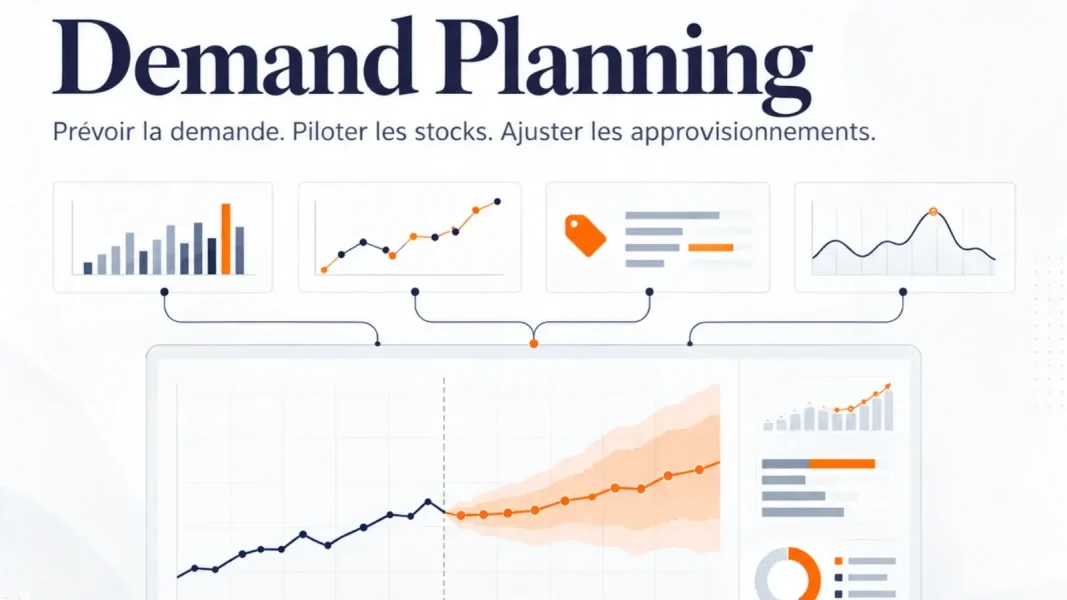
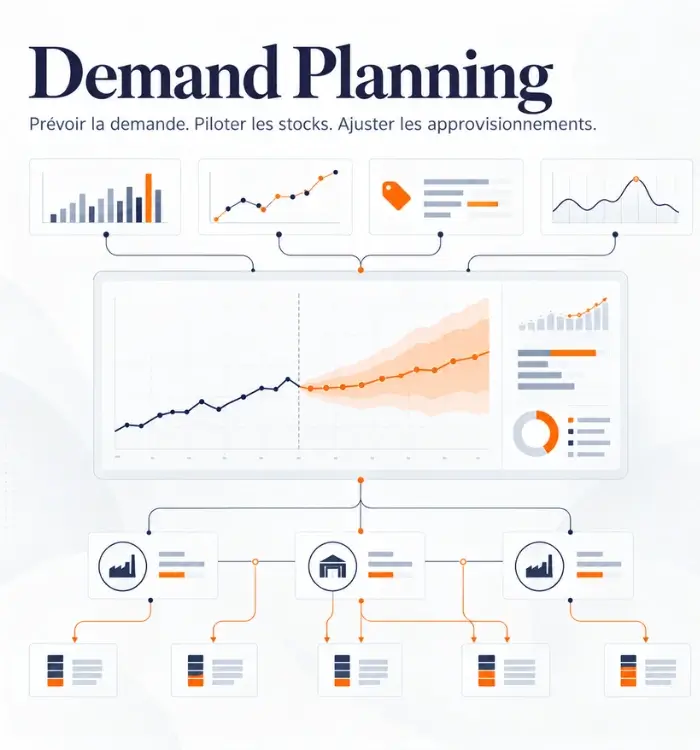
The Demand Planninginvolves estimating future customer demand based on historical data, forecasting models, and business intelligence.
Statistical forecasting is an important component of this process, but it does not encompass the entire approach. Demand planning must also take into account events that could affect demand: promotions, price changes, product launches, changes to the product mix, new store openings, or shifts in purchasing behavior.
This distinction is fundamental.
An algorithm can identify a trend or seasonality. It does not necessarily know the timeline of a planned sales campaign, the impending loss of a customer, or the expected substitution between two products. Conversely, business intuition is not necessarily more reliable than a model simply because it comes from the field.
The challenge, therefore, is to compare the various sources of information, document the assumptions, and gradually assess their contribution to the quality of decisions.
The expected result is not a figure presented as a certainty. It is a regularly updated estimate of what might be requested, accompanied by an understanding of the factors that could cause it to change.
This approach changes the way we evaluate demand planning: A forecast isn’t valuable simply because it’s accurate. It’s valuable when it enables you to make a better decision early enough to still take action.

Why is Demand Planning Essential to Supply Chain Performance?
The supply chain operates with a structural lag: customers may want to be served immediately, while companies sometimes need several weeks or months to source, produce, and ship a product.
This time lag between when a decision must be made and when demand actually becomes apparent accounts for much of the value of demand planning.
The longer or more costly it is to reverse a decision, the more important it becomes to plan ahead.
Reduce stockouts without increasing inventory levels
In the face of uncertainty, a simple solution is to increase safety stock. This strategy can reduce certain stockouts, but it ties up more capital and does not guarantee that the additional inventory will be for the right SKUs or in the right location.
Demand Planning enables a more selective approach to inventory management.
Regular, seasonal, intermittent, or heavily discounted products do not carry the same level of uncertainty or have the same consequences in the event of an error. Similarly, a forecasting error for an item that is easy to restock does not have the same impact as one for a seasonal product ordered several months in advance.
Not all forecasting errors are therefore the same.
The goal should not be to uniformly maximize reserves or even statistical accuracy, but to focus efforts where uncertainty can actually impair service or economic performance.
Demand planning thus helps minimize inventory while protecting the products, time periods, and markets where a stockout would have the most significant consequences.
Provide visibility into procurement and production
Suppliers and industrial sites need visibility to reserve capacity, organize raw materials, and plan their resources.
When information arrives too late, the supply chain must compensate by making schedule changes, arranging urgent procurement, or using more expensive transportation solutions. When volumes are overestimated, however, the supply chain commits resources that may not necessarily be put to use.
Demand Planning provides a time-based view of demand, which helps improve supply chain management and production planning.
It also makes it possible to distinguish between relatively predictable volumes and those that depend on more uncertain assumptions. Teams can then adjust their commitments based on the level of risk rather than treating every forecast figure as a certainty.
This visibility improves the organization’s responsiveness, but above all its agility : it’s not just about reacting faster, but about knowing in advance which decisions can be adjusted if demand deviates from the anticipated scenario.
Prevent uncertainty from spreading throughout the supply chain
A relatively small change in customer demand can lead to much larger adjustments as it moves up the supply chain.
A distributor increases its orders as a precaution. The warehouse increases its requirements. The purchasing department reports an even larger increase to the supplier to secure the volumes. At each stage, the initial uncertainty can be amplified.
The result is paradoxical: the company seeks to protect itself against risk, but in doing so, it actually contributes to creating greater volatility in its logistics flows.
Shared demand planning limits this amplification by providing the various functions with a common reference point and, above all, by making visible the assumptions that explain its evolution.
The quality of information flows then becomes just as important as that of physical flows. Better control of these flows is not simply a matter of moving products more efficiently; it requires that decisions made at every level be based on a consistent understanding of demand.
Place inventory where demand will arise
A company may have sufficient inventory on a global scale and still experience stockouts.
The problem, then, lies less in the total volume than in how it is distributed.
An item may be in excess stock at one warehouse or store and unavailable elsewhere. In an omnichannel environment, this challenge is compounded: the channel through which the customer places an order does not necessarily correspond to the location from which the product will be fulfilled.
Demand planning thus helps manage inventory flows by anticipating not only how many products might be in demand, but also where and when they are likely to be needed.
A sufficiently localized forecast improves initial allocations, facilitates rebalancing decisions, and reduces the need for late transfers.
Supply chain optimization is therefore not just about maintaining the right level of inventory. It involves positioning that inventory at the point in the network where it provides the most value to both the customer and the company.
Planning Promotions and Launches Without Confusing Ambition with Demand
Promotions and product launches are particularly good examples of the limitations of an approach based solely on historical data.
A promotion can boost sales, but its impact depends on its depth, duration, visibility, competing promotions, and cannibalization effects. Some sales may also have been shifted from previous or subsequent periods.
When it comes to a product launch, the uncertainty is even greater because there is no track record specific to that product.
Demand planning then makes it possible to develop assumptions based on comparable products, the distribution plan, product characteristics, and various adoption scenarios. Initial sales are then used to quickly revise these assumptions.
The challenge is not to predict the outcome of the launch with perfect accuracy. It is to detect early enough whether the actual trajectory deviates from the assumptions so that we can adjust supplies, allocations, or production before the deviation becomes costly.
Past sales do not always reflect actual demand
Historical data is generally the starting point for a forecast. But what was sold is not necessarily what customers wanted to buy.
When a product is out of stock, recorded sales decline or drop to zero. This does not mean that demand for it has disappeared.
Some customers postpone their purchases. Others choose an alternative product or buy from a competitor. If the observed sales figures are then used without adjustment to forecast the next period, the company risks misinterpreting a product shortage as a decline in demand.
This can then lead to a vicious cycle: stockouts reduce actual sales, which in turn lead to a downward revision of the forecast; the downward revision reduces future procurement levels and increases the risk of further stockouts.
The system eventually learns the consequences of its own constraints.
The same reasoning applies to promotions, changes in product assortment, store openings and closings, special sales, or data issues.
That is why demand planning cannot be limited to extrapolating from historical data. It must seek to distinguish between three different realities: what was sold, what customers might have wanted to buy, and what they might ask for tomorrow.

Better forecast accuracy is not enough
It is tempting to measure the maturity of demand planning primarily by the accuracy of forecasts.
This measure is necessary, but it tells only part of the story.
An improvement of a few points in forecast accuracy is of little value if it does not influence any decisions. Conversely, detecting a major risk early enough for a few critical items can have a significant economic impact, even if the overall accuracy metric changes only slightly.
The performance of demand planning must therefore be linked to the decisions it supports: inventory management, procurement, capacity, allocation, delivery times, service levels, or cost reduction.
This also means tailoring the forecasting effort to the economic value of the error.
Not all data points require the same level of human attention, the same frequency of review, or the same level of statistical sophistication. Segmentation allows us to focus our analysis on areas where better forecasting can truly improve logistics performance.
The best forecast, therefore, is not necessarily the one that minimizes the average error. It is the one that reduces the errors that matter for the decision.
Linking demand to financial and operational decisions
Demand planning isn’t just about the logistics department.
A change in the projected demand may affect purchases, required capacity, working capital needs, revenue forecasts, and the resources needed for execution.
However, sales, finance, and supply chain teams still frequently work with figures generated using different methodologies.
It is therefore essential to make a distinction: a goal is not a forecast.
The objective describes what the company hopes to achieve. The forecast estimates what seems likely based on the available information.
When these two figures are artificially aligned, there is a risk of aligning the supply chain with a business objective rather than with a well-documented estimate of demand.
Demand planning, on the other hand, creates a common foundation that makes the discrepancy visible.
The organization can then decide how to proceed: step up a marketing campaign, adjust a price, secure supplies, adjust capacity, or explicitly accept a risk.
This is where demand planning goes beyond mere logistics optimization: it becomes an integral part of the company’s decision-making process and helps align business objectives with operational constraints.
From a Single Number to Decision-Making Under Uncertainty
The quest for a perfect forecast can easily lead to a false sense of accuracy.
A mature company must certainly identify the scenario it considers most likely, but it must also understand what could cause demand to deviate from that scenario.
So the right question is no longer just:
“How many are we going to sell?”
It becomes:
“What levels of demand are plausible, what assumptions could cause us to shift from one scenario to another, and what decisions do we need to make in each of these cases?”
This development is transforming the role of demand planning.
The forecast provides a baseline. Uncertainty analysis helps prepare responses. Supply Planning then compares these needs with available capacity. When constraints require broader trade-offs, S&OP helps bring them to the appropriate level.
This approach improves operational management and enables the company to remain competitive without attempting to eliminate uncertainty, which, by its very nature, will never completely disappear.
Demand Planning is, above all, a decision-making system
The value of demand planning does not lie in its ability to predict exactly what will happen.
It comes from the time he gives the company to take action.
Since supplies, production capacity, inventory, and the organization of material flows cannot be adjusted instantly, the company must make certain decisions before all the information is available.
Demand planning makes this uncertainty explicit, distinguishes assumptions from facts, and focuses attention on the variances likely to have the greatest impact.
A mature organization, therefore, does not simply seek to produce a more accurate forecast. It seeks to understand where better foresight can change a decision.
It is this capability that makes it possible to better manage inventory, secure supplies, improve delivery times, enhance customer satisfaction, and support logistics performance without systematically increasing the resources involved.
Over time, this ability to manage workflows and make decisions earlier can become a real competitive advantage.
The quality of demand planning is therefore not measured solely by the accuracy of the forecast, but by the quality of the decisions it enables before actual demand is known.