

Out-of-stocksThese problems are frequent in many companies, and have a direct impact on sales performance, profitability and customer satisfaction. Poor anticipation of demand can disrupt supplies, disrupt production and generate high logistics costs.
In sectors such as mass distribution, specialized retail or e-commerce, not being able to control demand often means suffering events rather than anticipating them. Teams must then manage emergencies: unexpected orders, accelerated transport, stock imbalances between warehouses.
It is precisely to meet these challenges that Demand Planning has become a strategic lever.
Demand Planning is a process for forecasting future demand and aligning sales, operational and logistics decisions. It is based on the analysis of historical data, market trends and consumer behavior, in order to anticipate sales volumes and optimize inventory management.
Integrated at the heart of the supply chain, it enables production, procurement and distribution to be better coordinated. Thanks to information systems such as ERP or WMS, companies can link forecasts to operations and manage their flows more effectively.
Companies that master their Demand Planning gain in responsiveness, reduce out-of-stocks and optimize their inventory levels, while improving their overall performance.
What is demand planning?
Demand Planning is a key supply chain process which aims to forecast future demand in order to align production, supply and distribution with market reality. Demand forecasting makes it possible to anticipate logistical flows, organize the supply of raw materials and ensure the availability of finished products for the end customer. Demand Planning relies on supply chain demand forecasting to align operations
In an industrial or commercial organization, Demand Planning has a direct influence on production management, logistics planning and supply management. A reliable forecast enables production to be planned, material flows to be organized, and logistics service providers for transport and distribution to be coordinated.
Companies implement demand planning approaches in order to anticipate future needs and guide their decisions. This approach, at the heart ofadvance planning, consists in building reliable forecasts based on historical data, trends and market signals. It enables upstream alignment of resources, priorities and action plans, while taking into account the uncertainties and variability of demand. Demand Planning information can then be used to improve scheduling, plan assembly and optimize supply management.
It is important to distinguish between sales forecasting from Demand Planning. Sales forecasting involves estimating future sales, generally based on historical data and the expertise of sales teams. Demand planning, on the other hand, corresponds to actual customer needs. It aims to anticipate and plan demand reliably, based on data analysis and close collaboration between sales, marketing and supply chain teams.
Sales teams, supply chain managers, logistics managers and pricing managers work together to align market demand with operational capabilities. This collaboration improves coordination between production flows, supply flows and logistics distribution.
What is the difference between demand planning and sales forecasting?
Sales forecasting involves estimating the volumes or revenue likely to be generated over a given period. Demand planning encompasses a broader scope: it compares this estimate with the teams’ insights, formalizes the assumptions, and produces a validated demand plan.
It is also important to distinguish between observed sales and actual demand. When an item is out of stock for several days, its sales history shows fewer sales. This decline does not necessarily mean that customers were less interested in buying it. Using sales data without taking availability into account can therefore lead to an underestimation of future demand.
The request plan must also be kept separate from a business objective. A budget expresses an ambition; a forecast describes a trend deemed likely based on available information. Comparing the two makes it possible to identify the actions needed to achieve the objective without artificially altering the estimates.
To learn more, discover the main differences between sales forecasting and demand planning.

Demand Planning and Supply Planning: What Are the Differences?
Demand planning and supply planning are complementary, but they do not address the same question.
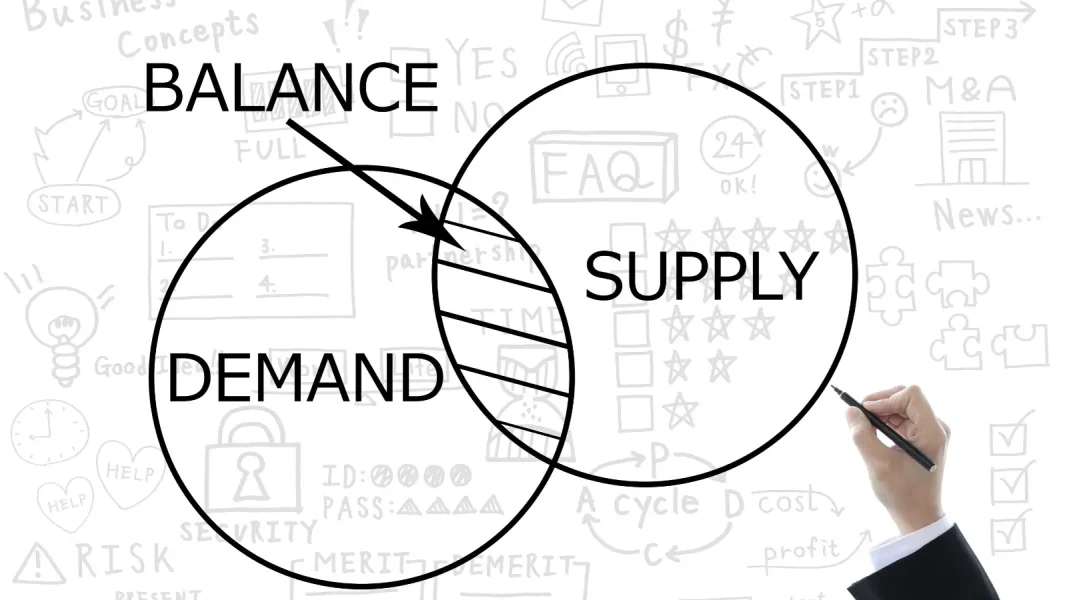
Demand Planning estimates what customers are expected to demand, regardless of immediate production or supply constraints. It develops a forecast of demand by product, time period, and market. Supply Planning then determines how to meet this demand, taking into account available inventory, capacity, lead times, lot sizes, suppliers, and logistical constraints.
In other words, the first identifies the expected need; the second organizes a feasible response.
This separation safeguards the quality of the decision. If the demand forecast is scaled back from the outset to match available capacity, the company loses visibility into the sales it may be forgoing. Conversely, if the procurement plan ignores physical or economic constraints, it remains purely theoretical.
The two processes must therefore interact without becoming confused. When a gap arises between demand and capacity, several options can be considered: increasing production, changing suppliers, prioritizing certain customers, substituting a product, rescheduling a promotion, or accepting a loss in sales. The decision then comes down to an explicit economic choice.
Demand Planning | Supply Planning |
Estimate future demand | Coordinate the response to this request |
Based on sales, events, prices, and market information | Takes into account inventory levels, capacity, lead times, and supplier constraints |
Generates a forecast by product, period, channel, or region | Generates a plan for purchasing, production, distribution, or replenishment |
Highlights the needs and the uncertainty surrounding them | Assess the feasibility and use of resources |
Answers the question, “What should the market demand?” | Answers the question, “How can we fulfill this request?” |
Why is Demand Planning essential?
Without a structured Demand Planning process, many companies face operational difficulties. Poor anticipation of demand can lead to stock-outs that disrupt the supply chain and damage customer relations.
When volumes are poorly anticipated, the company has to organize urgent deliveries or mobilize additional carriers. This increases logistics costs and reduces supply chain performance.
Another common problem is overstocking. A poor estimate of demand often leads to an accumulation of products in warehouses. These inventories tie up cash and complicate logistics management.
In some companies, the lack of coordination between sales, production and logistics teams creates information silos. Decisions concerning procurement, deliveries or the organization of logistics flows are then taken without a global vision of the supply chain.
On the contrary, Demand Planning enables us to improve the management of logistics flows, and to organize supply more coherently. Reliable forecasting helps to ensure the supply of logistics centers, improve distribution organization and boost supply chain performance.
Companies that master their Demand Planning process benefit from greater operational responsiveness and more efficient logistics.
What factors influence forecast quality?
Historical data quality
The quality of forecasts depends heavily on the reliability of the data used. Information from the logistics information system, ERP or management software forms the basis of Demand Planning.
Incomplete or incorrect data can disrupt demand analysis and lead to inappropriate operational decisions concerning production, supply or distribution.
Good traceability of logistics flows and accurate sales tracking improve the quality of forecasts.
Historical depth available
The historical depth of the data also plays an important role. A database spanning several years helps identify consumption cycles, seasonality and variations in demand.
This information facilitates logistics planning and enables production and supply flows to be organized with greater precision.
Selected forecast horizon
The forecast horizon also influences the accuracy of Demand Planning. A short-term forecast enables rapid adjustment of supplies and distribution logistics.
Long-term forecasting enables us to plan production, organize the production line and coordinate supplies with suppliers.
External market volatility
Market volatility is an important factor in supply chain management. Price variations, changes in consumer behavior or competitive developments can rapidly alter demand.
Regular market intelligence enables us to adjust forecasts and improve supply chain responsiveness.
Market intelligence
Market intelligence complements the analysis of historical data. It is based on the observation of market trends, competitive analysis and an understanding of consumer habits.
This market knowledge improves the accuracy of Demand Planning and optimizes operational decisions.

Forecast exceptions to watch out for
One-off exceptions
Certain variations in demand correspond to one-off exceptions. These variations generally appear over a short period and may be linked to promotions, commercial events or temporary changes in consumer habits.
Structural exceptions
Structural exceptions correspond to more lasting variations in demand. When an evolution exceeds a certain threshold over several months, this may indicate a market transformation or the emergence of a new trend.
New trends and anomalies
It is essential to distinguish new market trends from mere statistical anomalies. In-depth market analysis helps identify whether a variation corresponds to a lasting change in consumer behavior or an isolated event.
Effective market analysis is based on adapting the forecasting model to the type of exception observed. This improves the accuracy of Demand Planning and the quality of sales decisions.
Key success factors for Demand Planning
The quality of a Demand Planning process can be assessed on the basis of a number of control points, which can be used to identify whether forecasts are reliable and genuinely useful for steering the business.
- Compare forecasts with actual sales. When forecast volumes remain close to actual sales, the forecasting model correctly reflects market demand.
- Visualize forecast readability. Teams need to be able to understand how a forecast has been constructed, and which market factors influence results.
- Evaluate team confidence. When sales, supply chain and pricing teams base their decisions on these forecasts, it shows that the process is credible.
- Audit the relevance of information. Efficient Demand Planning helps anticipate orders, improve replenishment and better manage inventory.
- Observe the reproducibility of the process. Forecasts must be able to be recalculated regularly using a stable method, to ensure consistent monitoring of demand.
How does demand planning support inventory management and S&OP?
Demand Planning estimates future needs. Supply Planning examines ways to meet those needs while taking resources and constraints into account. S&OP aligns these plans with business and financial objectives to facilitate decision-making across the entire company.
This distinction prevents a forecast from being confused with an order. Forecasting sales of 1,000 units does not mean that 1,000 units must be purchased. The quantity to be ordered depends, among other things, on available inventory, expected shipments, supplier lead times, safety stock, and ordering rules.
Replenishment therefore translates the demand plan into operational requirements. It must take into account the period during which inventory must cover sales, as well as the associated uncertainty. Constraints related to packaging, shelf life, or capacity are then factored into the calculation.
The target service level influences these trade-offs. High availability may require greater protection against fluctuations in demand, but this decision must be weighed against the product’s value, the cost of a stockout, and the risk of excess inventory.
Inventory optimization therefore depends on several coordinated decisions. Even improved forecasting may have no effect if the lead times used are incorrect or if orders are not adjusted in a timely manner. Monitoring must link the quality of the plan to the results achieved.
Forecast vs. reality: how can you better align your Demand Planning?
If several of these control points are not validated, an audit of the Demand Planning process becomes necessary in order to identify sources of error and improve forecast quality.
The gap between forecast and actual demand is one of the main challenges of Demand Planning. When poorly managed, it can lead to stock-outs, over-stocking and disorganized operations.
To improve forecast accuracy, several strategies can be implemented. Data quality is the foundation: reliable, well-structured historical data makes it easier to identify trends and seasonality. It is also essential to incorporate field data—particularly from sales and marketing teams—to enhance forecasting models.
The implementation of a collaborative process, such as the S&OP (Sales & Operations Planning), aligns the different teams around a common vision of demand. Finally, regular monitoring of variances between forecasts and actual sales enables models to be adjusted and Demand Planning reliability to be continuously improved.
En combinant données, collaboration et pilotage continu, les entreprises peuvent significativement réduire l’écart entre prévisions et réalité et gagner en performance opérationnelle.

How do you set up intelligent Demand Planning?
Implement a intelligent demand planning process is not just about producing forecasts, but about structuring a process capable of effectively leveraging data, integrating business expertise, and guiding decisions over the long term. The first step involves ensuring data reliability: clean sales history data, enriched with seasonal trends, promotions, and exceptional events, is essential to accurately reflect market realities.
On this basis, adapted forecasting models can be set up, taking into account product specificities and demand behavior. The aim is to generate dynamic forecasts, capable of automatically adjusting to market trends.
However, Demand Planning performance is not just about models: the integration of business intelligence is essential. Sales, marketing and supply chain teams need to work together to enrich forecasts with their knowledge of the field, and to align decisions.
Finally, truly effective Demand Planning is part of a continuous management approach. Tracking discrepancies between forecasts and actual sales, regularly adjusting models, and automating replenishment decisions all help to gradually improve accuracy and responsiveness. Optimix Solutions’ Forecast & Replenishment solutions facilitate this approach by directly connecting forecasting to operational actions, enabling companies to move from reactive to proactive demand management.
The role of software in effective Demand Planning
Faced with increasingly complex supply chains, companies can no longer rely solely on manual methods or Excel files. The Demand Planning software software has become essential for reliable demand forecasting and improve decision-making.
These solutions make it possible to exploit large volumes of data to generate more accurate forecasts and improveinventory optimization. They also facilitate collaboration between teams by centralizing information in a single tool.
Among these solutions, the Forecast & Replenishment tool from Optimix Solutionsas ademand planning toolenables sales and demand forecasts to be linked to operational decisions, and replenishment strategies to be optimized.
Thanks to advanced algorithms and a collaborative approach, the solution enables :
- significantly improve forecast accuracy,
- reduce out-of-stocks and overstocks,
- automate replenishment decisions,
- quickly adapt plans to market trends.
As a result, some companies have reduce their inventory levels by up to 75%, while while improving their service rate and generating a 4% margin in 6 months through better management.
By integrating forecasting and replenishment into a single platform, Optimix solutions transforms Demand Planning into a genuine performance lever, serving profitability and customer satisfaction.
What metrics can be used to evaluate demand planning?
The reliability of forecasts cannot be summarized by a single percentage. An indicator must always be associated with a scope, a period, and a time horizon. It is also important to use the version of the forecast that was available at the time the decision was made.
The mean absolute error allows you to interpret deviations in the product’s unit of measurement. Weighted metrics, such as WAPE, can provide an aggregated view, but high-volume items play a significant role in them. MAPE requires caution when sales are low or nonexistent.
This bias completes the interpretation. A recurring underestimation can lead to insufficient inventory, while a repeated overestimation can result in surpluses. The convention for determining the sign must be explicitly stated to avoid conflicting interpretations.
It is also helpful to compare the baseline forecast with the version adjusted by the teams. This analysis shows whether business contributions improve the results and in which situations they add the most value.
Finally, dashboards must correlate these metrics with stockouts, availability, excess inventory, and inventory turnover. These results also depend on logistics execution: accurate forecasting does not make up for late deliveries.
Control demand for better supply chain management
In an environment marked by uncertainty and volatility, the ability to anticipate demand makes all the difference between having to endure operations… or managing them.
By combining reliable data, collaborative processes and appropriate tools, companies can significantly reduce discrepancies between forecasts and reality, limit out-of-stocks and optimize their inventory levels. Demand Planning thus becomes a real driver of profitability, agility and customer satisfaction.
But this transformation requires more than just methods: it also requires solutions capable of connecting forecasting to operational decisions. With this in mind, tools like Optimix Solutions’ Forecast & Replenishment enable us to move from a reactive approach to proactive, controlled demand management.
Controlling demand means regaining control of the supply chain.

Frequently Asked Questions About the Demand Planning Process
How much historical data is needed to forecast demand?
There is no one-size-fits-all timeframe. The time series should cover the behaviors to be analyzed and remain representative of current activity. For annual seasonality, having multiple cycles makes comparisons easier. However, historical data may lose its relevance following a significant change in price, supply, or distribution.
How can you forecast demand for a new product?
Forecasts can be based on comparable products, their characteristics, and the number of planned retail locations. Assumptions must take into account ramp-up and potential shifts from other product lines. Initial results can then be used to gradually revise the plan.
Can you do demand planning with Excel?
A spreadsheet may be suitable for a limited scope and a simple process. However, as the number of products, sites, and stakeholders increases, it becomes more difficult to manage versions and make adjustments. The need for a specialized tool arises when maintaining files takes up too much of the time normally devoted to analysis.
Is Artificial Intelligence Replacing the Demand Planner?
AI can automate calculations and help identify changes in demand. The Demand Planner continues to play a role in interpreting data, validating assumptions, and coordinating teams. New developments and business decisions always require business judgment.
What is the difference between demand planning and procurement?
Demand Planning estimates what customers are expected to demand. Procurement determines the purchases needed to meet those needs based on inventory levels, incoming shipments, and supplier constraints. The forecast therefore serves as input data for the procurement calculation.