

Silos between sales, supply chain, finance, and logistics lead to conflicting decisions, excess inventory, or costly stockouts. On a day-to-day basis, it is the supply chain, planning, logistics, and procurement teams that must absorb these misalignments and make quick decisions, often under pressure. Yet these trade-offs directly impact profitability, product availability, and customer satisfaction.
In an environment marked by volatile demand, accelerating product cycles, and increasingly complex supply chains, forecasting sales alone is no longer enough. S&OP software therefore becomes a key driver for ensuring reliable decision-making, aligning key business functions, and securing trade-offs.
A simple forecasting process based on sales history or internal constraints cannot accommodate fluctuations in demand or anticipate financial trade-offs. Supply chain managers then find themselves reacting to emergencies: adjusting inventory levels, responding to stockouts, rescheduling procurement, or resolving conflicts between business objectives and operational constraints. Implementing sales and demand forecasting software improves the quality of forecasts, consolidates data, and ensures consistent decision-making across teams.
Understanding the role of S&OP, its stages, its benefits, and the conditions for its implementation is now a strategic priority, particularly for small and medium-sized enterprises (SMEs) and mid-market companies seeking to strengthen their demand management and improve the overall performance of their supply chain.
What Is S&OP (Sales and Operations Planning)?: Definition and Objectives
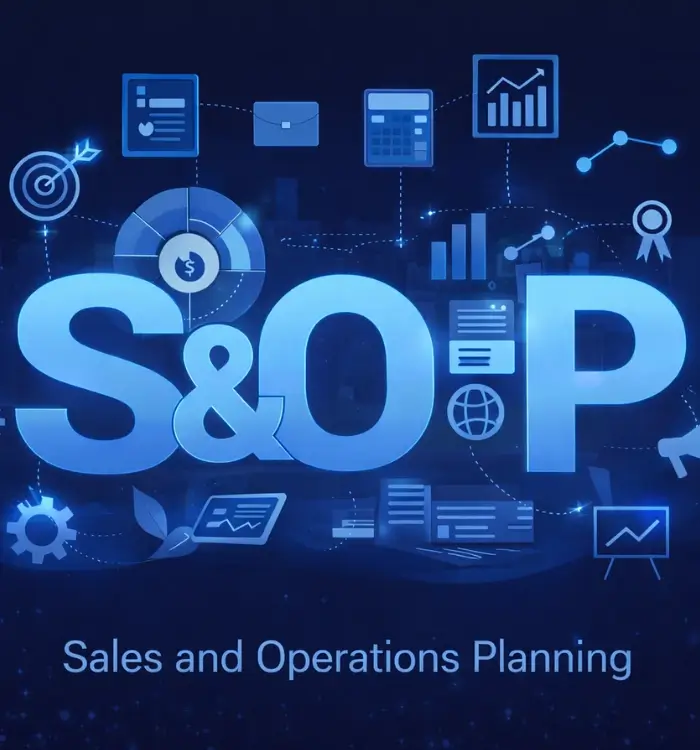
Sales and Operations Planning is an integrated planning process designed to align market demand with a company’s internal capabilities over a medium-term horizon, generally ranging from three to twenty-four months.
Its primary objective is to coordinate key functions (sales, marketing, production, supply chain, finance) around a single, shared plan. S&OP is not limited to consolidating forecasts. It provides a framework for collective decision-making that enables companies to optimize resources, improve service levels, and meet financial goals.
The process is based on collaborative management of sales forecasting, production planning, inventory management, and resource requirements. It ensures that operational decisions are consistent with the company’s strategy and that trade-offs are made transparently.
By implementing an S&OP process, a company reduces inconsistencies across departments, anticipates future needs, and improves its ability to respond to market changes without compromising profitability.
A Process at the Heart of Integrated Planning
S&OP serves as the link between strategy and operational execution. It translates budgetary guidelines and medium-term objectives into a consolidated plan, which is then broken down into detailed operational plans.
It comes before the Master Production Plan and demand planning mechanisms such as MRP. While the Master Production Plan (MPP) organizes precise short-term scheduling, S&OP balances the key volume-capacity-margin equations on a monthly basis.
S&OP is also distinguished from IBP, or Integrated Business Planning. IBP extends the S&OP framework to a broader scope, incorporating the product portfolio, advanced financial planning, and sometimes strategic investment management. S&OP often serves as the first foundational step toward this broader integrated planning.

S&OP (Sales and Operations Planning) : Challenges to Anticipate to Ensure Success
The S&OP (Sales and Operations Planning) process faces several major challenges that must be anticipated to ensure its effectiveness. Data integration and reliability are key foundational challenges: since data comes from multiple and diverse sources (sales, production, finance, logistics), its quality directly determines the plan’s relevance. Synchronizing systems and consolidating reliable metrics are therefore essential prerequisites.
Added to this is the challenge of managing demand uncertainty: since no forecast is perfect, S&OP must incorporate alternative scenarios and adjustment margins to absorb volatility without throwing the organization off balance. Cross-functional coordination is another key factor for success: breaking down silos, clarifying roles, and formalizing explicit arbitration rules—with the involvement of senior management—are essential to ensuring consistency in decision-making.
Finally, the process must remain adaptable to market fluctuations; regularly reviewing assumptions and adjusting the plan in a structured manner helps preserve operational stability while maintaining the agility needed in evolving competitive environments.
To learn more about this topic, we invite you to read our article here
Why is S&OP essential for the supply chain?
Alignment Between Sales, Operations, and Finance
S&OP (Sales and Operations Planning) is essential for the supply chain because it enables sales, operations, and finance to align sustainably around a common plan. It establishes a shared language across departments: sales teams contribute their perspective on the market and growth opportunities, while supply chain and operations teams assess logistics and procurement capabilities, and finance evaluates the impact of decisions on margins, cash flow, and investments.
This alignment transforms sometimes divergent objectives into a coherent and realistic plan, based on a single version of the data and driven collectively. Decisions are no longer based on isolated forecasts or imposed constraints, but on a consolidated and shared vision. A structured S&OP process thus improves internal communication and streamlines decision-making. Discussions take place within a formalized framework that encourages anticipation rather than reacting under pressure.
It strengthens the balance between supply and demand through consolidated and reliable forecasts, enabling companies to adjust procurement and inventory levels based on a realistic view of demand. This approach limits excess inventory, reduces stockouts, and optimizes resource utilization. By incorporating seasonality, operational constraints, and capacity fluctuations into the planning process, S&OP reduces internal tensions and ensures sound trade-offs.
It also enhances competitiveness by providing greater insight into market trends, making it easier to identify risks and opportunities. Finally, it directly contributes to improving service levels: more accurate demand forecasting ensures product availability, makes delivery times more reliable, and sustainably enhances customer satisfaction.
The Role of S&OP Software in Supply Chain Performance
Today, S&OP software is a key driver of performance for industrial and retail organizations. By centralizing data from sales, production, procurement, and finance, it offers a Consolidated and Shared Visibility key indicators. This transparency makes it possible to move beyond fragmented analyses and base decision-making on a comprehensive and coherent vision.
Thanks to its scenario simulation capabilities , decision-makers can assess the impact of a change in demand, a capacity constraint, or a margin target before making a decision. This makes decisions more robust, objective, and aligned with corporate strategy.
Automating consolidations and workflows significantly reduces manual tasks, which are sources of errors and wasted time. Data reliability is enhanced, S&OP meeting preparation cycles are shortened, and teams can focus on analysis, risk anticipation, and value creation rather than on gathering information.
Finally, the S&OP software integrates with existing ERP tools, sales forecasting solutions, and replenishment systems, serving as a cross-functional management layer .. It does not replace transactional systems, but rather structures planning, formalizes trade-offs, and ensures consistency among business objectives, operational capabilities, and financial constraints. This integration strengthens decision-making discipline and contributes to long-term improvements in supply chain performance.
Key Steps in the S&OP Process
An effective S&OP process is not based on a simple monthly meeting, but on a structured sequence that ensures sound decision-making from the operational level all the way up to the strategic level. It begins with consolidating and validating data (forecasts, sales, inventory, market information)—an essential foundation for any meaningful analysis. Next comes the development of the demand forecast, led jointly by the sales and marketing teams, followed by an assessment of the supply chain and procurement teams’ ability to meet that demand.
The identified discrepancies are then analyzed and resolved during a pre-alignment phase, in which various scenarios are compared to balance supply and demand. The cycle concludes with executive approval, ensuring consistency between the selected plan, operational constraints, and the company’s strategic objectives.
To gain a detailed understanding of the role and challenges of each step, see our article on the key steps in the S&OP process.

Difference Between S&OP and IBP (Integrated Business Planning)
S&OP and IBP share the common goal of aligning market demand, internal capacity, and financial objectives, but their scope and level of integration are not the same.
S&OP focuses on balancing supply and demand over the medium term. It aligns sales forecasts, production planning, logistics capacity, and financial constraints within a structured monthly cycle. Its role is to ensure operational and economic consistency over a period of several months by balancing volumes, resources, and priorities.
IBP, or Integrated Business Planning, expands on this approach. It more closely integrates detailed financial planning, product portfolio management, strategic priorities, and, in some cases, the longer-term investment trajectory. Whereas S&OP consolidates an operational plan aligned with financial objectives, IBP aims for complete integration between strategy, finance, and execution, with greater analytical depth.
The distinction, therefore, is not merely a matter of terminology, but rather a matter of organizational maturity. S&OP often serves as a foundational first step toward more integrated management. It establishes cross-functional discipline, formalizes trade-offs, and creates a common decision-making framework. IBP then builds on this foundation to strengthen the alignment between the product portfolio, financial performance, and growth trajectory.

How do you implement an S&OP planning process in a company?
Implementing an S&OP planning process in a company requires, above all, a structured and step-by-step approach.
The first step is to define a clear framework: scope (products, entities, markets), planning horizon, data granularity, and the roles of the various functions. Reliable sales and demand forecasts are an essential prerequisite, requiring the consolidation of historical data, the integration of sales information, and the establishment of shared performance metrics.
Implementation then relies on establishing a structured monthly cycle, organized around a series of reviews: a review of demand, a review of capacity and supplies, financial trade-offs, and finally an executive approval meeting. Each step must be based on consolidated data and comparative scenarios to inform decision-making.
The use of an S&OP tool or software facilitates the centralization of data, ensures the reliability of assumptions, and formalizes scenarios, while guaranteeing a single, shared version of the plan. Finally, the success of S&OP depends heavily on team buy-in, clear lines of responsibility, and the organization’s ability to foster a culture of collaboration and foresight—an essential condition for transforming planning into a true driver of performance.
S&OP: Driving Overall Performance
S&OP transforms the way a company manages its performance and growth trajectory. By linking strategic objectives to operational decisions, it aligns demand forecasts, supply chain constraints, and financial goals around a single, coherent, and realistic plan. Planning thus becomes a comprehensive management tool, capable of structuring decisions related to volumes, inventory, business priorities, and investments.
Its impact is directly measured in terms of profitability: better alignment between demand and capacity reduces excess inventory, minimizes obsolescence, and lowers costs associated with logistical emergencies. At the same time, anticipating demand fluctuations improves service levels, ensures product availability, and enhances customer satisfaction.
In the medium term, companies’ competitiveness will depend less on their ability to react than on their ability to anticipate and make effective trade-offs. S&OP provides this sustainable decision-making discipline.