

S&OP (Sales and Operations Planning) is an integrated management process designed to continuously align market demand, operational capacities and the company’s financial objectives. It enables a realistic, shared and arbitrable plan to be drawn up over a medium-term horizon.
Understanding the S&OP principle is the first step. Implementing it effectively and reproducibly is another. This page focuses on the operational functioning of S&OP, step by step, with a logic applicable to any company. The aim is to show how to structure a clear, rhythmic and controllable cycle, which transforms planning into a genuine performance lever.
S&OP relies on a rigorous process, quality data and collective discipline in decision-making.
In this article, we detail the key stages of the S&OP cycle, from the construction of the demand forecast to the validation of the plan and its long-term management, in order to understand how to set up a structured, efficient and truly decision-making process.
Understanding the S&OP cycle as a monthly iterative process
A steering ritual, not just a meeting
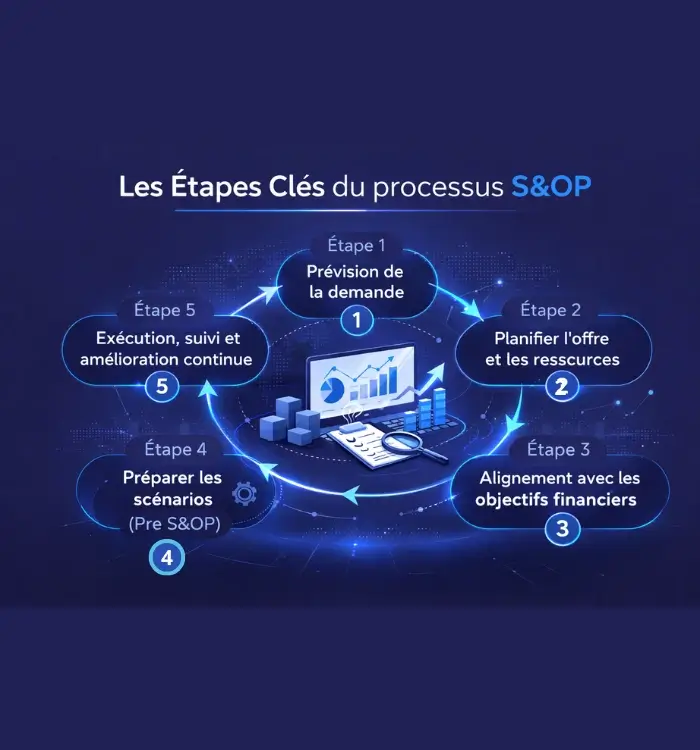
S&OP (Sales operating Planning) is part of a structured management loop that continuously links available data, their analysis, managerial arbitration and operational execution. Each month, information is consolidated, discrepancies are analyzed, several scenarios are constructed and a single plan is validated before being rolled out to operations.
The planning horizon generally covers 3 to 24 monthsThe monthly rhythm enables us to capture market trends while maintaining a stable framework, essential for securing production, supply and customer commitments. The monthly rhythm enables us to capture market trends while maintaining a stable framework, essential for securing production, supply and customer commitments.
The S&OP plan is not set in stone: it evolves with each cycle. Its aim is not to “predict perfectly”, but to create a common frame of reference enabling the company to be managed with consistency and anticipation.
The S&OP cycle is generally structured around four successive meetings, as it cannot be reduced to a single monthly meeting. In practice, this process is based on rituals that provide a framework for decision-making and avoid improvised arbitration. The Demand Review consolidates and validates sales and demand forecasts. The Supply Review then aims to analyze the company’s capacity to meet this demand, integrating supply, production and logistics constraints.
The Pre S&OP meeting enables us to compare possible scenarios, identify discrepancies and prepare decisions. Finally, the Executive S&OP corresponds to the validation of the single plan by management. This progressive sequencing ensures that the executive meeting does not become a technical debate, but a genuine moment of strategic arbitration based on structured analyses.

Steps to building an effective S&OP process
Step 1 – Data Management
The first step in the S&OP process is to collect, validate and consolidate all the data required for planning. This includes sales histories, forecasts, stock levels, orders in hand, available capacities, as well as supply and logistics constraints.
The aim of this phase is to guarantee a single, coherent information base, shared between the various functions. Data quality is crucial, as it determines the reliability of analyses and decisions made throughout the S&OP cycle. Incomplete or inconsistent data undermines the entire process.
Step 2 – Building the demand forecast (Demand Review)
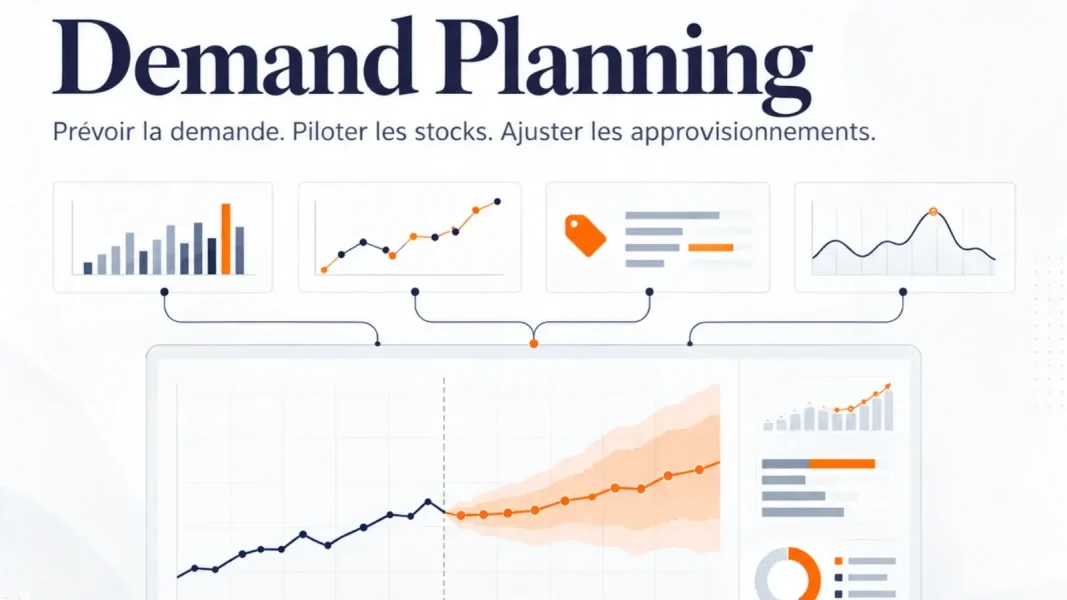
The S&OP cycle begins with the construction of a structured, consolidated demand forecast. Historical sales are an indispensable basis, but they are not sufficient to produce a reliable vision. To be relevant, the forecast must integrate all factors likely to modify the trajectory, such as seasonality, planned promotions, product launches and innovations, end-of-life and delistings, cannibalization effects between ranges, changes in distribution channels, price changes, as well as market signals from competitors.
It must also take into account the order book or backlog, so as to align the projection with commercial reality. This collection and consolidation phase directly conditions the quality of the S&OP plan and the company’s ability to anticipate.
The level of data quality directly conditions the reliability of the plan. The aim of S&OP is not to mechanically extend a statistical trend, but to build a realistic forecast that takes account of business events.
Build a single version of the request
The forecast derived from statistical models is a starting point. The sales and marketing teams challenge it and adjust it according to signals from the field. Finance checks consistency with budget targets. The supply chain identifies the impact on inventories and workloads.
The key challenge is to produce a single version of the application. An organization cannot manage effectively if each function retains its own assumptions. S&OP then becomes a tool for alignment: it transforms multiple visions into a single frame of reference.
Step 3 – Supply and resource planning (Supply Review)
Analysis of capacities and constraints
Once demand has been consolidated, the company analyses its actual capacity to meet it by comparing the forecast workload with the resources actually available. This stage involves a structured assessment of machine and production line capacities, workforce availability, and industrial constraints such as changeover times, yields or maintenance stoppages.
It also takes into account supplier constraints such as lead times, minimum order quantities (MOQs) or critical dependencies, as well as logistical capacities in terms of transport, storage and warehousing. Finally, regulatory or quality requirements likely to limit operational flexibility must be taken into account to obtain a complete and realistic vision of the company’s capacity to serve forecast demand.
This phase highlights potential imbalances between load and capacity. It enables us to anticipate periods of tension and prepare for trade-offs rather than suffer outages or overloads.
Drawing up a supply and production plan
Forecast demand is then converted into volumes to be produced or supplied, integrating expected quantities, lead times, target stock levels, safety stocks, component requirements and incoming and outgoing flows. This transformation also makes it possible to assess logistical absorption capacity and check that the plan remains consistent with industrial reality.
Financial impacts are analyzed in a structured way, notably on working capital requirements, logistics costs, production costs and inventory levels. This is a key step in the S&OP process, as it provides a concrete link between sales vision and operational execution, and ensures that sales ambitions are based on realistic, robust and sustainable foundations.
Step 4 – Alignment with the company’s strategic objectives
Translating the plan into an economic trajectory
The plan constructed in the previous stages must now be aligned with the company’s financial trajectory. Forecast volumes are translated into sales, margins and financing requirements, while the impact on cash and inventory levels is assessed in a structured way. The S&OP process thus enables operational decisions to be concretely linked to overall economic objectives, and verifies that industrial planning supports the expected financial performance.
Balancing ambition and constraints
Gaps often arise between sales ambitions and available operational capacities. Adjusting the product mix, smoothing out certain volumes or reviewing priorities may prove necessary to preserve the overall balance. The S&OP cycle provides a formal framework for organizing these trade-offs, avoiding decisions taken under pressure, and maintaining consistency between strategy, capacity and economic results.

Step 5 – Prepare scenarios (Pre S&OP)
Preparing scenarios
Before the executive meeting, the teams draw up several scenarios to inform decisions and structure trade-offs. In practice, three options are generally sufficient: a central scenario, corresponding to the most probable hypothesis; a cautious scenario, incorporating a market slowdown, cash constraints or a logic of risk reduction; and an ambitious scenario, based on a growth dynamic, reinforced promotions or higher volumes.
To be comparable and truly exploitable, these scenarios need to be analyzed according to a common grid including expected service rate, stock levels and obsolescence risk, production and logistics costs, impact on margins and cash flow, and level of capacity tension. The aim of Pre S&OP is precisely to clarify sticking points ahead of the management meeting, so that the Executive S&OP remains a moment of strategic arbitration and not a technical debate.
Decisions and validation of a single plan
At the S&OP meeting, management examines the scenarios and validates a consolidated plan that commits the entire organization. The plan adopted becomes the reference for the month ahead, and serves as the framework for operational execution. Formalizing decisions and compromises ensures consistent management and clarifies priorities for all teams.
Stage 6 – Operational implementation and management (S&OE)
Turning the plan into concrete action
Once the S&OP plan has been validated, it needs to be translated into operational processes and transformed into concrete, executable decisions. This step is essential, as it enables us to move from a medium-term trajectory to a detailed organization of industrial and logistics flows. The S&OP plan then becomes a frame of reference that guides day-to-day decisions in production, procurement and distribution.
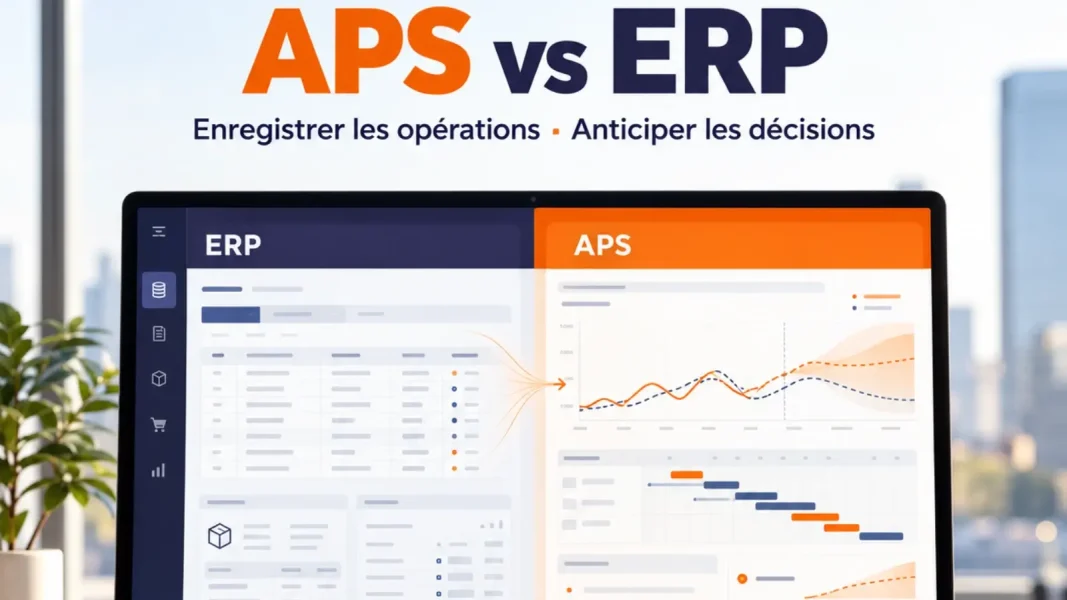
In concrete terms, the plan is translated into detailed planning tools and processes, notably through the master production plan (MPS), the calculation of material requirements (MRP), supplier planning, scheduling, and the organization of transport and storage flows. This ensures that the assumptions validated by the S&OP committee actually materialize in operations, and that teams have a coherent plan to secure execution.
S&OP thus sets the overall trajectory, while operational processes ensure its transformation into detailed decisions. The challenge is not just to produce a plan, but to ensure that it is actually applied, and that it really drives the business.
Week-by-week control with S&OE
In an unstable environment, a monthly S&OP cycle is not enough to absorb the vagaries of execution. Variations in orders, supplier delays, industrial incidents or logistical constraints can quickly create a significant gap between the validated plan and reality on the ground. To maintain control, S&OP must therefore be complemented by a short-term steering process, often referred to as “short term steering”. S&OE (Sales and Operations Execution).
S&OE functions as a weekly or even bi-weekly control loop, designed to manage operational deviations without permanently calling into question the trajectory defined by S&OP. It enables actions to be prioritized, emergencies to be arbitrated and customer commitments to be secured, by rapidly dealing with events such as supplier delays, order peaks, shortages, production contingencies or customer prioritization arbitrations.
Without S&OE, S&OP runs the risk of remaining theoretical, as daily execution imposes its own urgencies and ends up gradually misaligning teams. Conversely, a structured S&OE helps maintain consistency between the medium-term plan and operational reality, while reinforcing the company’s ability to react to unforeseen events.
Step 7 – Implementation, monitoring and continuous improvement
Once the S&OP plan has been validated, it must be translated into concrete actions within operations. The plan is then translated into detailed planning, scheduling, purchasing and logistics tools, to ensure that execution is consistent with the assumptions made during the cycle. This operational deployment phase ensures alignment between the medium-term trajectory defined and the day-to-day decisions taken by supply chain teams.
However, S&OP only creates sustainable value if it is part of a continuous improvement process. At each cycle, actual performance is compared with the validated plan in order to measure deviations, analyze root causes and adjust assumptions for subsequent cycles. Indicator monitoring thus becomes a pillar of management, transforming S&OP into a genuine learning system.
The KPIs monitored generally cover three complementary dimensions: forecast quality (Forecast Accuracy, Forecast Bias), operational performance (service rate, OTIF, adherence to plan, capacity utilization) and economic performance (stock rotation and coverage, backlog, obsolescence, cash impact and WCR). The aim is not to multiply the number of indicators, but to select those that really enable us to anticipate, alert and secure trade-offs.
Over time, this analysis and feedback loop reinforces the robustness of the process, improves forecast reliability, stabilizes stock levels and reduces emergency decisions. It is this iterative dynamic that makes S&OP a sustainable lever for performance and competitiveness.

The keys to a successful S&OP process
The success of an S&OP process depends first and foremost on a structuring framework. Defining the right planning level is an essential prerequisite: steering should generally not be carried out at SKU level, which is too detailed and complex to maintain over time. An aggregated level, by product family, segment or business unit, enables us to build a coherent and exploitable trajectory, while fine planning is handled by downstream operational processes (MPS, MRP, scheduling). The aim of S&OP is to align and arbitrate, not to manage detailed execution.
The structuring of the time horizon is just as decisive. Distinguishing between a frozen zone, a flexible zone and a strategic zone clarifies the room for manoeuvre and avoids calling into question decisions that have already been made. In this way, the process can focus on the really relevant trade-offs and anticipate high-impact decisions.
Governance and the involvement of key functions also determine the effectiveness of the system. Sales, marketing, supply chain and finance teams must actively contribute at every stage, while management intervenes to arbitrate when divergences arise. A formal framework defining responsibilities, timetables and decision-making rules guarantees the consistency and continuity of the process.
Finally, data reliability, monthly cycle discipline and transparency between functions reinforce the robustness of S&OP. Appropriate tools facilitate the consolidation of information, the preparation of scenarios and the monitoring of indicators, provided they remain at the service of governance. When it is structured, regular and shared, S&OP becomes a real lever for steering and sustainable performance.
How do you start a short-term S&OP process?
It’s best to start with a clear, controlled scope. A consolidated forecast, a coherent supply plan and a structured monthly meeting form a solid basis for building an effective S&OP process.
Maturity then develops progressively. The process may incorporate more advanced scenarios, greater consideration of financial aspects, or the support of specialized tools. The key to success lies in the consistency of the process, the regularity of the cycle and the involvement of key functions.
A structured S&OP links medium-term vision with operational execution. It improves internal coordination, secures supply chain performance and strengthens the ability to anticipate market trends.
S&OP: an iterative process for anticipation and consistency
S&OP is first and foremost a structured management process that transforms a business vision into a coherent operational and financial plan. Its value lies not only in the quality of forecasts, but also in the company’s ability to orchestrate, month after month, a disciplined cycle of consolidation, analysis, scenario-building and arbitration.
By following clearly defined stages – demand construction, capacity analysis, financial alignment, scenario preparation, executive validation, operational implementation and short-term management – the company acquires a robust framework for anticipating rather than undergoing. S&OP then becomes a concrete decision-making tool, capable of securing service levels, controlling inventories, optimizing resources and steering economic performance.
When properly governed and regularly animated, the S&OP cycle creates a common language between sales, operations and finance. It reinforces the coherence of decisions, improves responsiveness to unforeseen events, and establishes a dynamic of continuous improvement. More than just a planning process, S&OP becomes an essential strategic lever for sustainably aligning operational execution with growth and profitability objectives.