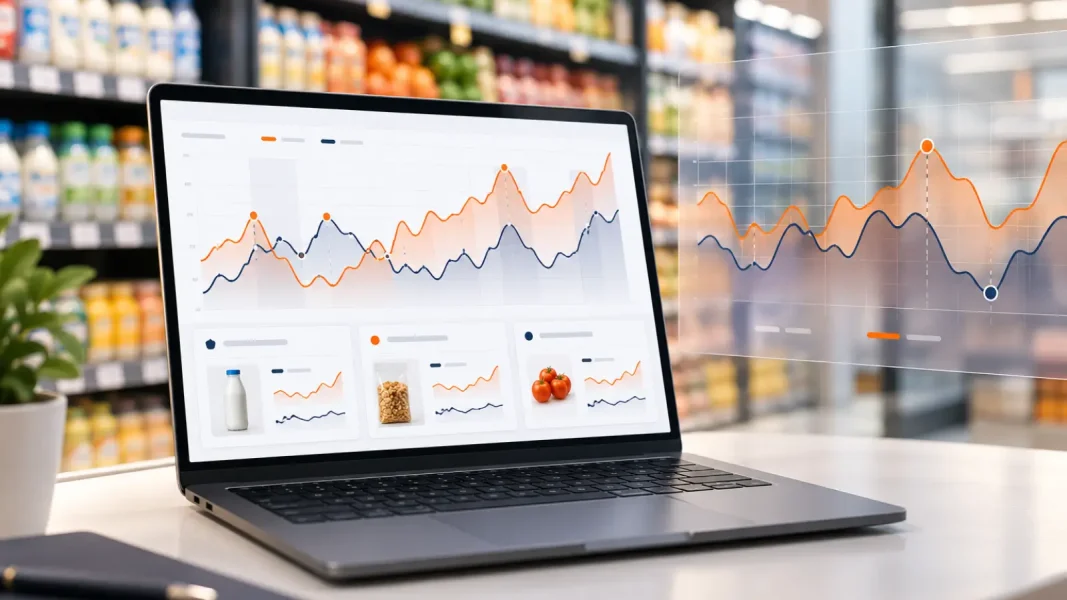




Understanding why some products succeed so quickly, while others struggle to sell, is a central issue for any company. Behind these differences in performance usually lies a fundamental mechanism: the balance between supply and demand.
To decipher this dynamic, companies rely on market research and market analyses to analyze the market, understand their target market, consumer habits and the expectations of potential customers. This market-analysis approach enables us to gain a good understanding of the market, identify potential markets and adjust strategic decisions.
When this balance is poorly anticipated, the effects are quickly felt: poorly positioned prices, costly overstocking or out-of-stock situations.
Conduct an in-depth analysis of supply and demand based on both quantitative and qualitative data, enables us to better anticipate imbalances. It provides a more accurate view of the market, sheds light on opportunities and helps build a more relevant and structured sales strategy.
What is a supply-demand analysis?
Supply and demand analysis involves studying the market in depth to understand the interactions between the companies present on the market and consumers.
It is based on several complementary dimensions. Supply-side analysis enables us to analyze market players, the sector of activity, existing market offerings and the positioning of each competitor. Demand analysis, on the other hand, is aimed at understanding buying behavior, the their needsexpectations of future customers and their habits.
This approach is part of a broader marketing study, combining a quantitative study (figures, volumes, prices, market volume) and qualitative analyses based on marketing surveys, fieldwork or collected data. The information gathered enables us to assess market potential and the viability of a project.
In economic terms, this relationship is represented by two curves. Demand illustrates the reaction of consumers to price variations, while supply reflects the capacity of companies to offer their products. Their intersection corresponds to market equilibrium, a key benchmark for adjusting pricing, positioning and business models.
Rigorous analysis enables us to analyze markets, identify imbalances and detect opportunities to launch a new product. new product or enter a niche.

Benefits for companies
Setting optimal prices based on equilibrium
One of the major benefits of supply-demand analysis lies in the definition of a relevant pricing strategy. A price poorly adjusted to demand has a direct impact on sales and sales forecasts.
By integrating forecasting and elasticity models, companies can better quantify the impact of pricing decisions. This approach is essential for business plans and start-up projects, to ensure feasibility and profitability.
In retail, it is not uncommon to observe that a 5% price cut generates a 12% increase in sales. These analyses enable us to arbitrate between volume and margin, while remaining competitive.
Anticipating market trends
The study of supply and demand enables us to identify market trends and major consumer trends.
By analyzing demand trends, companies can target target new segments, adapt their offer and gain market knowledge. This ability to anticipate is essential for develop the market and stay competitive.
In some cases, a rapid rise in demand can reveal opportunities for a new project, or for bringing a new offering to market ahead of the competition.
Identify positioning opportunities
In-depth analysis allows us to identify segments where demand exceeds existing supply.
These opportunities are essential for identifying new markets, refining segmentation and improving targeting. In this way, a company can adapt its offer, reinforce its differentiation or capture new customers in a specific geographic area or catchment area.
In some sectors, these opportunities arise when existing offers do not fully meet consumer expectations.
Optimize inventories and reduce losses
Demand management is also essential to optimize operational management.
Thanks to a customer analysis and data frommarket researchcompanies can adjust their volumes and improve their supply chain.
This avoids stock-outs, but also overstocks, which have a direct impact on profitability and the smooth running of the of the company.. Optimized management also helps to improve the performance of points of sale.
Supply and demand analysis is more than just a theoretical exercise or a simple market research stage. It is a genuine decision-making tool, at the heart of a company’s economic performance.
By structuring the analysis of customer behavior, competitive dynamics and pricing mechanisms, it transforms data into concrete levers for action. Pricing, positioning, resource allocation or inventory management: every decision gains in precision when it is based on a detailed understanding of market equilibrium.
In an environment where cycles are accelerating and consumer expectations are changing rapidly, companies that master these analyses have a clear advantage. They are no longer subject to the market, but rather anticipate and even influence it.
Integrated from the earliest stages of a project, whether it’s a launch, expansion or optimization, this approach not only helps to secure decisions, but also to identify sustainable growth drivers.
In other words, a well-exploited supply-demand analysis not only serves to understand a market: it becomes a real driver of competitiveness and value creation.
Manage performance with a clear understanding of the market
Supply and demand analysis is more than just a theoretical exercise or a simple market research stage. It is a genuine decision-making tool, at the heart of a company’s economic performance.
By structuring the analysis of customer behavior, competitive dynamics and pricing mechanisms, it transforms data into concrete levers for action. Pricing, positioning, resource allocation or inventory management: every decision gains in precision when it is based on a detailed understanding of market equilibrium.
In an environment where cycles are accelerating and consumer expectations are changing rapidly, companies that master these analyses have a clear advantage. They are no longer subject to the market, but rather anticipate and even influence it.
Integrated from the earliest stages of a project, whether it’s a launch, expansion or optimization, this approach not only helps to secure decisions, but also to identify sustainable growth drivers.
In other words, a well-exploited supply-demand analysis not only serves to understand a market: it becomes a real driver of competitiveness and value creation.