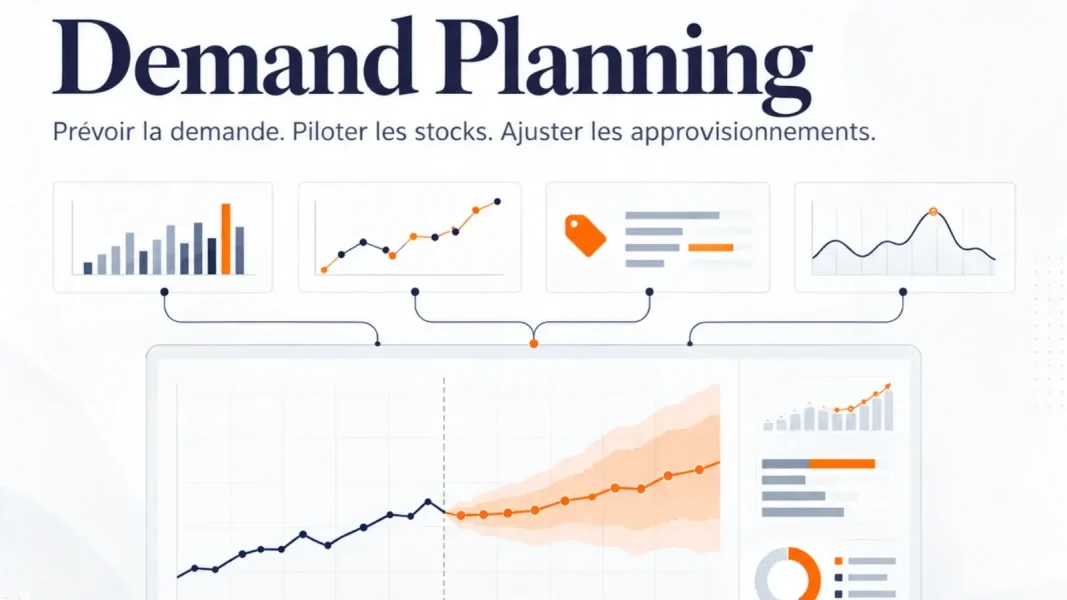




La prévision des ventes est au cœur du pilotage commercial. Elle influence directement des décisions clés : planification des ressources, gestion des stocks, organisation des équipes ou encore construction budgétaire. Lorsqu’elle est fiable, elle apporte de la visibilité, sécurise les opérations et aligne l’ensemble de l’entreprise autour d’objectifs cohérents.
Yet, in many organizations, forecasting remains a source of uncertainty: limited visibility into future demand, imbalances between stockouts and overstocking…
Ces difficultés ne proviennent pas d’un manque d’implication, mais de faiblesses structurelles in the way forecasts are constructed. Poorly exploited data, poorly formalized processes, lack of coordination… these are just some of the factors that undermine the reliability of forecasts, and weaken both operational and strategic decisions.
The good news is that these pitfalls are not inevitable.
With a more rigorous, collaborative and tool-based approach, forecasting can become a genuine performance levercapable of improving cost control, boosting responsiveness and sustaining growth.
In this series, we take a look at the five major mistakes to avoid to make your sales forecasts more reliable, and the concrete levers you can use to sustainably improve your forecasting process.
Data errors
One of the main causes of error in sales forecasting lies in the quality of the data used upstream. Incomplete sales history, erroneous data entry, erratic consumption or even duplicate entries can distort the calculation base and introduce significant biases into the results. Missing or incorrectly entered data can, for example, be misinterpreted as a drop in demand, leading to underestimates and stock-outs. Conversely, an unjustified spike can lead to overvaluation and costly overstocking. This is what could happen if you use an Excel-type file to manage your forecasts. We’ve covered the subject in depth here: why you should abandon Excel if you want to manage your sales.
But simply providing clean data is not enough. It is essential to enrich time series with contextual information such as seasonality, promotions, stock-outs, product launches or exceptional events (strikes, bad weather, health crises…). In their absence, the model cannot distinguish a true underlying trend from a one-off or exogenous effect. This lack of context prevents the algorithm from generalizing correctly and making reliable medium- or long-term predictions.
So, to make forecasts more reliable, it is crucial to implement a rigorous process of data cleansing, consistency checks and enrichment. Only then can the forecasting tool become a genuine lever for strategic management.
Wrong choice of software
The choice of software used to produce sales forecasts plays a decisive role in the reliability of the process. Relying solely on a spreadsheet or ERP system with no statistical engine is not viable in the medium term. These tools, although useful for operational management, quickly show their limits in a context where demand volatility, multiple sales channels and product complexity demand greater reactivity and precision. The risk of manual error is high, calculations are time-consuming and unreproducible, and fine data analysis quickly becomes impossible as the volume of information increases.
In addition, unsuitable software cannot be used to implement a structured demand planning approach, or to align sales forecasts with the company’s financial objectives. It lacks advanced functionalities such as scenario modeling, automatic recalibration of forecasts, integration of performance indicators (variances, coverage rates, correlations) or collaboration between the various departments involved (supply chain, marketing, sales).
Investing in specialized software, capable of cross-referencing internal and external data, modeling consumption behavior and providing dynamic dashboards, is becoming a necessity for any company wishing to secure its supply chain, optimize inventory and gain agility.
Optimix Forecast and Replenishment is a sales forecasting software that stands out for its ability to produce reliable estimates through the intelligent use of historical data. By applying appropriate statistical methods, such as exponential smoothing or regression, it accurately anticipates seasonal fluctuations. The solution allows you to visualize data in customizable tables, monitor discrepancies between forecasts and actual sales, identify sources of error, and manage adjustments collaboratively. Connected to ERP and planning tools, it helps secure inventories and industrialize the sales process, while establishing itself as a genuine decision-making tool.
If you’re wondering how to choose your forecasting software, we’ve written a complete article here

lack of rigorous sales forecasting methods
It’s one of the most widespread mistakes, and yet one of the most costly: basing sales forecasts on intuition, personal experience or a few empirical signals. Many sales teams still build their estimates “by feel”, extrapolating results from the previous month or relying on impressions from the field. The problem is that these approaches lack reliability and create a distorted vision of reality.
Without a structured method, forecasts become unstable, difficult to defend and even more difficult to use to steer business. The consequences are immediate: unrealistic targets, poorly calibrated budgets, wrongly sized inventories, tension between teams and strategic decisions taken on shaky foundations.
In an environment of fast-moving markets, changing customer behavior and increasing competition, intuition alone is no longer enough. It can be useful, but it needs to be backed up by a solid approach.
To make forecasts more reliable, it’s essential to rely on a rigorous approach combining data, analysis and collective intelligence.
1. Use statistical analysis Historical data can be used to identify trends, cycles, breaks and weak signals. Quantitative methods provide an objective, measurable and reproducible basis. They also reduce the impact of cognitive biases, which are very present in intuitive forecasts.
2. Integrate proven forecasting models Depending on the context, different models can be mobilized: regressions, temporal models, probabilistic approaches, or even machine learning tools. The aim is not to add complexity, but to provide consistency and precision.
3. Encourage a collaborative approach The best forecasts are rarely the fruit of a single department. They emerge from the cross-fertilization of information from sales, marketing, finance, supply chain and customer service. Each has a part to play in market reality. Collaboration enriches models, challenges assumptions and reinforces support for results.
To find out more, we’ve covered the subject in depth here
Not involving teams in sales forecasts
It’s one of the most underestimated pitfalls: building sales forecasts in a closed office, between a few decision-makers, without integrating those who are closest to the field. Many companies still draw up their forecasts centrally, assuming that the teams will follow. But a forecast built without the teams is often a forecast disconnected from reality.
When sales, marketing, supply chain or customer service are not involved, several problems arise:
assumptions do not reflect market signals,
the objectives lack credibility,
adhesion is low,
and the gap between forecast and reality is exploding.
And yet, operational teams possess a wealth of information: customer feedback, emerging trends, obstacles in the field, competitive reactions, weak signals… Ignoring these insights means depriving ourselves of an essential part of the market’s truth.
To obtain reliable forecasts, it is essential to create a participative process in which each team contributes to the construction of the scenario.
1. Involve sales reps in information feedback They are in direct contact with customers. Their perception of purchasing intentions, obstacles, opportunities and risks is a major asset. But beware: their contribution needs to be supervised to avoid bias towards optimism or excessive caution.
2. Integrate marketing to enrich vision Marketing brings an understanding of campaigns, product launches, market trends and consumer behavior. Their role is key to anticipating variations in demand.
3. Mobilize the supply chain and operations They provide a realistic vision of capacities, logistical constraints and lead times. Their involvement helps avoid forecasts that are disconnected from actual capacities.
4. Create a structured collaborative process Regular meetings, shared indicators, common tools, transparent arbitration… Collaboration must not be informal: it must be organized, paced and managed.

How can you improve your sales forecasts?
1. Structuring and cleansing data
Start with good data hygiene: clean up extreme points, segment each product, and archive specific events in your time series. A good model relies on a reliable sales history.
2. Choosing the right method for each family
Adapt your forecasting methods to the profile of your references. Highly seasonal products require different treatment from stable products. For a new product, use an analogical method or a linear adjustment by category.
3. Use a professional tool
Opt for analysis software like Optimix. It offers automatic modeling, variance analysis, integration of exogenous data and generation of financial forecasts integrated with your business plan. This enables you to simulate your cash flow and financing requirements with a high level of accuracy.
4. Review regularly
Forecasts should be reviewed on a monthly or quarterly basis. A good tool can compare the initial forecast with actual results, adjust seasonal coefficients and automatically recalculate the equation of the adjustment line if the context changes.
5. Align teams with a clear forecasting process
Involve operational staff, sales people, analysts and forecasters. Forecast reliability improves when it’s shared, challenged and explained. It’s a truly collaborative sales process.
Turning sales forecasting into a competitive advantage
Sales forecasting is more than a simple calculation exercise: it is a real strategic lever for better anticipation, better sales and better production.
Errors relating to data, methods, tools or their interpretation can have a major impact on overall company performance. On the other hand, by relying on appropriate solutions such as Optimix Forecast and Replenishment, you can improve the reliability of your analyses and refine your decisions.
By mastering these issues, companies can turn their forecasts into a genuine and sustainable competitive advantage.