



Why do some competitors manage to sell at a higher price while remaining more attractive? And why do offers that are sometimes very similar achieve radically different performances in the same market?
The answer often lies in the way companies read their competitive environment and manage their prices.
Setting a price isn’t just about covering costs or reaching a profitability target. It’s about choosing the place you want to occupy in a market where each player seeks to influence the perception of value. Some focus on aggressive pricing, others on differentiation, depth of range or quality of service. But whatever the pricing strategy adopted, one reality remains: no one sets prices alone.
This is precisely where many companies come up against a blind spot. They know their costs, objectives and internal constraints, but have a fragmented view of the market. They look at competitors one by one, with no real overview. They see prices, but rarely the logic behind them. They react to isolated signals without understanding the competitive dynamics that really structure their sector.
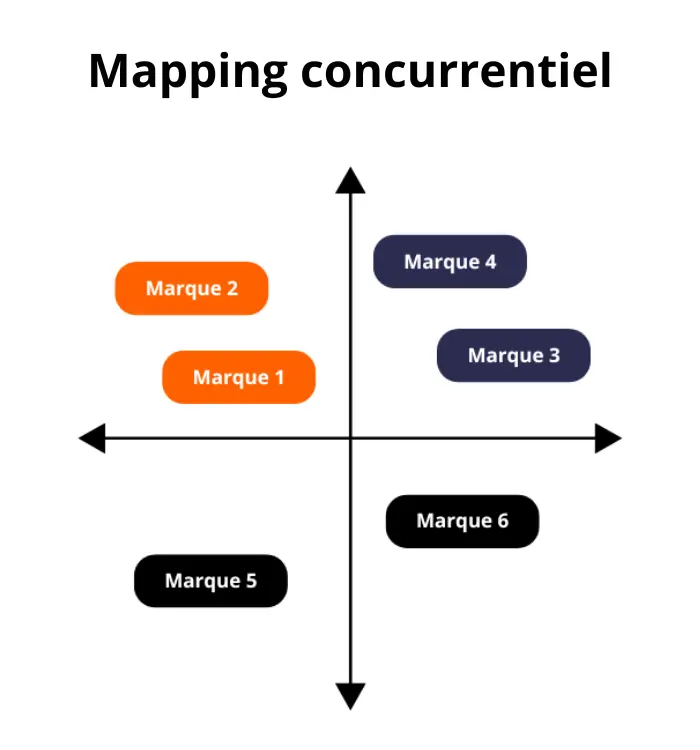
Competitive mapping turns complexity into clarity. By representing players on a price-value axis, it reveals areas of tension, inconsistent gaps, differentiation strategies and repositioning opportunities. It helps pricing teams to make more coherent decisions, anticipate market movements and steer their pricing strategy with method rather than instinct.
In an environment where every price variation can alter the perception of value, having a precise vision of the market becomes essential to maintain a credible, competitive and profitable positioning.
Competitive mapping: what is it?
Competitive mapping is an analysis tool that visually represents the position of market players according to key criteria, most often price and perceived value. Its strength lies in its ability to organize information in a structured way, showing how offers are distributed and revealing gaps that are not always visible in conventional analyses.
It differs from competitive benchmarkwhich examines offers in detail, and price watchwhich tracks price trends over time. Mapping provides a cross-sectional reading: it shows the players, their pricing choices, their promises of value, and the areas where competition is tightening or easing.
This tool displays the price-value ratioan essential indicator for understanding why certain players capture demand better, why others struggle to justify their prices, and how a brand can adjust its positioning to strengthen its competitiveness.
Why is reading the market essential for setting prices?
Setting a price without analyzing the competition is tantamount to moving forward without understanding the forces structuring your competitive environment. Competitive mapping provides a precise view of the positioning of direct and indirect competitors, highlighting areas where competitive pressure is intensifying, and revealing segments where certain players are adopting particularly aggressive pricing strategies. This competitive analysis helps to avoid pricing decisions that are out of touch with market reality.
It also helps maintain a coherent balance between price and perceived value. A high price with no tangible competitive advantage undermines conversion, while too low a price blurs positioning and weakens competitiveness. By visualizing the gaps between price, benefits and promise, mapping highlights situations of over- or under-positioning, and opportunities for differentiation from the main competitors.
Finally, keeping a close eye on competitors’ movements makes it easier to anticipate market reactions. By observing how players adjust their offers, it becomes easier to identify signals of intensifying competition or the arrival of new entrants. Pricing teams can thus avoid hasty reactions and price cuts that erode margins without strengthening competitive positions.
What a good competitive mapping should analyze
Price levels and pricing structure
Competitive analysis begins with a precise reading of price levels: advertised prices, final prices, differences between ranges and pricing logic. These elements reveal how direct competitors are actually positioned, and where the most competitive offers in the sector lie. Understanding these variations enables you to identify the areas where competitive pressure is strongest, and adjust your price positioning accordingly.
Promotions, discounts and competitive dynamics
Promotions have a strong influence on price perception and modify a brand’s competitive position. Their frequency, intensity and seasonality can sometimes weigh more heavily than the base price. Incorporating these signals into the mapping enables us to distinguish between players who rely on aggressive promotions and those who are building a more sustainable competitive advantage.
Product or service offering and perceived value
Features, depth of range, options, packaging or associated services shape perceived value and explain why some competitors manage to justify a higher price. This aspect of mapping helps us to understand the strengths and weaknesses of competing offers, and to identify the most relevant differentiation levers for boosting competitiveness.
Distribution channels and business models
The choice of channels – direct site, marketplaces, retail, partners or hybrid models – strongly influences the competitiveness of an offer. Each channel imposes its own constraints, margins, visibility rules and differentiation levers. Incorporating them into the mapping enables you to assess a product’s real competitive position across the entire value chain.
Value discourse and differentiation
Promise, benefits and differentiation play a key role in the perception of price-value. Studying how a brand differentiates itself from its competitors helps to understand why certain offers capture demand better, and how to strengthen its own competitive positioning.
Market signals and competitive performance
Availability, customer reviews, key features, warranties, lead times or commercial terms complete the analysis. These signals, often overlooked in traditional benchmarks, nevertheless influence competitive performance and explain differences in market share between players. Including them in the mapping provides a more detailed view of the competitive forces at play.

How do you build a relevant competitive map?
Clarify strategic objectives
Building a competitive map starts with a clear intention. Repositioning an offering, preparing for a launch, optimizing margins or refining your understanding of the market all require different approaches. Defining the objective from the outset helps to frame the competitive analysis and avoid an overly broad or superficial benchmark, which would blur the reading of the competitive positioning.
Identify direct and indirect competitors
The selection of players is a decisive step. Direct competitors provide an initial view of the competitive field, while indirect competitors and substitute products influence the perception of value and the choices of potential customers. Integrating these different profiles enables you to situate your offer within a complete competitive environment, and to anticipate the arrival of new entrants.
Select the most relevant analysis criteria
The criteria selected must reflect the key success factors of the sector. Price, features, quality, service, availability or reputation structure the competitiveness of an offer and guide the analysis of the competition. This choice determines the ability of the mapping to reveal the strengths and weaknesses of the main competitors, and to inform strategic decisions.
Position players on a price-value axis
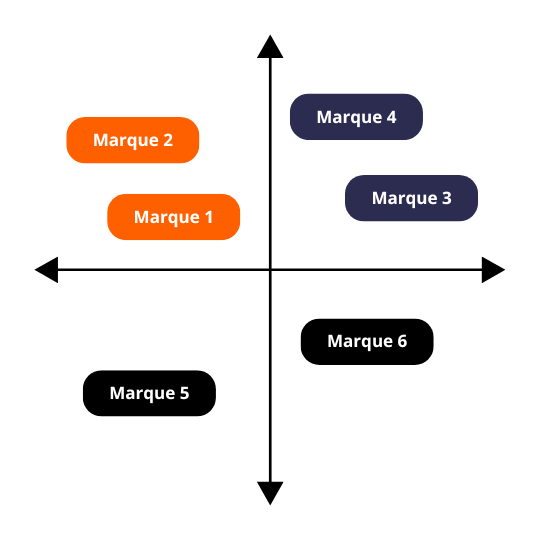
Placing competitors on a price-value axis, or price-features axis depending on market maturity, immediately reveals gaps, groupings and areas where competitive pressure is concentrated. This step reveals differentiation strategies, pricing inconsistencies and areas where a brand can stand out to reinforce its competitive advantage. This positioning analysis enables us to identify the perception gaps between offers, and to visualize the areas where competition is strongest.
Interpret discrepancies and detect opportunities
Once the players have been positioned, the analysis reveals market dynamics. Density zones show where the competitive struggle is most intense, vacant spaces signal under-exploited niches, and certain isolated positions reflect offers poorly aligned with their promise.
What indicators should you follow to adjust your prices?
Tracking the right indicators enables you to adjust your pricing strategy with greater responsiveness and consistency. This price monitoring helps to quickly identify gaps in positioning, aggressive moves by competitors and market trends likely to affect the competitiveness of an offer.
List price and final price
Tracking the posted price and the price actually paid helps us to understand an offer’s effective competitive position. This gap reveals how competitors structure their pricing strategy, and directly influences the perception of value.
Promotion trends
Observing the frequency, intensity and logic of promotions helps to measure the level of pricing aggressiveness in the sector. These variations show how players seek to capture demand and differentiate themselves in a shifting competitive environment.
Frequency of price changes
The speed at which prices evolve is an indicator of market volatility. A sustained pace often signals strong competitive pressure, the arrival of new entrants or heightened demand sensitivity.
Competitor differential
Regularly comparing prices with those of direct and indirect competitors helps to identify the optimum gap to maintain in order to remain competitive. This monitoring informs repositioning decisions and helps maintain a consistent competitive edge.
Impact on margins and competitiveness
Relating each pricing adjustment to its effect on margins and sales performance enables us to assess the relevance of our pricing strategy. This indicator shows whether the company is really gaining in competitiveness or unnecessarily sacrificing profitability.
Market reactions
Analyzing the effect of a price change on sales, conversion and the perception of the offer gives a direct reading of market sensitivity. These signals make it possible to quickly adjust pricing strategy and avoid decisions that would weaken competitive positioning.

Mistakes to avoid
Focus only on the most visible competitors
Many companies limit their analysis to established leaders, whereas emerging players, indirect competitors and substitute offerings often have a greater influence on the perception of value. Ignoring these signals creates an incomplete mapping and distorts understanding of the competitive landscape.
Hot on the heels of every price cut
Competitive mapping is used to analyze trends, not to follow impulsive movements. Reacting immediately to every price adjustment made by a competitor weakens the pricing strategy and leads to decisions that degrade margins without strengthening the competitive position.
Compare offers that are not equivalent
Without standardized criteria (functionality, scope, services included), conclusions become misleading. Comparing heterogeneous offers prevents us from identifying the real competitive gaps, and blurs our understanding of positioning.
Neglecting perceived value
Price alone says nothing. What counts is how the market assesses the price-value ratio. Forgetting this dimension leads to pricing decisions that are disconnected from customer expectations, and weakens competitiveness in the face of direct and indirect competitors.
Building a mapping without regular updates
A market evolves too quickly to be satisfied with a snapshot. Without updating, mapping loses its relevance, no longer reflecting competitors’ movements and no longer helping to anticipate changes in positioning or the arrival of new entrants.
The role of data and automation
Manual mapping quickly becomes insufficient when the market has several players, several ranges or frequent variations.
Scraping, price monitoring and pricing tools make it possible to :
- continuous data collection
- keep pace with market movements without manual effort
- detect weak signals
- automatically feed decision models
- keep your mapping up to date
Automation transforms mapping into a living tool, capable of informing day-to-day decisions. These technologies feed a pricing intelligence logic capable of analyzing market movements in real time and facilitating pricing decisions.
Use cases by sector
Retail and e-commerce
In retail and e-commerce, competitive mapping is based on precise observation of prices, promotions, availability, range depth and customer reviews. These signals show how players structure their offer and influence the perception of value in a world of constant comparison.
SaaS and B2B services
In SaaS and B2B services, the analysis is built around pricing tiers, options, subscription models and functional differentiation. Competitors distinguish themselves by the way they compose their offer and articulate their value proposition, which makes mapping essential for understanding competitive gaps.
Tourism, hotels and transport
In the tourism, hotel and transport industries, competitive dynamics are shaped by yield management, seasonality, availability and segmentation. Mapping enables you to monitor rapid price variations and position your offer in a market where reactivity directly conditions performance.
Insurance, energy and telecoms
In insurance, energy or telecoms, offers are more complex: pricing grids, contractual conditions, options, ancillary costs. Competitive mapping helps to clarify these sometimes opaque structures and identify the levers that really influence customers’ decisions.
What all sectors have in common
Each sector has its own signals, but they all share the same imperative: to understand how the competition is structured in order to fine-tune prices and defend a competitive position.
Method for moving from analysis to pricing decision
Define a pricing rule
The transition from analysis to action begins with a clear rule: a target deviation to be maintained, tolerance thresholds and a coherent range logic. This is the basis for transforming mapping findings into stable, comprehensible pricing decisions.
Setting alert thresholds
Warning thresholds enable you to quickly identify unusual market movements. A sudden variation, a competitor changing strategy or an unexpected promotion become signals that can be exploited rather than surprises.
Linking mapping and margin targets
Competitive analysis only makes sense if it is in line with margin objectives. Linking price differentials to profitability constraints helps to arbitrate between competitiveness and economic performance, and to avoid adjustments that would weaken margins without strategic benefit.
Set up a continuous optimization loop
Pricing decisions become more effective when they are part of a continuous cycle: analysis, decision, measurement, adjustment. This loop makes it possible to quickly correct deviations, integrate new market signals and maintain a competitive position over the long term.
Competitive mapping: a clearer view of the market for better pricing
Competitive mapping is not just about observing the market. Above all, it enables us to understand the logics that influence the perception of value and purchasing decisions. By cross-referencing price, promise, differentiation and competitive dynamics, it provides a clearer picture of an offer’s real position in relation to its competitors.
This visibility helps teams to make more coherent pricing decisions, avoid knee-jerk reactions and defend a sustainable positioning. Adjustments become more controlled, clearer and better aligned with market expectations and profitability targets.
Because good pricing doesn’t just depend on costs or internal constraints. It depends above all on how the market perceives the value of an offer.
Competitive mapping makes this perception visible and therefore controllable. It transforms the reading of the market into a real decision-making lever.