



A lost customer doesn’t show up in inventory… it shows up in your bottom line. During the sales season, retailers carefully monitor their sales, stock levels and conversion rates. However, one of the most frequent causes of lost sales often remains invisible in dashboards: the desynchronization between physical and digital inventories.
The scenario has become commonplace. A customer consults your website, checks the availability of a product in the nearest store and decides to go there. Once there, he discovers that the item is unavailable. Conversely, another customer orders online, receives a purchase confirmation, only to learn a few hours later that his order has been cancelled due to lack of stock.
In both situations, the problem goes far beyond a simple missed sale. The retailer loses not only immediate sales, but also part of the customer’s trust. The experience generates frustration, increases the likelihood that the buyer will turn to a competitor, and permanently weakens the brand’s image.
This consumer reaction is far from anecdotal. According to HR & Associés, 70% of consumers abandon their purchase when a product they are looking for is unavailable, and 40% never return to the site concerned. So an availability error doesn’t just mean a lost sale: it can also lead to a lasting loss of customers.
In this article, we analyze the main causes of inventory desynchronization, its consequences on sales performance and the levers to activate to guarantee a smooth and reliable omnichannel experience during the 2026 summer sales.
OMNICHANNEL IS NO LONGER AN OPTION
Consumers no longer distinguish between channels
In 2026, the buying process has become totally hybrid.
The consumer discovers a product on social networks, consults online reviews, compares prices, checks availability and then chooses the most convenient mode of purchase: store, e-commerce, click & collect or delivery.
According to the Institut du Commerce, the majority of French people now buy as much online as in-store, and use several channels before making their purchasing decision.
For the customer, there’s only one brand.
When stocks or prices differ between channels, he doesn’t perceive a technical problem. He perceives a broken promise.

The true cost of desynchronization
A lost sale is often just the tip of the iceberg
When a product is advertised as available when it isn’t, the most obvious consequence is the loss of a sale. However, the real impact goes far beyond the immediate loss of sales.
Loss of income
The customer doesn’t find the product he’s looking for and abandons his purchase, often in favor of a competitor able to meet his needs.
A loss of confidence
When the information displayed does not correspond to reality, consumers question the reliability of the brand and its sales channels.
A loss of loyalty
A disappointing experience encourages customers to compare offers more closely when making future purchases, reducing their propensity to naturally return to the same brand.
A loss of image
In the age of online reviews and social networking, a bad experience can quickly be shared and influence the perception of other consumers.
This means that out-of-synch inventory is not just an operational problem. It’s a business risk that affects sales, customer satisfaction and the brand’s reputation.
Why do sales amplify the problem?
A period of maximum tension for stocks
During sales periods, desynchronization between physical and digital stock becomes more frequent, more visible and, above all, more costly. What may remain marginal in normal times quickly becomes a major point of friction when sales volumes increase, customers compare offers more and decision times shorten.
Much faster sales
The first reason is the sudden acceleration in demand. The speed at which certain items are sold out can increase four or five-fold in the first few days of a sale. In this context, stock shown as available at 9am may no longer be available at 10am. If systems are not synchronized in real time, the discrepancy between actual and displayed availability immediately creates a risk of broken promises.
Busy teams
The second difficulty is the operational pressure in store. Teams are busy stocking shelves, assisting customers, managing queues, exchanging information and requesting availability. In this environment, stock movements can be recorded late, particularly when sales follow on quickly or returns are not immediately reintegrated into the systems.
Inventory shared between several channels
Stocks are also used simultaneously by several channels. The same item may be bought in-store, ordered on the e-commerce site, reserved via click & collect or sold via a marketplace. Without clear allocation rules, these channels compete for the same level of stock. The risk is twofold: displaying online a product already sold in store, or needlessly blocking stock that could have been converted to another channel.
More returns
Added to this is the increase in returns and exchanges, particularly high during promotional periods. Each return creates an additional movement to be processed: checking the item, putting it back in stock, putting it back on the shelf if necessary, updating the stock available online. If these steps don’t run smoothly, certain items may remain invisible to the digital channel even though they are physically available, or conversely be offered for sale even though they are not yet really usable.
The average e-commerce basket has risen from €89.2 to €96.8 in one year (Source: WiziShop). This progression shows that consumers are buying with greater intention and selectivity. They therefore expect reliable information, particularly on product availability, withdrawal times and price consistency between channels.
During sales, desynchronization isn’t just a technical problem. It’s a direct business risk: it slows conversion, generates cancellations, degrades the customer experience and can divert a sale to a competitor in a matter of minutes.

What the most successful chains do
The most successful retailers no longer simply monitor their stock levels. They manage their omnichannel visibility to ensure that every customer promise is based on reliable information, whatever the channel used. This approach enables them to reduce out-of-stocks, improve the customer experience and secure their sales performance during busy periods.
A unified stock vision
The first condition is to have a single source of truth for all inventories. All in-store sales, e-commerce orders, click & collect withdrawals, warehouse receipts and customer returns feed into a centralized, continuously updated repository.
This real-time visibility provides a consistent view of availability across the entire network. Teams can make faster, more reliable decisions, while customers benefit from more accurate stock information. During sales periods, when goods movements accelerate dramatically, this capability becomes a real competitive advantage.
Channel allocation rules
The most mature brands define upstream the rules governing the sharing of stock between different sales channels. The aim is to prevent physical stores, e-commerce sites and click & collect from competing for the same available units.
These rules take into account expected sales volumes, delivery commitments, commercial priorities and critical stock levels. In this way, certain references can be partially reserved for a specific channel, while others can be managed more flexibly according to demand.
By anticipating these arbitrages before the start of the sales season, retailers considerably reduce the risk of overselling and allocation conflicts.
Automated alerts and proactive management
The most advanced organizations don’t just observe problems: they put in place mechanisms capable of anticipating them.
When a stock reaches a critical threshold or an anomaly is detected, automatic alerts immediately trigger the appropriate actions. These may include temporary suspension of sales on a channel, reallocation of available stock, adjustment of delivery times or priority replenishment.
This automation makes it possible to react in minutes rather than hours. Decisions are taken before the customer is confronted with a breakdown or a broken promise, thus limiting the impact on sales and customer satisfaction.
By combining real-time visibility, structured allocation rules and proactive exception management, the most successful retailers are transforming their omnichannel organization into a genuine lever for growth and loyalty.
Use cases
When a few minutes make all the difference
A French home furnishings retailer with over 100 points of sale was synchronizing its stocks once an hour. During the sales season, this delay was enough to create discrepancies between online availability and in-store reality, leading to numerous click & collect order cancellations.
Better visibility, better results
By reducing the synchronization time to just a few minutes and setting up automatic alerts, the retailer has significantly reduced order cancellations, improved customer satisfaction and increased the in-store collection rate.
This experience illustrates a simple fact: in many cases, the problem is not the level of stock available, but the quality and speed of information shared between channels.

Price consistency: the second pillar of omnichannel
Stock synchronization is essential, but it’s not enough. Consistent pricing across channels is just as important to ensure a seamless customer experience and reinforce trust in the brand.
Strong consumer expectations
Today, customers naturally move from the website to the mobile app to the physical store. When they see a price difference for the same product, they perceive above all a lack of consistency and transparency.
A particularly sensitive issue during sales
Promotional periods multiply price changes and increase the risk of inconsistencies between channels. Even if temporary, these discrepancies can create frustration and put the brakes on purchases.
Prices synchronized in real time
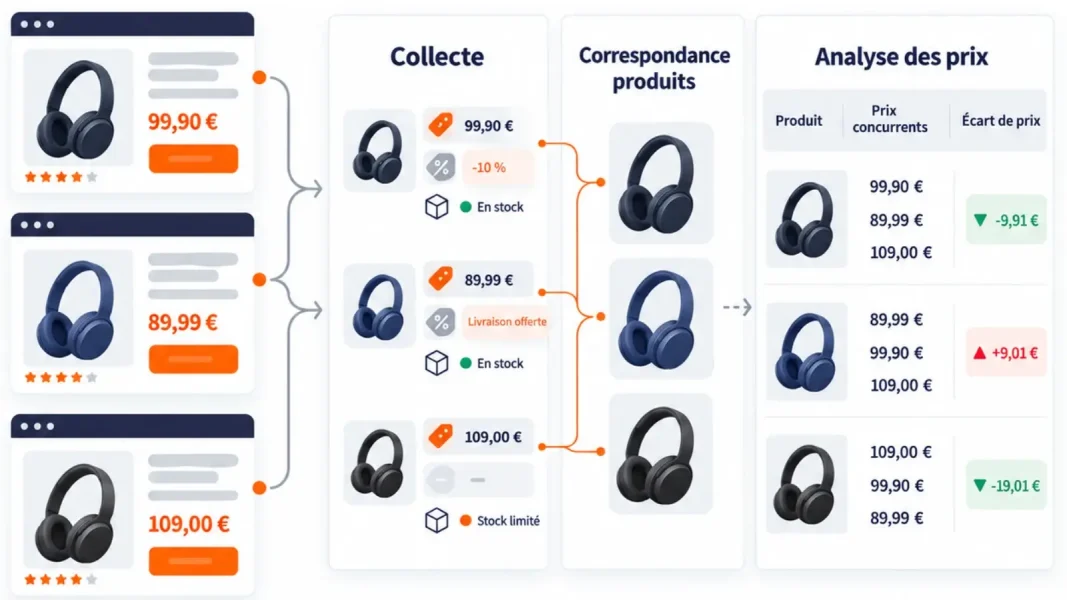
The most successful retailers rely on centralized systems capable of automatically distributing price updates across all channels. According to EuroShop, 30% of major European retailers already use electronic labels to guarantee this real-time consistency.
As with inventory, price reliability has become a key element in omnichannel performance and customer confidence.
4 THINGS TO DO BEFORE THE SALES START
1. Audit your actual synchronization frequency
Precisely measure the time between a sale and its entry into all your systems.
2. Formalize your allocation rules
Define priorities between stores, e-commerce and click & collect.
3. Identify critical references
Set up automatic alerts for the most sensitive products.
4. Test omnichannel paths
Create complete order, reservation and collection scenarios before the start of the sales period.
How can Optimix Solutions help you?
With its demand forecasting, inventory optimization and price management solutions, Optimix Solutions helps retailers improve their operational and commercial performance.
By providing a more reliable, accurate and dynamic view of inventory, our solutions help to reduce out-of-stocks and overstocks, optimize pricing strategies and ensure better stock synchronization between physical and digital channels.
This approach helps to secure sales, improve the customer experience and sustainably boost the profitability of retail activities, while promoting more agile and efficient supply chain management.
Better synchronization for better sales
At a time when shopping paths are increasingly hybrid, the performance of sales no longer depends solely on the quality of offers or the depth of assortments. It also depends on the ability of retailers to guarantee reliable, consistent information across all their sales channels.
A unified view of inventory and pricing not only reduces out-of-stocks and availability errors, but also improves the customer experience, boosts consumer confidence and preserves sales that might otherwise benefit the competition.
Omnichannel is no longer just a technological issue: it’s a lever for sales performance and customer loyalty that can be measured directly in results.
Would you like to identify the main risks likely to impact your performance during the summer sales? Optimix Solutions experts can help you evaluate your processes, detect friction points between your sales channels and identify concrete avenues for improvement to enhance the reliability of your omnichannel system.
Make an appointment with one of our consultants to discuss your needs.