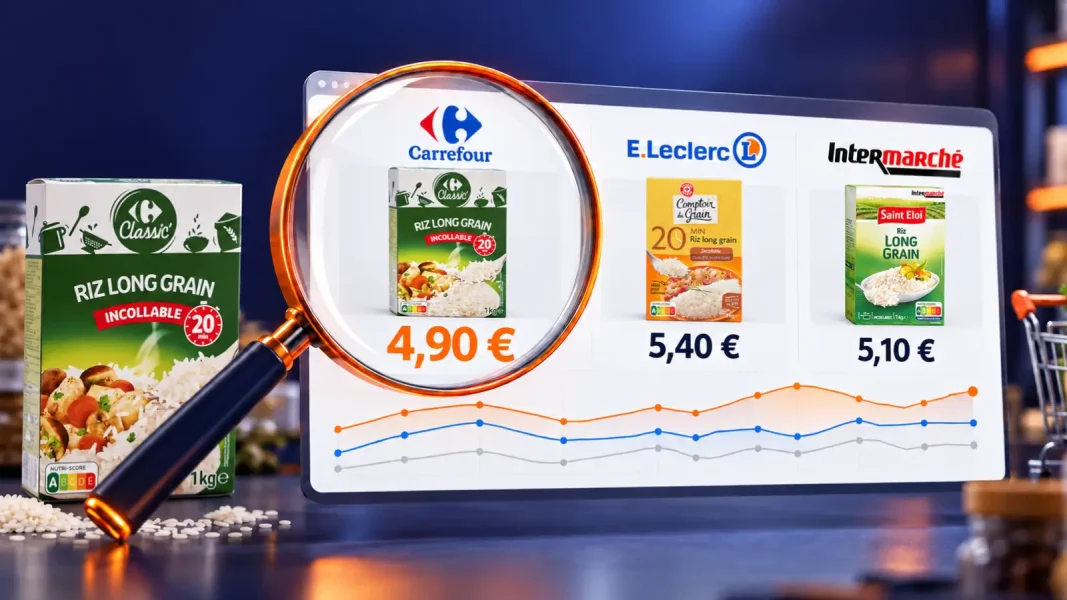


Prices are never managed in a static environment. A supplier price increase alters the margin equation; a competitor reposition the price of a frequently compared product; a promotion disrupts the price gap between two product sizes—each of these changes can upset the balance of a product assortment. For a retailer, the challenge is therefore not simply to determine the “right” price, but to know Which prices to adjust, by what percentage, and what the impact will be on margins, competitiveness, and the consistency of the product offering.
Price price management refers to the set of processes used to define, apply, update, and manage retail prices. It is based in particular on costs and margin targets, the brand’s positioning, competitors’ prices, demand, and the pricing relationships among products within the same product line.
But a pricing strategy is only as good as its execution. A theoretically optimal price can quickly lose its effectiveness if a discount erodes the projected margin, if a cost fluctuation is passed on too late, or if a change creates an inconsistency between two comparable products. Pricing management therefore requires evaluating each decision not only against a benchmark, but also within its competitive environment and within the pricing structure of the product line.
For retailers, building an effective pricing management system therefore involves linking pricing strategy, rules for setting and adjusting prices, operational execution, and performance measurement. A structured approach helps protect profitability while maintaining a consistent and transparent pricing strategy for the customer.
What is price management?
Pricing management refers to the process by which a company sets, applies, monitors, and revises its prices. It encompasses a product’s initial price, price changes, discounts offered, and the terms that determine the amount paid by the customer.
In retail, it covers regular prices, promotions, and markdowns. It also specifies the effective dates, the stores involved, and the distribution channels. Pricing management systems can thus link the preparation of price changes to their approval and then to their transmission to checkout systems and e-commerce sites.
The pricing answers the question: What price should be set to sell a product? Pricing management also addresses the factors leading up to and following this decision. It organizes the collection of information, margin controls, the approval of exceptions, and the analysis of results.
A retailer that changes a product’s price must, for example, assess the impact on other sizes, schedule the change, and monitor its implementation. It must then determine whether the new price improves profitability or simply shifts sales within the product line.
Pricing management helps maintain the link between a decision and its actual effects.

Why Should Price Management Be Structured?
Maintaining Profitability After Discounts
The listed price does not always match the amount collected. A promotion, a loyalty discount, or a sales discount can affect the profit margin on the sale of a product.
Monitoring must therefore compare the reference rate, the benefits granted, and the amount paid. Without this analysis, a company may maintain its prices while experiencing a decline in profitability.
Costs must be adjusted based on the same scope. An increase in the purchase price or distribution costs can reduce a product’s contribution before the teams have revised its price.
Maintain a chosen competitive position
The prices charged by competitors influence customers’ comparisons, particularly for well-known and frequently purchased items.
Price management helps identify discrepancies that warrant action. A difference of just a few cents on a highly visible product can matter more than a larger discrepancy on a specialty item.
The price positioning It is therefore structured by category and product role. The business objective determines which comparisons to prioritize and what constitutes an acceptable deviation.
Keep the layout clear
A product’s price must also be considered in relation to the retailer’s other products. Price differences between small and large sizes, national brands and store brands, and entry-level and premium products must remain reasonable.
A one-time price decrease can make an intermediate product more expensive than a higher-tier product. A price increase can eliminate the expected cost savings from buying in bulk.
These situations call for rules to ensure product line consistency, which must be verified before the new prices are implemented.
What are the three main pricing strategies?
There are three main approaches to setting a price:
Cost-Based Pricing
It involves taking the purchase price or cost of goods sold and adding a markup. This method helps maintain profitability, but it must be balanced against market conditions.
Competition-Based Pricing
The company sets its prices relative to those of its competitors: at the same level, lower, or higher. The choice depends on the desired positioning, costs, and the value provided to the customer.
Pricing Based on Perceived Value
The price is determined based on the value the customer attributes to the product: quality, brand, services, features, or experience. This approach requires a thorough understanding of customers’ expectations and price sensitivity.
In practice, these three strategies can be combined to set a price that is profitable, competitive, and consistent with the product’s positioning.
What data should be used to set prices?
Purchasing Costs and Cost of Goods Sold
The purchase price corresponds to the amount paid to the supplier, in accordance with the agreed-upon terms of sale. The purchase cost may include the expenses necessary to acquire the merchandise. The cost of goods sold goes a step further by aggregating the costs allocated to the product until it is brought to market.
Depending on the activity, the calculation includes direct costs, logistics costs, and a portion of indirect costs. The allocation rules must be documented to ensure that comparisons are made on a consistent basis.
It is also important to distinguish between fixed costs and variable costs. The former remain relatively stable within a given range of activity; the latter vary with volume. This distinction makes it possible to examine how much each sale contributes to covering expenses.
Market prices and competing offers
In-store and online price checks provide information on the competitors’ prices, but using them requires several checks: whether the product is identical or equivalent, the quantity, packaging, availability, and promotional terms.
A discount available only to cardholders cannot be directly compared to a regular price. A three-pack must be converted to a comparable quantity before assessing the difference.
The market prices must also be associated with a date. An old record can be misleading when a category undergoes frequent changes.
Sales and Terms and Conditions
Volumes, discounts, returns, and availability provide insight into the results of a pricing strategy. They must be analyzed at the same level: SKU, store, channel, and time period.
A decline in sales may be due to a price that is too high, but it can also result from a stockout, a change in display, or a promotion on a substitute product. Diagnosis comes before adjustment.
Pricing strategies cannot always be separated from product availability. A price change can affect sales volumes and, consequently, inventory and procurement needs. Conversely, excess inventory or stockouts can influence pricing decisions.
Learn how to coordinate price management and inventory forecasting.
What pricing methods should be used?
The fastening methods provide different points of reference. Combining them helps to set a price that is economically sustainable and consistent with market expectations.
Determining the price based on costs and margin
Cost-based pricing involves adding a markup to a clearly defined base. This base can be the purchase cost or the production cost, depending on the metric being tracked.
In trading, the sales margin is the difference between the selling price (excluding tax) and the purchase cost (excluding tax) of the goods sold. The margin rate expresses this margin as a percentage of the purchase cost; the markup rate relates it to the selling price excluding tax.
Calculation | Formula |
Unit Gross Margin | Selling price (excluding tax) − purchase cost (excluding tax) |
Margin rate | Sales margin ÷ purchase cost (excluding tax) × 100 |
Brand rate | Sales margin ÷ selling price (excluding tax) × 100 |
Price with a target margin rate | Purchase cost (excluding tax) × (1 + markup rate) |
Price with a target brand rate | Purchase cost (excluding tax) ÷ (1 − brand markup) |
For a purchase cost of €10 (excluding tax), a 50% markup results in a price of €15 (excluding tax). A 50% markup results in €20 (excluding tax). Confusing these metrics significantly alters the resulting price. The basis for the calculation must therefore be specified in the rules used.
The multiplier coefficient can simplify the calculation of the selling price, provided that the method is clearly defined. When it relates the selling price (including tax) to the purchase price (excluding tax), it takes the effect of VAT into account and does not directly correspond to the profit margin.
Set prices based on the competition
The competitive approach involves setting prices relative to comparable offerings. The company may choose to align its prices, set a lower price, or set a higher price, depending on its offering and objectives.
Theprice alignment may be relevant for products that significantly influence the perceived value. It must remain consistent with the retailer’s purchasing terms and costs.
A single competitor does not, on its own, provide a business model worth replicating. Its price may be the result of a clearance sale, a promotional campaign, or different supplier terms.
Set prices based on perceived value
The perceived value corresponds to the benefits the customer recognizes in the offering: quality, usability, availability, service, or trust in the brand.
A higher price may be acceptable when these benefits are identified and appreciated. However, a benefit that is costly for the company is not enough to justify the price to the buyer.
The psychological price helps explore what price levels are considered acceptable. It differs from price endings, such as €9.99. Surveys provide insights into price acceptability, which should be compared with actual purchasing behavior.
These methods must then be translated into rules tailored to each category. A penetration strategy, a skimming strategy, or a stable positioning strategy do not lead to the same decisions throughout the product life cycle.

How can you organize day-to-day price management?
Segment the products before setting the rules
Applying a single rule across the entire product line can lead to decisions that are ill-suited to the situation. Products differ in terms of visibility, purchase frequency, differentiation, and sensitivity to competition.
The retailer can distinguish between items that serve as price benchmarks, specialty products, new arrivals, and seasonal items. It then sets margin targets and identifies competitive constraints for each group.
This segmentation makes it possible to tailor decisions to each product’s role and to focus analyses on the SKUs that have the greatest impact on sales and margins.
Define the constraints and their priority
A applicable pricing policy must specify the rules that determine price proposals: minimum margin, competitive spread, consistency across formats, rounding, or variation limits.
We need to anticipate conflicts. If matching a competitor’s price causes our margin to fall below a certain threshold, which rule should take precedence? Should the proposal be blocked or submitted for approval?
Exceptions must have a designated person in charge and a set duration. A temporary exception should not become a permanent rate due to a lack of follow-up.
Simulate changes before confirming them
Before implementing a price increase or decrease, the teams review the impact on margins, competitive pricing, and the product line.
When demand assumptions are available, several scenarios can be compared. Their accuracy depends on the quality of the data and the limitations of the model used.
The results must remain clear: current rate, proposed price, change, expected margin, and reason for the change. This presentation facilitates approval based on the business implications.
Publish rates and monitor their implementation
Approved prices must be forwarded to the sales systems, specifying their effective date, the stores, and the channels involved.
The audit must also take into account promotions, discounts, and loyalty benefits to identify any unintended combinations. It ensures that the displayed price and the invoiced amount match the approved terms.
How can you measure the profitability of a price change?
An increase in revenue is not enough to demonstrate that an adjustment improves performance. The value margin, volumes, and effects on other products must be examined together.
Let’s look at an illustrative example, with a constant variable cost of €12 per unit.
Location | Selling Price (Excluding Tax) | Quantities Sold | Revenue | Profit After Variable Costs |
Initial Rate | 20 € | 1 000 | 20,000 € | 8,000 € |
Reduced rate | 18 € | 1 200 | 21,600 € | 7,200 € |
The decrease in the selling price increases sales volume by 20%, but reduces the contribution by €800. At €18 (excluding tax), at least 1,334 units would need to be sold to maintain a contribution of €8,000, assuming variable costs remain unchanged.
This analysis must be extended to the category level. Additional sales may come from a related product or from customers bringing forward their purchases. A promotion can thus improve the performance of a specific product without generating an equivalent gain for the retailer.
The break-even point provides another benchmark. In a simplified, single-product model, the break-even volume is equal to fixed costs divided by the unit contribution after variable costs. For a product line, the sales mix must also be taken into account.
What metrics should be tracked to manage pricing?
The dashboard should make it possible to distinguish between financial results, market positioning, and the quality of decision implementation.
Dimension | Useful Indicators | Informed Decision |
Profitability | Value margin, brand rate, contribution | Maintain or revise the rules |
Activity | Volumes, revenue, product mix | Understanding Changes in Purchasing Behavior |
Competition | Price Index, Price Differences for Comparable Items | Adjust the positioning |
Promotions | Actual discount, contribution, post-transaction sales | Renew or modify the offer |
Execution | Compliant prices, anomalies, implementation deadlines | Correct Operational Discrepancies |
Priceprice elasticity measures the relative response of demand to a change in price. It helps assess the price sensitivity, but estimating it requires controlling for other factors that influence sales.
A promotion accompanied by a special feature does not mean that the entire increase in volume can be attributed to the price. Seasonality, availability, and competing promotions must be taken into account.
It is best to analyze the metrics by category, channel, and time period. An overall average can mask improvements in some areas and declines in others.
What software should I use for price management?
The choice of a tool depends on the number of SKUs, the sales channels, the frequency of changes, and the complexity of the rules.
A spreadsheet may be suitable for a limited scope. Challenges arise when multiple people edit the files, when data needs to be reconciled regularly, or when the relationships between products become difficult to manage.
A price management software should help teams leverage consistent data, apply their rules, and identify decisions that require intervention. It should also maintain a history of changes and integrate with relevant systems .
XPA (Optimix Pricing Analytics), the pricing analytics solution from Optimix Solutions, combines, among other features, competitor price tracking, product matching, and customizable pricing rules. Its pricing strategy module takes business constraints into account and analyzes actual metrics against projected results. These features support the preparation and monitoring of decisions.
The ability to handle exceptions is just as important as calculating current prices.
Does pricing management vary by industry?
The principles of price management remain similar, but their application depends heavily on the industry, the product mix, the level of competition, and commercial or regulatory constraints.
In the pharmacy sector, for example, pricing management must account for thousands of product lines, products that are frequently compared, significant price differences across categories, and varying degrees of pricing flexibility depending on the product.
Learn about the specifics of pharmacy pricing management.
When should prices be adjusted?
A review may be triggered by rising costs, a persistent competitive gap, changes in demand, or inconsistencies among products.
The frequency should depend on the category. A market where rates change rapidly requires close monitoring. Changes that occur too frequently for a stable offer can create extra work and make it harder for customers to understand the price.
A price increase must be assessed based on the volumes likely to be lost, the recognized value, and the available alternatives. A reduction must be evaluated based on the additional volume needed to maintain the contribution.
The tiered pricing by store, region, or channel also require a clear business rationale. Service costs may vary, but customers can compare offers. The implications for understanding pricing must therefore be anticipated.
Each adjustment should be associated with an evaluation date. The results can then be used to uphold the decision, correct it, or revise the initial assumptions.
Can pricing decisions be automated?
Automation makes it possible to prepare proposals, monitor constraints, and process changes that comply with the limits set by the company.
It may indicate that a security has moved out of its target range, that a margin has become insufficient, or that a range deviation is inconsistent. The teams are then presented with a selection of situations to review.
Uncertain data must be handled in a specific way. A questionable product reconciliation or a missing cost should not automatically trigger a price change.
Artificial intelligence can help match references and analyze demand patterns. Recommendations depend on the available data and the assumptions used.
The company remains responsible for defining objectives, constraints, and validation criteria. Effective automation speeds up controlled operations and highlights exceptions.
What mistakes should you avoid when managing prices?
Systematically matching the lowest-priced competitor exposes a company to a price war whose impact on margins may extend beyond the initial transaction. Before taking action, it is important to identify the nature of the offer and its significance to customers.
Applying the same markup rate to all products can also undermine the positioning of products that are frequently compared or undervalue a differentiated offering.
Another mistake is to judge a promotion based solely on sales volume. Discounts, cross-selling, and post-promotion sales must all be factored into the evaluation.
Finally, the data and the application of rates must be verified before the strategy is called into question. A decline in margin may result from an outdated cost, a combination of discounts, or a price applied that differs from the approved rate.
Effective pricing management is built on the ability to explain price variances. Rules set a direction; results allow us to verify their relevance and adapt them accordingly. A company that masters this cycle can adjust its prices with greater precision, while maintaining the consistency of its offerings and its profitability.
Manage pricing more effectively to maintain profit margins
Pricing management is not limited to setting a selling price. It is based on an ongoing process that combines cost data, competitive positioning, product line consistency, business rules, and performance monitoring. To be effective, every pricing decision must be evaluated in terms of profitability, its commercial impact, and its proper implementation across the various sales channels.
Structuring this process allows retailers to respond more quickly to changes in costs, competition, and demand, without losing sight of their margin goals and market positioning. Pricing management tools facilitate this process by centralizing data, automating certain controls, and highlighting situations that require intervention.
The challenge, therefore, is not to change prices as often as possible, but to make better-informed decisions, measure their effects, and adjust the rules when results deviate from objectives. Effective price management thus becomes a sustainable tool for preserving profitability, maintaining consistency in the product offering, and strengthening the company’s competitiveness.

FAQ – Price Management
What is pricing management software?
Pricing management software helps companies centralize data relevant to pricing, apply their pricing rules, and track price changes. Depending on the solution, it can incorporate costs, competitor prices, margin targets, product line constraints, and sales data. It also facilitates the simulation, validation, and monitoring of pricing decisions.
What are the different pricing strategies?
Several approaches can be used. Cost-based pricing involves determining a price based on the purchase cost or production cost plus a markup. Competitive pricing sets the price relative to what is available on the market. Value-based pricing takes into account what the customer is willing to pay based on the perceived benefits.
These methods can be supplemented by strategies such as market penetration—which involves offering an attractive price to facilitate entry into a market—or price skimming, which relies on a high initial price before any adjustments are made.
What are the main factors to consider when setting a price?
Purchase or cost of goods sold are a starting point, but they are not enough. The company must also take into account its margin targets, competitors’ prices, demand, customers’ price sensitivity, and the product’s role within the product line. Changes in costs or market conditions may then warrant a price adjustment.
How can you tell if a price is profitable?
Profitability cannot be measured solely by revenue. It is necessary to examine the margin or contribution generated by each sale, as well as the volumes achieved. A price reduction, for example, may increase the quantity sold without improving the total contribution if the additional volume does not offset the decrease in unit margin.
What is the difference between price management and pricing policy?
Pricing policy defines the company’s guidelines regarding prices: positioning, margin targets, competition strategy, and promotional rules. Price management translates these guidelines into day-to-day operations. It includes, in particular, preparing price changes, approving them, implementing them, and monitoring their results.
How often should you review your prices?
There is no single frequency that works for all companies. It depends, in particular, on cost volatility, the intensity of competition, and the rate at which demand changes. A highly competitive category may require frequent monitoring, while a more stable product line may be reviewed less often. However, every change must be based on a clear rationale.
Can price management be automated?
Yes. Automation can be used to detect discrepancies with competitors, monitor margin thresholds, apply certain pricing rules, or identify SKUs that require intervention. Automated decisions must, however, remain governed by business rules and data quality controls.
How do you choose pricing management software?
The choice depends on the number of SKUs, the frequency of changes, the sales channels, and the complexity of pricing rules. For a limited scope, a spreadsheet may suffice. As data volumes and rules increase, a specialized solution can facilitate the centralization of information, the automation of checks, the simulation of changes, and the monitoring of their implementation.
Above all, this decision must be evaluated based on real-world scenarios: changes in supplier costs, changes in competitors’ prices, product launches, managing a promotion, or conflicts between margin targets and pricing strategies.