


In inventory managementThe order point or ROP (Reorder Point) is one of the most strategic indicators for distribution, retail and industrial companies. This critical threshold precisely determines the point at which it becomes necessary to place a new order with suppliers to avoid stock-out while maintaining optimal inventory levels.
Order point control has a dual objective: to guarantee constant availability of products to satisfy customer demand, while minimizing the financial capital costs associated with excess inventory. Companies that effectively manage their POR significantly reduce out-of-stocks, optimize their working capital requirements and improve their service rate. They increasingly rely on order management software to ensure the reliability of their thresholds and automate their procurement decisions.
In this article, we explain in detail why the order point is a central lever for a high-performance supply chain, and how new technologies are transforming its calculation, tracking and automation.
What is an order point?
The reorder point is a key indicator in inventory management. It corresponds to the level at which a new order must be placed to avoid stock-outs before replenishment. When an item reaches this threshold, an alert is triggered to guarantee the continuity of sales and production.
Its role is to anticipate the time between order and receipt of products, maintaining enough stock to cover demand during this period.
How do I calculate the control point?
Three data are essential:
- Estimation of forecast demand (expected average consumption)
- Delivery time
- Safety Stock
Order point formula :
Order point = (Expected average consumption × Delivery time) + Safety stock
Example
A company sells 8 units a day, the supplier lead time is 7 days and the safety stock is set at 20 units.
(8 × 7) + 20 = 76 units
As soon as stock reaches 76 units, an order is placed. This maintains product availability while avoiding overstocking and stock-outs.
Points to watch and calculation assumptions
The calculation is based on a number of assumptions, which need to be checked regularly. Stable demand assumes relatively regular consumption, but many products are highly seasonal. The consistency of the replenishment lead time may vary from period to period.
Structural modifications, such as a change of supplier or a range evolution, require recalculation. Data obsolescence is a constant risk: an ROP calculated six months ago may be totally out of touch with current reality.

Why is ROP a key indicator for avoiding shortages or overstocking?
The replenishment point is the central pivot in the balance between two opposing risks: out-of-stock and overstock. Out-of-stock situations generate lost sales, damage the company’s image and require costly emergency orders. Overstocking ties up capital, increases storage costs and increases the risk of obsolescence.
A properly calibrated ROP enables us to navigate between these two pitfalls, by triggering orders at the optimum time: early enough for delivery to arrive before stock is exhausted, but not too early to avoid unnecessarily high stock levels. For a retail company, an improvement of just a few points in the turnover rate can free up several million euros in cash flow.
The Ordering Point (OP) and its role in inventory management
The replenishment point is defined as the stock level that automatically triggers the launch of a new order with the supplier. When available stock reaches or falls below this predefined threshold, an alert signal is triggered to initiate the replenishment process. This mechanism theoretically guarantees that the new delivery will arrive before the stock is completely depleted.
For companies providing regular monitoring, the order point can be integrated directly into APSsoftware, which automatically monitors stock levels. As soon as a threshold is crossed, the system automatically generates an order proposal, or even places the order directly if the company has set up a fully automated workflow.
The benefits of POR for the supply chain
Avoid stock-outs
The fundamental benefit of POR lies in its ability to prevent stock-outs. By automatically triggering orders at the optimum moment, it ensures that stock never runs out completely. A properly parameterized ROP can maintain service rates in excess of 98%, compared with rates often below 90% for companies that manage their inventories in an approximate manner.
Optimize costs and inventory levels
ROP optimizes the overall economic balance by simultaneously minimizing breakage costs and carrying costs. If ROP is too high, orders are placed too early, resulting in excessive stock levels. Too low an ROP increases the risk of breakage. Companies that refine their calculations generally find that they can reduce their average inventory by 15% to 30%, while simultaneously improving their service rate.
Improve operational performance and customer satisfaction
Automated order release frees teams from repetitive tasks, allowing them to focus on continuous improvement. Predictable flows facilitate logistics planning. Suppliers also benefit from this stability, which can translate into better commercial conditions. Customer satisfaction is the ultimate benefit: a consistently high availability rate creates a seamless experience and strengthens loyalty.

What is the difference between a reorder point, minimum stock and safety stock?
Safety stock is a reserve deliberately maintained to deal with unforeseen events. It is used to absorb contingencies, such as higher-than-expected demand or late deliveries. Its role is to protect the company against stock-outs in the event of unanticipated variations.
Minimum stock generally corresponds to safety stock alone. It is the critical threshold below which the company exposes itself to a high risk of imminent stock-out. It therefore represents the level of stock that must not be exceeded if a service or production interruption is to be avoided.
The Reorder Point (ROP) is the total stock level that triggers a new order. It includes safety stock in its calculation, but is not confused with it. In practice, it is defined as the expected consumption during the replenishment lead time, to which the safety stock is added. It is therefore an operational threshold which indicates when a replenishment must be launched to avoid falling below the minimum stock level.
POR-related replenishment methods
Replenishment is at the heart of logistics performance. Between anticipation and reactivity, it’s all about striking the right balance: avoiding shortages while limiting overstocking.
Today, companies have a wide range of approaches at their disposal, some based on fixed intervals, others on actual demand, and still others driven by artificial intelligence.
What do they have in common? The use of a replenishment point (ROP) that triggers the order at the right time, depending on sales, supplier lead times or forecasts.
As data and automation progress, replenishment becomes smarter, faster and, above all, more predictive.
To find out more on this subject, we invite you to read our article here

Artificial intelligence and POR automation
More accurate calculations and forecasts
Artificial intelligence brings a degree of precision to the calculation of the control point that is unattainable with traditional methods.
Machine learning algorithms analyze massive volumes of data to identify complex patterns. Models simultaneously incorporate sales history, seasonal trends, correlations with external factors, and the effects of past promotions. AI detects changes in trends much more quickly, and explicitly integrates variability to optimally size safety stock.
Automate alerts and trigger orders
AI systems automate the entire chain, from detecting that the ROP has been crossed to triggering the order. Monitoring is carried out in real time, without human intervention. The proposals generated automatically integrate all parameters: economic quantity, optimal supplier, grouping with other products. In the most automated configurations, the system can even place orders directly via EDI or API.
Real-time analysis and dynamic adaptation
AI enables continuous dynamic adaptation of the ROP. The system continually recalculates parameters according to observed conditions. An acceleration in sales triggers an automatic increase.
A slowdown causes the threshold to drop. Scheduled events such as promotions are integrated automatically. Food retailers use algorithms to adjust ROP according to weather forecasts.
Tools, best practices and digitization of POR management
Inventory management software
ERP systems centralize all the necessary data and natively integrate ROP calculations. WMS systems complement ERP systems by finely managing physical flows and instantly feeding the calculation of available stock levels. APS solutions offer a more complete alternative, with advanced forecasting and optimization functions.
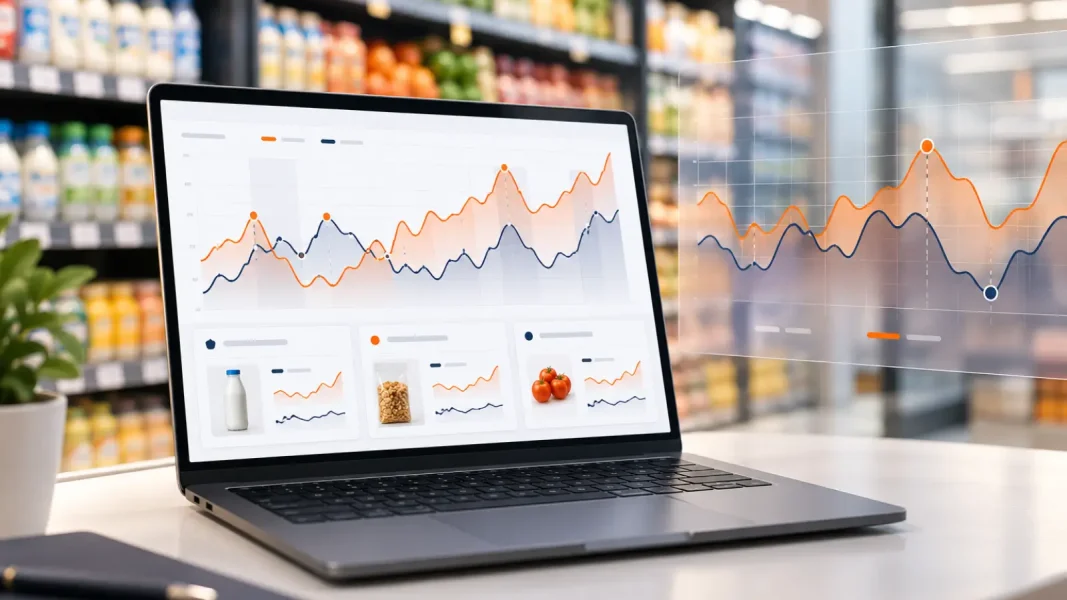
Platforms like XFR- Optimix Forecast and Replenishment combine artificial intelligence and business expertise to automatically calculate optimal replenishment points. These solutions analyze historical data, detect seasonal patterns, integrate supplier constraints and generate actionable recommendations.
Integrating POR into the global supply chain
ROP must be integrated into a global vision of the supply chain. Integration with demand forecasting feeds the calculation with prospective data. Connection with suppliers via EDI speeds up the process. Synchronization with sales systems ensures that movements are recorded in real time. This global integration ensures system consistency and efficiency.
the strategic importance of POR today
The replenishment point is becoming an essential strategic indicator. As demand volatility intensifies and customers demand unfailing availability, the ability to maintain the right balance between stock and service is becoming a major competitive lever.
The integration of artificial intelligence transforms the possibilities: real-time analysis, detection of complex patterns, dynamic adjustments. But this technological sophistication must not obscure the essential point: POR remains a means to the service of clear business objectives.
Successful implementation requires data quality and improved planning using order forecasting tools such as XFR. The benefits can be measured in concrete terms: reduction of out-of-stocks, optimization of safety stock, release of cash and improved customer satisfaction.
Companies that master this balance will have a sustainable competitive advantage in their markets.