

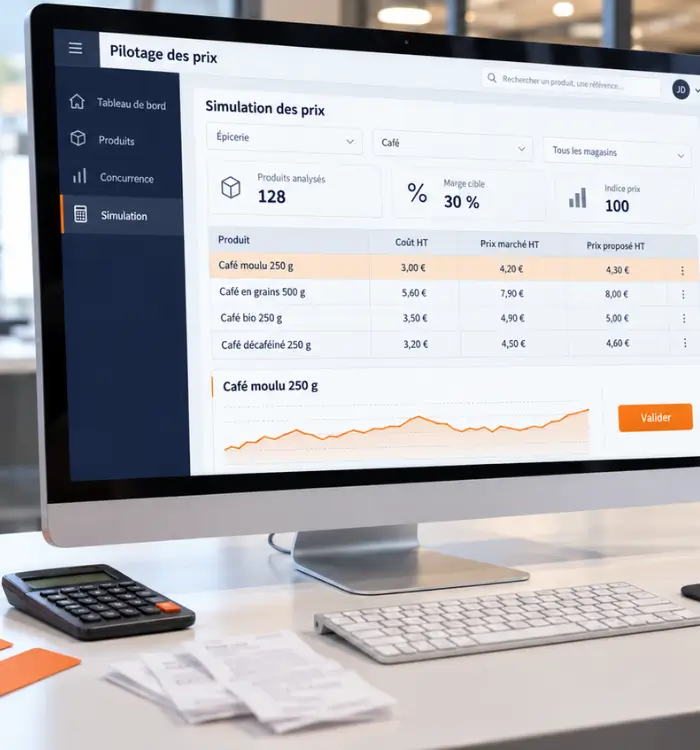
Setting a price is not simply a matter of adding a markup to a cost. The real challenge is to determine What price will allow us to achieve our goal without compromising profitability, market positioning, or perceived value?
The same product can thus result in very different prices depending on the method used. A cost-based approach ensures a certain margin level but may ignore market realities. A price based on the competition protects relative market positioning, at the risk of following competitors with different business models. As for an approach based on demand and perceived value, it seeks to capture what the customer is actually willing to pay, but requires a more nuanced understanding of the customer’s trade-offs.
That is precisely where the difficulty of pricing : no single method is optimal in all situations. The main approaches—cost, competition, and demand—are based on different rationales and often need to be combined. In particular, analyzing perceived value and psychological pricing allows for a deeper understanding of willingness to pay.
For a retailer, the choice is even more strategic. A highly comparable product, a loss leader, a private-label entry-level product, or a premium line cannot be managed using the same rules. Their role in the product mix, their price elasticity, the extent to which they are compared with other products, and their contribution to the margin directly influence the pricing strategy.
Mastering the various methods, their calculations, and—above all—their limitations therefore allows us to go beyond the simple question “What price should I set?” and answer a more critical question: “Which method should guide the pricing decision in this situation?”
What are the main methods for setting a selling price?
Set the selling price based on costs
The cost-based method involves starting with a cost-based figure and then adding a markup. It answers a specific question: At what price should we sell to achieve the desired profit margin?
Determine the correct basis for calculation
The purchase price does not always reflect all of the expenses associated with selling a product. Transportation, storage, order fulfillment, and distribution can also impact its profitability.
The cost of goods sold aims to include all expenses allocated to the product, from procurement or manufacturing through to sale. Its calculation may include variable costs, which fluctuate with business activity, and a portion of fixed costs.
The basis chosen therefore changes the meaning of the result. A margin calculated based on the purchase cost must still help cover the retailer’s other expenses. A surplus calculated after taking full production costs into account does not measure the same thing.
Calculate the selling price using a markup rate
In a trading business, the sales margin is the difference between the pre-tax selling price and the pre-tax purchase cost of the goods sold.
The margin ratio expresses this margin as a percentage of the purchase cost:
Margin Rate = (Sales Margin ÷ Purchase Cost Excluding Tax) × 100
To calculate the selling price based on a target margin rate:
Selling price (excluding tax) = purchase cost (excluding tax) × (1 + markup rate)
Let’s take a simplified example: A distributor buys an item at a cost of €20 (excluding tax) and aims for a 30% profit margin. The resulting price is 26 € (excluding tax), or a profit margin of 6 € per unit sold. This amount is then used to help cover the business’s other expenses.
The percentage must be expressed as a decimal in the calculation: 30% becomes 0.30.
Use the mark-up rate without confusing it with the margin rate
The markup rate expresses the margin as a percentage of the selling price excluding tax. Its denominator therefore differs from that of the margin rate.
Markup Rate = (sales margin ÷ selling price excluding tax) × 100
The calculation formula becomes:
Selling price (excluding tax) = purchase cost (excluding tax) ÷ (1 − markup rate)
With the same purchase cost of 20 € (excluding tax) and a target markup rate of 30%, the price comes to €28.57 excluding tax, after rounding.
A 30% margin target and a 30% brand mark-up target thus result in two different prices. This distinction must be explicitly stated in the pricing rules and in communications between teams.
Apply a multiplier
The multiplier allows you to convert directly from a cost basis to a selling price. It simplifies the application of a rule across multiple SKUs.
However, when using it, you must specify which convention is being followed: does it link a purchase cost (excluding tax) to a selling price (excluding tax), or to a price that includes tax?
For example, with an “excluding tax” to “excluding tax” agreement:
Sales price (excluding tax) = purchase cost (excluding tax) × multiplier
Applying a multiplier of 1.5 to a purchase price of €20 (excluding tax) results in a price of €30 (excluding tax). The applicable VAT is then added to arrive at the price including tax.
This ease of calculation is not sufficient to justify applying the same weighting factor across an entire product line. Two products purchased at the same price may rank very differently in customers’ comparisons.
The Limitations of Cost-Based Pricing
This method establishes an economic benchmark, but it does not directly measure price acceptance. The calculated amount may exceed what customers are willing to pay or fall short of the value they assign to the product.
The unit cost also depends on the volume assumptions used to allocate certain expenses. If actual sales are lower than forecast, the expected profitability may not be achieved even if the target rate is met.

Setting a Price Based on the Competition
The competitive method involves using market prices as points of comparison. It helps determine where an offer stands among the alternatives available to the customer.
Compare offers that are truly comparable
A competitive analysis is only useful if the differences identified are meaningful. Packaging, ingredients, product features, included services, or delivery terms can explain a price difference.
In the food industry, comparing prices per kilogram or per liter helps to account for differences in product size. For technical products, the comparison must be based on characteristics that are sufficiently similar.
The date of the survey and the presence of a promotion also matter. A temporary discount should not be interpreted as a competitor’s permanent pricing strategy.
Choosing a competitive advantage
Price alignment involves setting a price close to that of one or more benchmark competitors. The retailer may also aim for a lower or higher price, depending on the characteristics of the product and its objectives.
The method becomes more precise when the rule is explicit. A retailer could, for example, aim to stay within a price range around that of a competitor for the most frequently compared items, while retaining more flexibility for its exclusive products.
The choice of competitor is just as important as the margin selected. A national chain, a local specialist, and an online retailer are not necessarily equivalent benchmarks for all products.
However, comparing prices with competitors, however, is not limited to the listed price. It also involves identifying truly comparable competitors, assessing acceptable positioning gaps, and taking consumer perception into account. These challenges are particularly evident in certain specific markets, such as the organic market: learn how to set prices that are consistent with the competition.
The Limitations of the Competitive Method
Competitors’ prices do not provide insight into their purchasing terms, costs, or margin targets. Therefore, simply matching their prices does not guarantee comparable profitability.
A price drop may also have a specific cause: clearing out inventory, a promotional campaign, or a pricing error. Automatically following suit can erode profit margins without leading to a lasting increase in sales.
Competitive analysis should therefore inform pricing strategy, within the economic limits set by the retailer.
Set a price based on perceived value
The perceived value approach is based on the benefits the customer attributes to the product. It seeks to determine the additional amount the customer is willing to pay for a difference that the customer considers valuable.
Identify what justifies the price
Perceived value may stem from usability, composition, durability, ease of use, or an associated service. It depends on the customer’s perspective: a feature that is costly to produce does not automatically lead to a greater willingness to pay.
For a premium private-label brand, for example, a unique recipe or a selection of ingredients can justify a higher price if consumers understand and appreciate that difference.
The analysis then focuses on several elements: the desired benefits, the alternatives under consideration, and the evidence that lends credibility to the promise.
Assessing Willingness to Pay
Interviews, surveys, and price tests provide insights into the value placed on the offering. Sales data can then be used to compare these results with observed behavior.
Purchasing situations can affect the response. A product that is purchased regularly and compared across multiple retailers is not viewed in the same way as an occasional purchase intended as a gift.
The advantage of this method is that it links the price to a concrete offer for the customer. The challenge lies in gauging the response: the benefits reported in a survey do not always translate into a purchase at the proposed price.
Using Psychological Pricing and Demand Analysis
Demand analysis makes it possible to examine the acceptability of a price and how volume responds to price changes. It complements the value-based approach.
Distinguishing Between Psychological Prices and Commercial Break-Even Prices
The psychological price refers to a price level considered acceptable by a portion of the potential buyers surveyed. The survey seeks, in particular, to identify the level below which the product raises doubts about its quality and the level above which it seems too expensive.
This approach differs from a retail price, such as €9.99. Such a price is a matter of pricing presentation; it does not, on its own, demonstrate the price’s acceptability.
Survey responses provide a range of values. They are not sufficient to identify the price that will yield the best economic outcome.
Measuring the Elasticity of Demand
Price elasticity of demand measures the relative change in the quantity demanded in response to a relative change in price.
Price elasticity = % change in quantity ÷ % change in price
In a simplified example, if a 5% increase in price leads to a 10% decrease in quantity, the estimated elasticity is −2.
However, this interpretation requires an examination of other factors that could explain sales trends: seasonality, promotions, product availability, or changes in the competitive landscape. A decline in sales volume observed after a price increase does not prove that price is the sole cause.
This analysis helps compare pricing scenarios. It allows you to examine how a price change might affect revenue, volume, and margin, within the limits of the available data.

Compare the main fastening methods
Each method provides a different perspective for decision-making. The following table summarizes their uses and the main points to keep in mind.
Method | Starting Point | Main Purpose | Point to Watch For |
Costs and Margin | Clearly defined purchase price or cost of goods sold | Building an Economic Benchmark | The price obtained may not be well received by the market |
Competition | Prices of comparable offers | Define a positioning deviation | The competitors’ costs and objectives remain unknown |
Perceived value | Benefits Recognized by the Customer | Assessing a Justifiable Price Premium | A technical difference may not be highly valued |
Psychological price | Reported Acceptability | Identify a price range to test | Purchase intent may differ from actual behavior |
Elasticity Analysis | Volume Response to Price | Compare the potential effects of several rates | Other factors affecting sales fluctuations must be taken into account |
Which method should be used depending on the type of private-label product?
Entry-level, standard, and premium private-label brands illustrate how these approaches can be combined. Their application depends on the product category, the role of the products, and buyers’ expectations.
Low-price private-label brands: Balancing competitiveness and economic constraints
A budget-priced private-label brand aims to provide affordability for everyday needs. Comparing it with other affordable options on the market can therefore play a major role in the decision-making process.
The retailer must, however, verify what the price covers. A low profit margin per unit requires an examination of sales volumes, logistics costs, and the product’s actual contribution.
A competitive approach can help determine the target level, while a cost analysis helps assess its feasibility.
Standard Private Label: Focusing on Value for Money
A standard private label product is positioned in the mid-range. Its price is determined by comparing it with national brands, competing private labels, and other price points within the retailer’s product lineup.
Pricing based solely on a discount percentage relative to a national brand might fail to account for certain differences in format, quality, or use.
The intersection of competition and perceived value helps establish a clear gap. The margin calculation then verifies that this gap remains consistent with economic objectives.
Premium private label: Verify the amount of the requested surcharge
A premium private-label brand conveys a unique value proposition. Its price must be linked to benefits that shoppers recognize.
The perceived-value approach takes center stage here, without ruling out comparisons with other available premium offerings. The question then becomes: Does the premium charged reflect a difference that customers value highly enough?
Terms such as “organic,” “local,” or “regional” may be relevant to this analysis. They do not, on their own, constitute a product tier; their role depends on the product and the value proposition it offers.
Do not confuse pricing methods with pricing strategies
A method describes how to set or determine a price. A pricing strategy specifies the business objective being pursued.
Market penetration, market skimming, and market alignment are all matters of positioning strategy. Cost calculations, competitive analysis, and demand analysis provide the information needed to evaluate these strategies.
A pricing strategy can therefore incorporate several methods. A retailer may seek a highly competitive positioning for certain products, while relying more on value analysis for its exclusive offerings. Consistency is assessed in terms of the overall product offering and the objectives defined for each category.
FAQ – Methods for Setting a Selling Price
What is the simplest way to set a selling price?
Calculating based on a cost and a target margin is generally the most straightforward approach. You must specify the basis used and distinguish between the gross margin and the markup. The result is then a price to be compared with market prices.
What is the difference between cost of goods sold and purchase price?
The purchase price is the amount paid to the supplier for the product. The cost of goods sold includes a broader range of expenses associated with bringing the product to market. Therefore, these two metrics do not provide the same interpretation of the margin.
Does a price that yields a margin guarantee profitability?
A positive gross margin does not guarantee that all expenses will be covered. Profitability also depends on sales volume and cost structure. The break-even point is used to estimate the level of activity required to cover the expenses included in the calculation.
Should we match all of our competitors?
The comparison should focus on the competitors and offerings that customers view as alternatives. A systematic approach to price alignment can lead to the brand following prices that are not relevant to it or incompatible with its objectives.
Can we use multiple methods for the same product?
Yes. Cost provides an economic benchmark, competition determines the supply level, and demand analysis provides insight into price acceptance. Comparing these factors helps identify discrepancies that need to be resolved before setting a price.
Setting a selling price involves balancing an economic equation, a market position, and a value proposition. The preferred method may vary depending on the product; the decision becomes more precise when it is evaluated against other approaches. For a retailer, this integration makes it possible to set prices that are consistent with the role of each product and each product line.