



For all retailers, pricing has (once again) become a key driver of competitiveness.
In an environment where competition is both more intense and more diverse, offering the right price is crucial for acquiring and retaining customers, while also strengthening the brand image.
At the same time, pricing calculations are becoming more complex, making price automation increasingly essential to maintaining performance at scale.
However, the adoption of AI in pricing also raises questions:
Doesn’t excessive reliance on AI risk leading to a loss of control?
Is there a risk of a lack of transparency?
How can certain adjustments be justified if decisions are based on models that are difficult to interpret?
In light of these opportunities and challenges, a key question arises: How can automation and human oversight be balanced in a pricing strategy?
This article explores the key strategies for maintaining control over decision-making while taking full advantage of the capabilities offered by AI.
Define a clear strategic framework
Step 1: Clear Business and Financial Goals
To meet consumer expectations and keep pace with competitors, retailers must adjust their prices more frequently and be more responsive.
In this context, thepricing automation is now considered essential. The development of AI-powered pricing solutions is revolutionizing the way retailers approach their pricing strategies. These solutions save teams valuable time, boost profitability, and enable personalized pricing.
We talk about pricing automation. But in reality, it would be more accurate to talk about the automation of price calculations.
The pricing strategy, on the other hand, remains the responsibility of the teams. It stems from the corporate strategy defined by senior management, which sets profitability targets and determines the brand’s positioning (including price positioning). The marketing teams contribute their knowledge of the market, customer segments, and brand positioning. The finance department ensures that the set prices will enable the company to meet its profitability targets.
Next, from an operational standpoint, category managers are responsible for maximizing the profitability of their category. They are therefore the ones who set prices in accordance with the pricing strategy and based on competitors’ moves.
However, before automating price calculations, the first step is to define a clear pricing strategy that aligns with your positioning and to clarify your financial and sales objectives. For each product category, what is your top priority? Maximizing sales? Boosting margins?
For example, if your priority is to increase margins on certain flagship products, the algorithm should be programmed to adjust prices in a way that optimizes profitability while remaining competitive. Conversely, if the goal is to boost sales of end-of-cycle products, the automation system should prioritize more aggressive price adjustments to clear out inventory.
If you automate your pricing strategy without clearly defining its overall direction, you risk letting AI make decisions that are out of step with your priorities.

Step 2: Define your competitive scope.
Pricing is determined not only by the pricing strategy you’ve defined but also by your competitors’ pricing policies. When you automate your pricing, AI calculates your prices based on your strategic guidelines and competitors’ prices. Therefore, before automating, you must first define your competitive scope.
Automated pricing allows you to respond quickly to competitors’ price fluctuations, but you still need to know who your competitors are. It’s often tempting to focus on market leaders or to monitor all players. But both of these approaches carry risks. In the first case, you lack agility by comparing yourself only to the largest players. In the second, you spread yourself too thin.
To define a competitive scope that is both relevant and actionable, you need to strike the right balance and focus on competitors that share common characteristics with your brand:
- Similar product categories
- Similar customer segments
- A single shared catchment area
- …
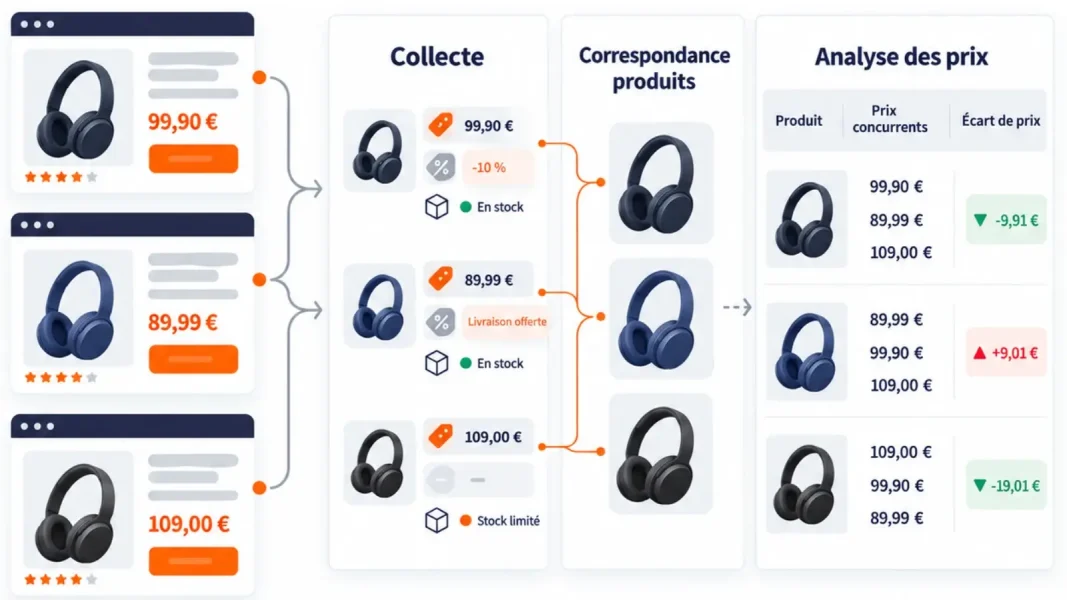
Once you’ve defined your competitive landscape, you can rely on a partner, such as Optimix, to collect competitor prices and automate pricing. In this case, the AI is configured to factor competitor prices into your pricing calculations.
Establish rules and constraints for the algorithm
Once you’ve clarified your strategy, you can automate the pricing process. However, to maintain control, be sure to define the rules and constraints that the algorithm must follow.
Indeed, AI can be very powerful, but without clear limits, it could make decisions that, while optimized in theory, would be absurd in practice.
Here are two safeguards to mitigate this risk.
Set minimum and maximum price thresholds
When you automate your pricing using artificial intelligence, setting minimum and maximum price thresholds for the algorithm is a good way to maintain control.
In fact, if you let the algorithm run without safeguards, AI can generate extreme or unrealistic price recommendations in the event of data anomalies or unusual market conditions.
By setting thresholds, you avoid the risk of charging unreasonable prices that could harm your brand image or profitability.
Price limits help ensure consistency in your pricing strategy, even when the algorithm dynamically adapts to market conditions. Thresholds help ensure that AI-generated prices remain aligned with your desired positioning.
Finally, from a profitability perspective, the minimum price reduces the risk of selling at a loss, while the maximum price prevents excessive prices that could discourage your customers.
Define an acceptable range of fluctuation
Another best practice for managing the algorithm is to define an acceptable range of price fluctuations.
The fluctuation range prevents sudden price changes that could unsettle customers. It helps ensure consistency in pricing policy, which is important for brand image and customer perception.
In fact, relatively stable prices help maintain customer confidence and prevent the negative perceptions associated with excessive volatility. They also allow customers to compare prices over time and make informed purchasing decisions.
Internally, limiting the range of fluctuations helps the company better anticipate and manage the impact of prices on its revenue and margins. An acceptable fluctuation range also makes it easier to plan inventory, procurement, and marketing campaigns.
Finally, this practice allows the algorithm to adapt to market changes in a gradual and controlled manner.

Maintain human oversight
Request human validation of the prices suggested by the algorithm
Although AI makes it possible to automate much of the pricing process, it is important to maintain human oversight.
For example, you can automate price calculations and require approval from the category manager before the prices are sent to the store teams. In the event of a significant fluctuation, you can also set up an automatic alert for the responsible employees to bring it to their attention.
Alerts help ensure that important decisions are reviewed by a human. If there is any doubt, the pricer can catch a potential error before the price is applied. If the solution allows it, he can trace the price calculation back to the input data to identify the source of the anomaly.
You can also plan in advance for use cases that require human intervention to maintain control over pricing decisions that are critical to your business.
Ensure traceability of prices provided by AI
Another key aspect of human oversight is the traceability of the algorithm’s recommendations.
To avoid the “black box” aspect of AI—where results are presented without any way to verify them—you can opt for an AI solution that allows you to “reverse-engineer” the AI’s decision-making process to understand how it reached its conclusions. This is the case with the Optimix pricing solution. You can view the AI’s decision-making process and the rules it used to make its recommendation.
Thanks to this traceability, you maintain control over price recommendations. You can explain them and, if necessary, refuse to apply them or correct them. This process of retrospective verification and validation also helps the algorithm learn and improve.
Train and educate teams on how to make the best use of the AI-powered pricing solution
One of the risks of automation is that employees in charge of pricing might place unlimited trust in the algorithm without truly understanding how it works.
To prevent this from happening, you need to train your teams and raise their awareness of both the capabilities and the limitations of the AI solution. Your employees need to know when verification or manual intervention is necessary.
Your teams need to understand the basic principles on which the algorithm relies to generate its pricing recommendations. Without proper training, employees may blindly rely on the algorithm’s results and overlook errors or biases.
The training should also highlight use cases where the algorithm has limitations, such as in exceptional situations for which it was not trained.
AI in pricing is a step forward, provided its use is part of a well-defined strategic framework. Once you’ve determined your goals and competitive landscape, you can use an AI solution to calculate your prices.
But your trust in the algorithm should not be blind. Include mechanisms for validation, alerts, and algorithm monitoring to prevent erroneous applications. With these safeguards in place, you maintain human control over pricing decisions.
Automation should not lead to a loss of skills within teams. Training helps maintain and develop human expertise in pricing, which remains essential for overseeing and refining the system.
At Optimix, our pricing solutions are designed to make your teams’ jobs easier, not to replace them. The future of pricing isn’t all-powerful AI, but artificial intelligence that supports the expertise of pricing professionals.
Do you have an automation project? Why not discuss it with one of our experts?